
History Blog
|
|
|
|
|
Editor’s Note: The replica ship Half Moon was completed in Albany in 1989 and served as a cultural ambassador celebrating the role of the Dutch in naval architecture, exploration, international trade, and colonization. An earlier replica was built in Amsterdam and presented to the United States during the Hudson-Fulton Celebration in 1909. This first replica was not maintained after the celebration and did not survive long as a static exhibit at Bear Mountain and later at Cohoes. The 1989 replica performed well once her characteristics were understood and was exhibited in a number of ports along the Atlantic seaboard. Later, she served as valuable and successful educational platform on the Hudson River through her “Voyages of Discovery” program for school children. The ship is currently in the Netherlands after spending several years as an exhibit in Hoorn. To read more about the technology and terminology of sailing in the seventeenth century and later, John Harland’s Seamanship in the Age of Sail, 1984 (republished by the Naval Institute Press in 1987) is recommended. For an account of Henry Hudson’s four voyages of exploration, including his trip up the Hudson River in 1609, Donald Johnson’s Charting the Sea of Darkness, International Marine, 1993 is recommended. This latter book is dedicated to the shipwright who designed and built the replica, Nick Benton. Follow Muddy Paddle, Able Seaman aboard the replica ship Half Moon here. The Maiden Voyage It was mentioned earlier that the 1609 Half Moon carried a standard six-sail rig of the period. This means that she carried a foremast and a mainmast, each spreading two square sails to drive the ship as well as a bowsprit and a mizzen spreading smaller sails that helped supplement the rudder to steer the ship, or more accurately position the ship’s angle relative to the wind direction. The foremast and mainmasts are comprised of three connected spars each; a heavy mast rising 30 to 40 feet above the deck; a lighter topmast 20 to 25 feet in length rising up above the circular tops colloquially called “crows’nests” and topgallant poles rising a little less than 20 feet above crosstrees at the top of each topgallant mast. The combined height of the mainmast assembly was approximately 78 feet above the waterline. The mizzenmast at the stern of the ship was shorter and lighter carrying only one sail and comprised of only one large spar and one short pole above that. The bowsprit overhanging the bow of the ship was shaped from a single spar. The replica Half Moon was fitted with an engine to facilitate movement when wind and tide were not favorable. Adding an engine was also intended to add a margin of safety and reliability to the replica’s operations. The unofficial but actual maiden voyage of the replica Half Moon took place just before sunset early in October, 1989. The ship was docked on her port side where she was held off of the bulkhead by a steel camel or pontoon. The work on this side was complete and it was time to turn the ship around so that the starboard side would be more accessible. After the volunteers arrived, lines were cast off. A paid member of the construction crew took command and the ship proceeded south under her own power. At the Port of Albany, our provisional captain ordered the helmsman to make a hard port turn. The helm was slow to answer, owing to the placement of the propeller on the port side of the ship and the relatively small surface area of our rudder. It took most of the width of the river to turn the ship around and to head back north to our dock. After straightening up, our captain gave the engine more throttle and we found that steering improved. We were sailing with the incoming tide and making rapid progress. A west wind picked up and even with sails furled, our ship heeled gently over. By now, a few boaters had begun to follow us and snap off photographs of the scene against an atmospheric sunset. We approached our dock and the highway bridge just north of it very quickly. The captain planned to proceed to the bridge, turn, and then dock with the starboard side to the wall. Once again, the ship was very slow to make a port turn. The ship’s momentum and the tide were quickly carrying us to the bridge which had a vertical clearance of less than 70 feet. Our captain shifted to reverse, and revved up the engine, but reverse failed to engage. As our foremast approached the bridge, all of the crew on deck tried to find cover. Some dove into the forecastle or down the main hatch. One dove into the river. The foretopgallant mast struck the bridge, broke off and went into the river. The taller main topmast was next in line to strike the bridge and would have resulted in a lot of falling spars and blocks and cordage. Fortunately, reverse engaged at the last second and the mast was spared. Our captain sheepishly landed at our dock. As a token of humiliation, the broken fore topgallant mast was hooked by one of the boaters and towed to us for presentation while we secured lines. Within hours, a replacement was hastily planed down from a long fir timber and raised into position before the owner of the ship arrived the next day for an inspection. Sea Trials Several days later, plans were made to send the Half Moon down to New York on a shakedown cruise. An experienced pilot was hired. The crew returned with sea bags in hand for a trip down the river. Once the owner came aboard, we cast off lines, started the engine and moved away from the dock. Cannon fire from the Rensselaer shoreline saluted the ship as she moved into the main channel. The trouble began almost immediately. Smoke billowed out of the engine compartment and up and out of the main hatch. While a few folks went below for fire extinguishers, our new pilot quickly reviewed the options and decided to run for the docks at the Port of Rensselear and get everyone off the ship. Several of us gathered up lines to secure the ship as soon as we touched. The pilot killed the engine and we hit the dock with a thud, breaking the rampant lion figurehead. After the smoke cleared we learned that the shaft bearings had overheated. The engine and the shaft were misaligned. The trip was cancelled. We all took our gear and departed. A week or so later, a tugboat named Spuyten Duyvil came up the river, attached a towline to the Half Moon’s forward bitts and unceremoniously towed the ship to New York and then to Bridgeport for drydocking. From there, she was taken to North Carolina. Thus ended the first chapter of Half Moon’s Albany story and her association with most of her original volunteers and would-be sailors. Join us again next Friday for the Part 3 of the "Half Moon" adventure! AuthorMuddy Paddle grew up near the Hudson River and always loved ships and boats. A job change in 1988 brought him to an office near the site where the Half Moon was being built and he became involved as a volunteer. Muddy learned the ways of seventeenth century sailing and accompanied the replica ship on a series of adventures and misadventures on the river, in New York Harbor and even offshore. He maintained a journal, which served as a reference for on-board terminology and operations as well as a place to record a few highlights of his trips. The accounts presented here, and several of the illustrations, were based on this journal and his recollection of these trips.
If you enjoyed this post and would like to support more history blog content, please make a donation to the Hudson River Maritime Museum or become a member today!
0 Comments
Editor’s Note: The replica ship Half Moon was completed in Albany in 1989 and served as a cultural ambassador celebrating the role of the Dutch in naval architecture, exploration, international trade, and colonization. An earlier replica was built in Amsterdam and presented to the United States during the Hudson-Fulton Celebration in 1909. This first replica was not maintained after the celebration and did not survive long as a static exhibit at Bear Mountain and later at Cohoes. The 1989 replica performed well once her characteristics were understood and was exhibited in a number of ports along the Atlantic seaboard. Later, she served as valuable and successful educational platform on the Hudson River through her “Voyages of Discovery” program for school children. The ship is currently in the Netherlands after spending several years as an exhibit in Hoorn. To read more about the technology and terminology of sailing in the seventeenth century and later, John Harland’s Seamanship in the Age of Sail, 1984 (republished by the Naval Institute Press in 1987) is recommended. For an account of Henry Hudson’s four voyages of exploration, including his trip up the Hudson River in 1609, Donald Johnson’s Charting the Sea of Darkness, International Marine, 1993 is recommended. This latter book is dedicated to the shipwright who designed and built the replica, Nick Benton. Follow Muddy Paddle, Able Seaman aboard the replica ship Half Moon here. Building the ship I was pretty skeptical when I first heard about it. Someone was planning to build a replica of Henry Hudson’s Half Moon, the ship Hudson sailed up the river now bearing his name in 1609. It seemed even more unlikely that construction would take place in Albany, a city with little in the way of docks or living maritime traditions. I realized the project was real when I drove past a downtown Albany parking lot along the river and was startled to see the outline of a wooden ship with a keel, a stem and a sternpost resting on thick timbers and braced in position. It was the summer of 1988. The original Half Moon was one of two “jagten” (yachts, meaning hunters or chasers) ordered by the VOC or Verenigde Oostindische Compagne (Dutch East India Company) in July, 1608. The Half Moon was to be 70 old Amsterdam feet long “binnen steven” (between stem and sternpost) 16 feet in beam and 8 feet depth of hold and she was to have a cabin fitted behind the mizzen mast. She carried a standard six-sail rig of the period and was built at the East India Company’s Scheeps-Timmer-Werf in Amsterdam in 1608-1609. Englishman Henry Hudson was employed by the VOC to search for a passage to the Far East in 1609 and set sail for the company aboard the new ship on March 25, 1609. Disregarding instructions, Hudson and his mixed Dutch and English crew explored much of the American east coast before sailing up the river that later bore his name in September. After the ship was returned to the Netherlands, she appears to have come to an accidental or deliberate end no later than 1618. The replica ship’s nascent frame was soon enclosed by a steel shed as the work of erecting frames (the ships wooden ribs) continued during the colder weather and into the winter. A job change took me to a downtown Albany building near this site, and I became involved as a volunteer, checking in at lunchtime, occasionally offering a little time at the end of the workday and helping on weekends. The Half Moon (Halve Maen in Dutch), replica was conceived of by Andrew Hendricks, a doctor from North Carolina with Dutch ancestry. Donations were solicited and volunteers welcomed. The ship was designed by Nick Benton, a young shipwright from Rhode Island. Benton travelled to Amsterdam and learned that the 1608 Halve Maen was quite different from the replica built in the Netherlands in 1909 for the Hudson Fulton Celebration. Subsequent research had uncovered the Dutch East India Company’s 1608 construction resolution which detailed critical dimensions and details. It was also theorized that hulls of this period were designed according to the Tangent Arc system instead of taking lines off of a model or drawings. As Benton described the system, frames were lofted directly using a system of mathematical proportions, straight edges and compasses. The resulting hull shape featured a very flat bottom, abrupt chines (the places where the hull changes from bottom to sides) and pronounced tumblehome (the sides are wider at the waterline than at the deck and “tumble” inward). The bow of the ship was very rotund while the stern was narrow and rose high above the intended waterline. We later learned that its high profile worked like the tail of a weathervane in maintaining the ship’s course while reaching and tacking, that is, sailing across the wind or slightly into the wind at an angle. In addition to Benton, the Albany work force consisted of Nicholas Miller who served as the foreman and an enthusiastic group of volunteers, many of whom brought useful skills and experiences to the team. After a temporary steel shed was built over the keel and the first positioned frames, several volunteers served as docents, explaining the project to visitors and encouraging participation. The project was promoted in the local press and advertised with car cards on city busses. There was an aggressive schedule to launch and sail the ship in the summer of 1989. This necessitated a non-traditional approach to the ship’s construction. Unlike the traditionally framed original ship or the 1909 replica, the structural members of the hull were all pre-fabricated and shaped offsite using glue laminated oak. Likewise, the decorative flourishes, cannon, rigging and sails were all being produced elsewhere by specialty contractors while the hull was under construction. Each frame was a composite, bolted together from multiple futtocks (sections of the ribs), braced at the top for rigidity and tilted into position. The frames were temporarily held in position by ribbands, scrap strips of wood, until the inner and outer coverings gradually replaced them. One pair of frames in the stern was misshapen, and they could not be shaped true. The tight schedule dictated using them anyway. The bulges remained but were not noticeable because they were below the waterline. The ship’s structural frame was completed in February of 1989 and was almost 30 feet in height. The interior of the hull was graceful, symmetrical, and might have been likened to the inverted rib cage of a huge whale. Ceiling planking (sheathing of the interior) and deck clamps (curving planks that would carry the deck beams) were installed next, followed by the exterior planking. This was also done in a non-traditional way by nailing and gluing one-inch strip planks to the frames. These were followed by two layers of plywood laid in diagonal strips and then covered by an outer shell of Kevlar up to the waterline. Scaffolding was raised as the sides grew in height. Laminated deck beams were installed and the decks were built as epoxy sandwiches of thin planks and plywood. Some volunteers quipped that the ship should be renamed the Half Glue. The volunteers quickly learned that few cuts were guided by straight lines. Everything was curved, cambered, beveled and often bent, requiring the use of templates and some degree of estimation. Once the main deck was completed, the large band saw was winched up and installed on deck near the main hatch, making the fitting of the forecastle (the small cabin in the bow), half deck and poop deck easier. The Launch The temporary shed was removed on June 6 and the hull was launched on June 10. It rained hard the night before and the bilges filled with rainwater. On the morning of the launch, volunteers desperately tried to pump out as much of this water as possible; there was some discussion that the crane hired to place the ship in the water was barely rated to handle the weight of the hull dry. A crowd assembled along the river and small boats motored out into the Hudson for the event. The owner’s wife christened the ship by breaking champagne on the bow. The crane successfully picked the hull up and then crawled over a bed of timbers to the river’s edge where the ship was gradually lowered into the river amidst cheers and musket fire. Later, we learned that the crane’s boom cable had come out of its seat and that it was a small miracle that a complete failure had been avoided. Work on the upper portions of the hull resumed almost immediately. Nick Benton began the training of the volunteer sailing crew the following week. We learned of the appropriate roles of the ship’s officers, the difference between commands and orders, and seventeenth century sailing handling techniques. Goosewinging, lacing-on-bonnets, up-ending the sprits’l, cockbilling, tricing, club-hauling and smiting became part of our new lexicon. Each sail and its handing were covered separately. Days later, Benton was killed in a shocking accident on the other side of the river in Rensselear. He was removing the shrouds from a coastal schooner when the mast he was perched atop broke, pitching him 80 feet down to the deck below. It was his 35th birthday. Sadly, his wife and children witnessed the accident. A memorial service was arranged aboard the Half Moon two weeks later. Nick was the charismatic force behind the project, and although it continued, the enthusiasm of the volunteers and the pace of work waned. The summer tour schedule, revised many times, was finally scrapped. Nevertheless, the shipbuilders and volunteers found several ways to shake off the gloom. Once the masts were stepped and the main yard and sail were rigged, an evening film festival was staged, projecting images onto the huge sail. Gunnery practices with the replica cannon (four brass three pounders mounted on the orlop deck) were scheduled. One volunteer slipped a small concrete-filled can into the muzzle of one of the guns and watched it hit the far bank of the river. On another occasion, a blank round was fired just as a local dinner cruise boat was docking behind the ship, startling the pilot and making him miss his landing. A complaint was lodged with the Coast Guard. As the rigging neared completion, plans were made to turn the ship around so that finish work could be more easily completed on the starboard side. This became an excuse to take the ship out for an “evening spin,” which became her unofficial maiden voyage. It was a near disaster. Join us again next Friday for the Part 2 of the "Half Moon" adventure! AuthorMuddy Paddle grew up near the Hudson River and always loved ships and boats. A job change in 1988 brought him to an office near the site where the Half Moon was being built and he became involved as a volunteer. Muddy learned the ways of seventeenth century sailing and accompanied the replica ship on a series of adventures and misadventures on the river, in New York Harbor and even offshore. He maintained a journal, which served as a reference for on-board terminology and operations as well as a place to record a few highlights of his trips. The accounts presented here, and several of the illustrations, were based on this journal and his recollection of these trips. If you enjoyed this post and would like to support more history blog content, please make a donation to the Hudson River Maritime Museum or become a member today!
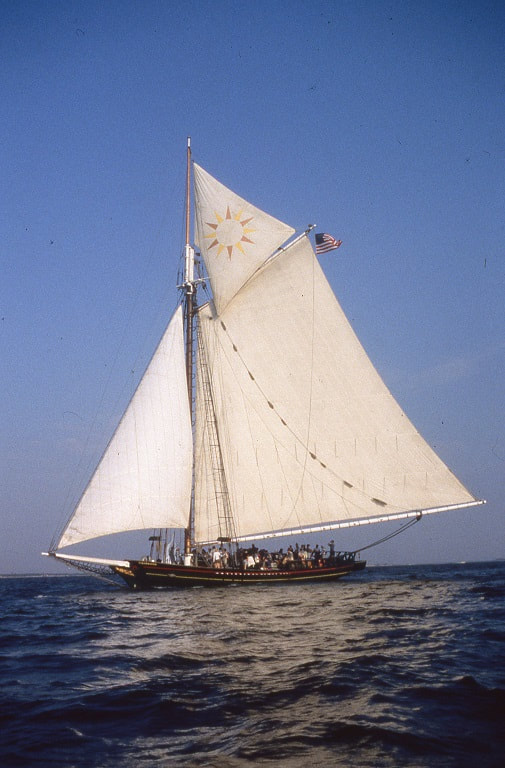
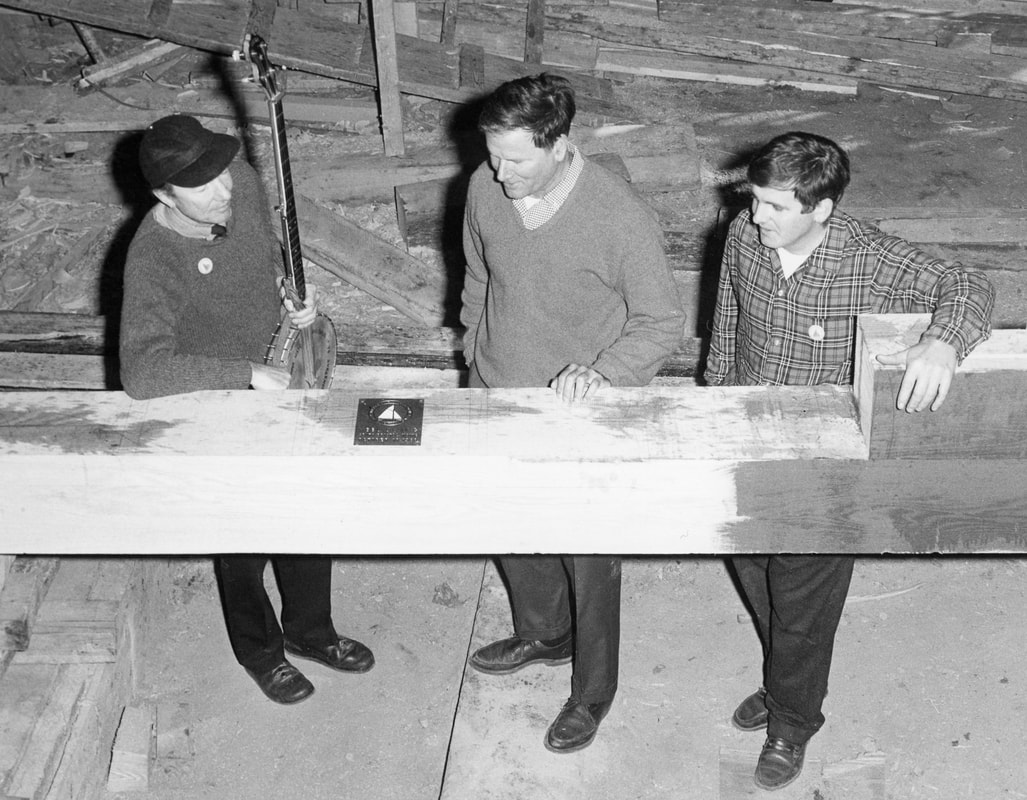
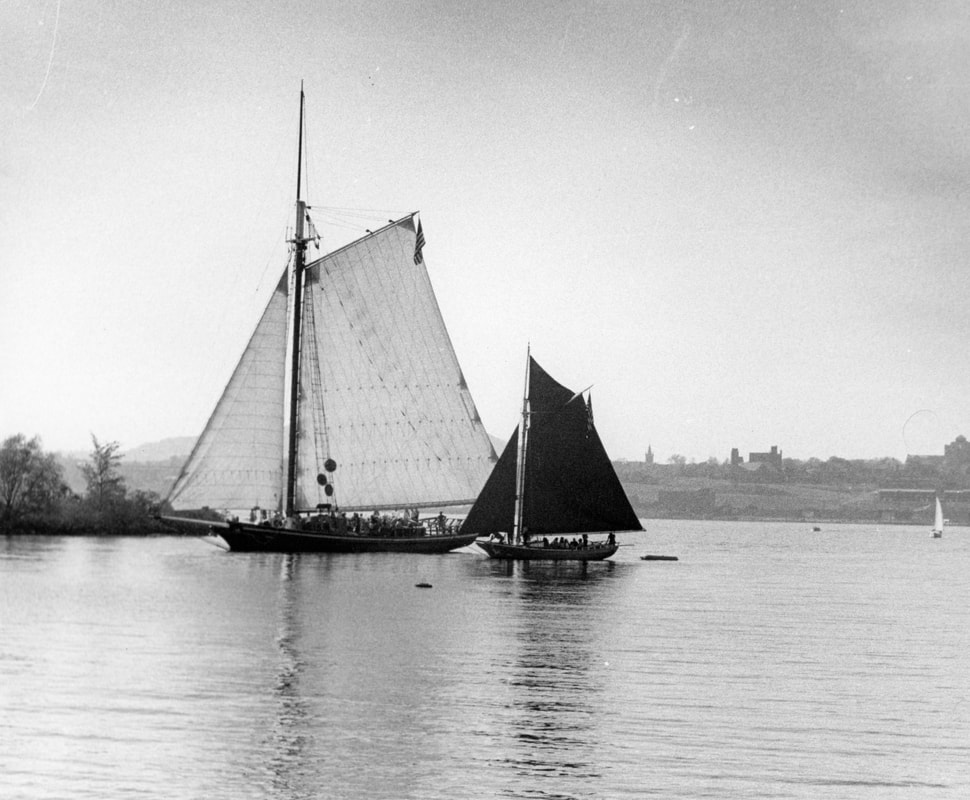
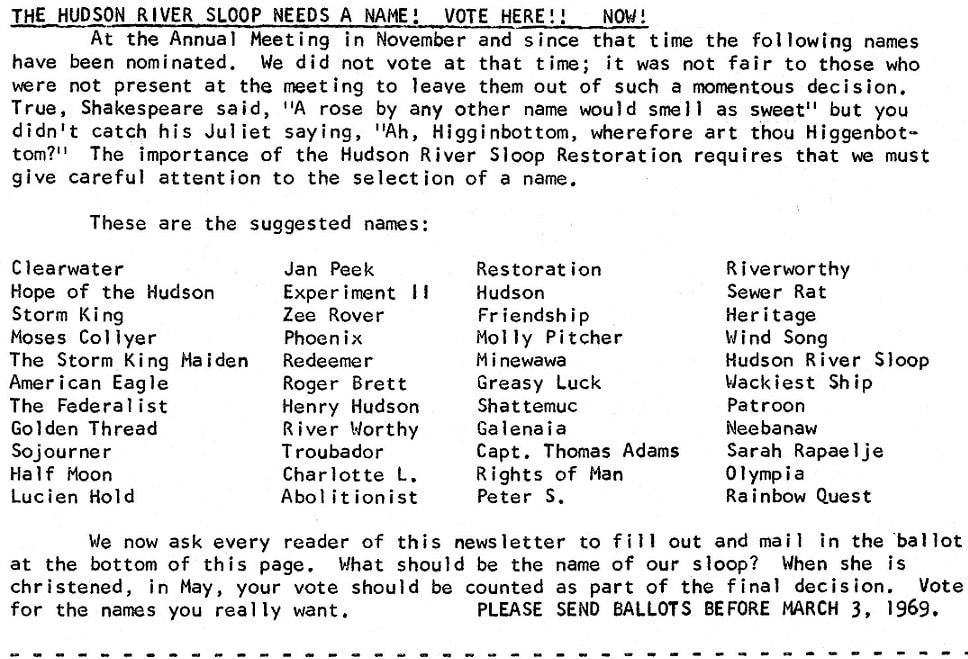
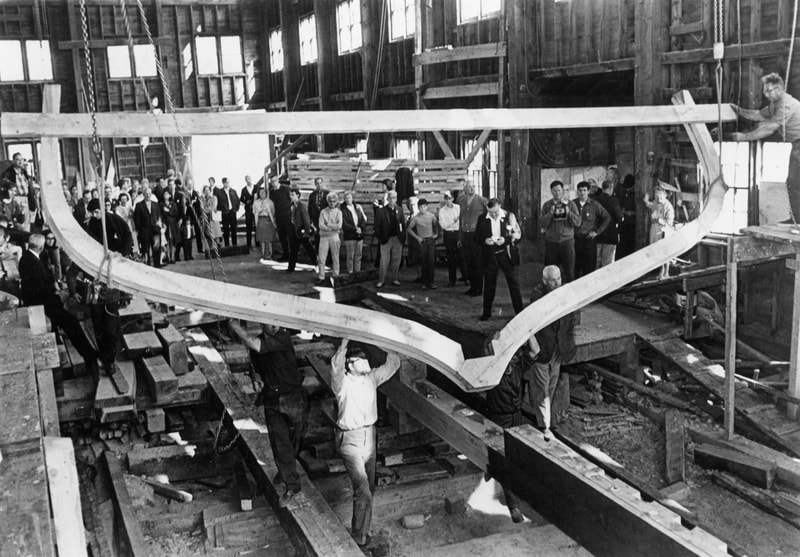
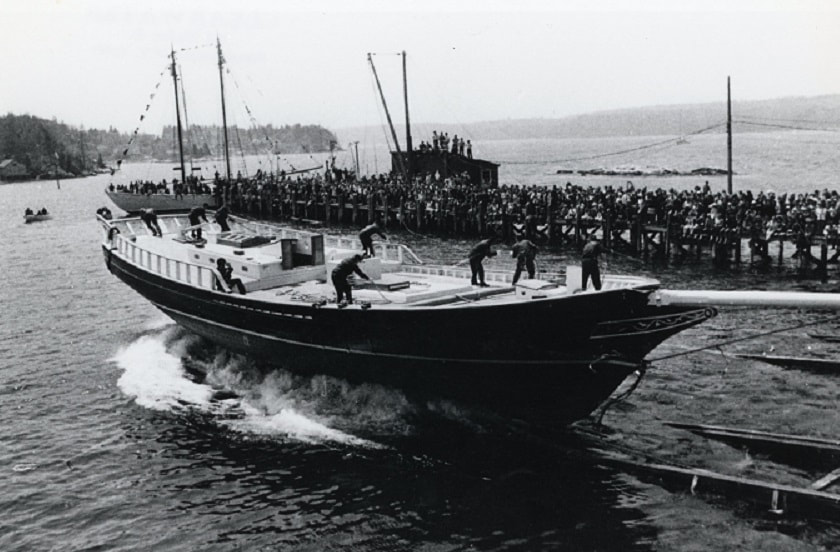
Most people familiar with CLEARWATER know the sloop was the brainchild of the late American folk legend and activist Pete Seeger. Pete was an idealist and an optimist. He once wrote, “There is a little Don Quixote in all of us.” You couldn’t tell him something couldn’t be done. But when you take a closer look at CLEARWATER’s story, it’s a miracle the boat was ever built at all. At the time CLEARWATER was built, the “tall ship revival” was still a decade or two away. Yes, the first Operation Sail brought tall ships from around the world to New York Harbor in 1964, but no one was building new tall ships with one or two exceptions. There were vessels built that were replicas of specific ships, such as the MAYFLOWER II, launched in 1956, and the HMS BOUNTY, launched in 1962 and built specifically for the filming of Mutiny on the Bounty. But to form a new not-for-profit to build a replica of a type of ship -- not even a famous historic ship? Nobody was doing that. Seeger and the fledgling Clearwater organization were ahead of the curve. When Pete got interested in sailing and subsequently in Hudson River sloops -- the traditional cargo-carrying sailing vessels of the Hudson -- he got an idea. Maybe you could build a vessel that was so grand, so extraordinary, and one that had not sailed the river in a very long time, and maybe you could draw people down to the banks of a river that had long ago been forsaken. Pete saw potential where others did not and believed that if CLEARWATER could bring people to the river, then maybe it could help people to “love their river again.” The challenges that the Clearwater organization faced were many. First and foremast, perhaps, was the fact that it was the 1960s. Pete Seeger had been blacklisted, and the Vietnam War was raging and becoming increasingly unpopular. So unpopular that President Lyndon B. Johnson declared in a nationally televised address in March 1968 that he would not run for re-election. The Rev. Martin Luther King Jr. was assassinated in April of that year, sparking riots in over 100 American cities. Robert Kennedy was assassinated in June. In August, there were violent clashes between police and protesters in Chicago during the Democratic National Convention. Years later, in recounting the early days of the sloop project, Pete would write: It really seemed a frivolous idea. The world was full of agony; the Vietnam War was heating up. Money was needed for all sorts of life-and-death matters, and here we were raising money to build a sailboat. It wasn’t just a turbulent civil and political climate, however, that made building CLEARWATER a challenge. There hadn’t been a Hudson River sloop built in over 100 years, and there were none left afloat. Pete’s inspiration for building a Hudson River sloop came in 1963 after his friend Vic Schwarz loaned him a copy of the 1908 book Sloops of the Hudson, written by William Verplanck and Moses Collyer, two retired sloop captains. He read it through in one night. Some time elapsed before Pete wrote his friend a five-page letter, which started: "One way to see if a pipe dream has any practicality is to get it down on paper. So I’m writing you now with the most grandiose and ambitious plan. It will make our wives groan. It will probably never get beyond the paper stage, but here goes:" He wrote the letter and then forgot about it. It was September 1965. Vic did not forget the letter and began chatting up fellow commuters on the train to New York. That fall, Vic called up Pete and asked, “When are we going to start building that sloop?” Pete answered, “You must be kidding!” Much of what we know about how the rest of the story unfolded is because in the 1960s people actually wrote letters and saved them. They also often saved carbon copies. Postage was inexpensive and long distance phone calls were most definitely not. After making a foray into the library at Mystic Seaport, Pete wrote a letter that December to Joel White, a boat designer and builder. Joel was the son of the writer E. B. White and had a boatyard in Brooklin, Maine. White wrote back, telling Pete his shop was too small to build a boat that big, and he was too busy to do any design work. He did recommend naval architect Cyrus Hamlin of Southwest Harbor, Maine. “He is a fine architect, and I am sure you would like him,” Joel wrote. The following month -- January 1966 -- Pete and Vic met with Cyrus Hamlin at the National Boat Show in New York City. Pete and Cy hit it off. Cy sent a formal letter to Pete in February, outlining his estimate for the cost of construction and a quotation for his design fee based on the estimate. In April, Pete wrote Cy a $500 personal check to cover the naval architect’s “advance research” on the Hudson River sloop. Pete’s initial vision, as outlined in his letter to Vic, was for the sloop to be something like a floating timeshare. Off the top of his head, he estimated that a 55-foot sloop might cost $100,000 to build. That was more money than he and Vic could scrape together, so he suggested that they try to form “Hudson River Sloop Clubs” up and down the river. If there were 10 clubs, then each would have to raise $10,000 to build the vessel, and each club could sail the sloop for a week at a time. Eventually, as we know, a non-profit formed. The Hudson River Sloop Restoration incorporated in September 1966. Interestingly enough, nowhere in the Articles of Incorporation is there any mention of the organization having an environmental purpose. Instead, the document states the purpose as: "To acquaint people with matters relating to our cultural heritage; and to maintain and promote interest in the history of the Hudson River both as a commercial and pleasure artery; and in connection therewith to build, own, operate and exhibit replicas of the great sloops which once freely navigated the river, thereby generating a greater interest in our cultural heritage and an understanding of the contributions made to our culture and commerce by the river and the sloops which sailed it." Also interesting is that multiple sloops are suggested and that there is no mention of actually sailing with passengers. Whether or not the sloop could be classified as a “yacht” or would have to be classified as a “passenger-carrying vessel,” making it subject to United States Coast Guard regulations and inspection, was an important determination that had to be made. Having to comply with USCG regulations would make the sloop more expensive to build and operate. It would also mean that it could not be an historically accurate replica, and perhaps not even a very good-looking one. At issue was the tragic sinking of the Brigantine ALBATROSS in 1961. A “school ship” carrying 13 American teenagers and five crew members went down in a sudden squall in the Gulf of Mexico. Six lives were lost, including four of the students. Although the ship was Panamanian registered, the USCG investigated the accident. Additional analysis resulted in the publication of On the Stability of Sailing Vessels by USCG officers John G. Beebe-Center and Richard B. Brooks in 1966. This work questioned the reliability of traditional stability assessment techniques for sailing vessels and would result in the adoption of more stringent USCG stability criteria. While the Maine fleet of “windjammer” schooners had been grandfathered when it came to stability requirements, new vessels would now come under additional scrutiny because of the ALBATROSS, even those built prior to the publication of the Beebe-Center & Brooks paper. The schooner MARY DAY, built for the charter trade by Harvey Gamage and launched in 1962, somehow sailed beneath the Coast Guard’s radar. This was not the case for the topsail schooner SHENANDOAH, also built for the charter trade by Gamage and launched in 1964. Because SHENANDOAH did not satisfy the Coast Guard’s stability requirements, the schooner’s owner was not allowed to charge his passengers any fee for its entire first season. The following year, Capt. Bob Douglas was able to obtain a conditional stability letter. Cy retained a Boston-based attorney in the spring of 1966 on behalf of Pete and the “sloop committee” to help facilitate a dialogue with the Coast Guard and explore various possibilities for the future vessel’s operation. Not coincidentally, Douglas had used this same attorney for his legal troubles. One option that was explored was to form a cooperative, wherein all the members of the cooperative would be considered “shareholders” and thereby owners of the vessel. The Coast Guard rejected this approach. Ultimately, Cy convinced HRSR to build their sloop to meet Coast Guard regulations, very likely the very first sailing vessel built to meet the new, more onerous stability requirements. This was not until as late as May or June of 1968, and there was still no plan to actually carry paying passengers. When, exactly, Pete realized that the sloop could be a tool to help clean up the river, we don’t know. However, in a New York Times article written following the organization’s first major fundraiser on October 2, 1966, he is quoted as follows: "Some people might think it’s the most frivolous thing in the world to raise money for a sailboat. But we want people to love the Hudson, not think of it as a convenient sewer." Despite Pete’s “green” inclinations, clearly many people within the organization were solely interested in maritime history and had no interest in being standard-bearers for the environmental movement. This is reflected in the results of a membership vote to name the sloop in March of 1969. There were 44 names nominated. Some of them were pretty silly, such as GREASY LUCK and SEWER RAT. In the end, the name CLEARWATER narrowly edged out HERITAGE, with HOPE OF THE HUDSON placing third. While there may not have been existing Hudson River sloops for Cy to study, he was able to research the vessel through builders’ half-hull models, periodicals and reference works, including John W. Griffith’s Treatise on Marine and Naval Architecture, published in 1850, and Lauchlan McKay’s The Practical Shipbuilder, published in 1839. He gleaned information about rigging details through paintings, period photographs and even a placemat or two that he discovered in a gift shop. He also had access to photos and drawings from Howard Chapelle, the great American naval architect and maritime historian, who was then a senior historian at the Smithsonian Institution. “Chap” provided Cy with the lines of the 1848 sloop VICTORINE and two others. Ultimately, Pete and company decided their sloop should measure approximately 75 feet long as this would allow for more headroom below decks. Cy presented preliminary drawings at the organization’s annual membership meeting on November 5, 1967. By late January of 1968, Cy had performed the necessary work to put the sloop project out to bid. He sent bidding documents to at least three yards in Maine and three in New York, including Rondout Marine. Cy also inquired with at least two yards overseas – one in Spain and another in Yugoslavia – where he had connections. Soliciting a bid from a foreign yard was not his idea. The organization thought that a foreign-built vessel might be less expensive. So Cy also agreed to look into shipyards in Nova Scotia. It was his opinion however that “the desirability of a yard is probably inversely proportional to the distance from the United States.” In the end, Harvey F. Gamage, Shipbuilder, Inc. of South Bristol, Maine came in with the lowest bid of those yards that submitted bids -- there is no evidence that any foreign yard did -- and was awarded the contract. Construction of the sloop began in August 1968. There was a keel-laying ceremony at the shipyard on October 18 attended by about 50 HRSR members. Toshi Seeger anointed the length of the sloop’s keel with Hudson River water, and Pete led everyone in song. After two-years of recruiting new members and vigorous fundraising, there was finally something concrete to celebrate. Over the next several months, however, a lot more money still needed to be raised. Approximately 200 guests attended a special fundraiser hosted by Mr. & Mrs. Steven Rockefeller at the Rockefeller Farm Barn at Pocantico Hills in November. There were informational meetings and slide show presentations at rotary clubs, libraries and coffee houses. Numerous concerts were held, including a sold out performance at Carnegie Hall in April 1969. Three larger gifts -- $10,000 each -- came from the Boscobel Restoration, Inc., the Lila Acheson Wallace Fund, and the Rockefeller Family Fund. On May 17, a crowd of about 2,500 gathered at the shipyard. People packed inside the boatshed to hear speeches and celebrate the occasion with song. At approximately 12:30 PM -- high tide -- Clearwater slid down the marine railway and into the waters of a quiet cove alongside the Damariscotta River. The schooner BOWDOIN was in attendance, as was Maine’s governor, Kenneth Curtis. It was a belated birthday present for Pete, who had turned 50 precisely two weeks earlier. Over the course of the next six weeks, the ship’s crew got busy rigging, fitting out, and provisioning the vessel. There were sea trials and Coast Guard inspections. But before the sloop could leave South Bristol, the shipbuilder needed to be paid in full. In the days before the sloop set sail, Toshi Seeger frantically called up a number of friends -- people she and Pete knew from the folk music world -- to secure personal loans to pay the bill. The Newport Folk Festival loaned the organization $10,000. The Seegers chipped in another $7,000. Finally, on June 27, the sloop set sail for Portland, the first stop on its journey. One of the plans to raise money was to give a series of concerts at various ports-of-call between Maine and New York on the sloop’s maiden voyage. To this end, most of the sailing crew was made up of musician friends of Pete’s. Billed as the “Hudson River Sloop Singers,” the group included Pete, Capt. Allan Aunapu, Louis Killen, Gordon Bok, Don McLean, Jimmy Collier, Rev. Frederick Douglass Kirkpatrick, Ramblin’ Jack Elliott and others. They made about 20 appearances including at The Fens in Boston and the Newport Folk Festival. The money raised made it possible to begin to repay those loans. On August 1, 1969, CLEARWATER tied up at South Street Seaport to much fanfare and with New York City Mayor John Lindsay onboard. What had started as a “pipe dream” nearly four years earlier was now a reality. A Hudson River sloop would be sailing the river once again. Fifty years later, CLEARWATER is still sailing. From on board, hundreds of thousands of school children -- and group sail participants of all ages -- have experienced the beauty and wonder of the Hudson River ecosystem. CLEARWATER’S award-winning education program has provided a model for organizations around the country, and the sloop remains a powerful symbol in the fight for clean water and a healthier, greener planet. AuthorBetsy Garthwaite is a former captain of the sloop CLEARWATER. She first stepped on board the sloop in 1983 as a volunteer with no previous sailing experience. She resides in Kingston and works at the Ulster Performing Arts Center. This article was originally published in the 2019 issue of the Pilot Log. If you enjoyed this post and would like to support more history blog content, please make a donation to the Hudson River Maritime Museum or become a member today!
|
AuthorThis blog is written by Hudson River Maritime Museum staff, volunteers and guest contributors. Archives
August 2026
Categories
All
|
|
GET IN TOUCH
Hudson River Maritime Museum
50 Rondout Landing Kingston, NY 12401 845-338-0071 [email protected] Contact Us RFP |
GET INVOLVEDRESEARCH
|
stay connectedABOUT
|