History Blog
|
|

|
Editor’s Note: The following text is a verbatim transcription of an article featuring stories by Captain William O. Benson (1911-1986). Beginning in 1971, Benson, a retired tugboat captain, reminisced about his 40 years on the Hudson River in a regular column for the Kingston (NY) Freeman’s Sunday Tempo magazine. Captain Benson's articles were compiled and transcribed by HRMM volunteer Carl Mayer. See more of Captain Benson’s articles here. This article was originally published September 9, 1982 in the "Ulster County Gazette". 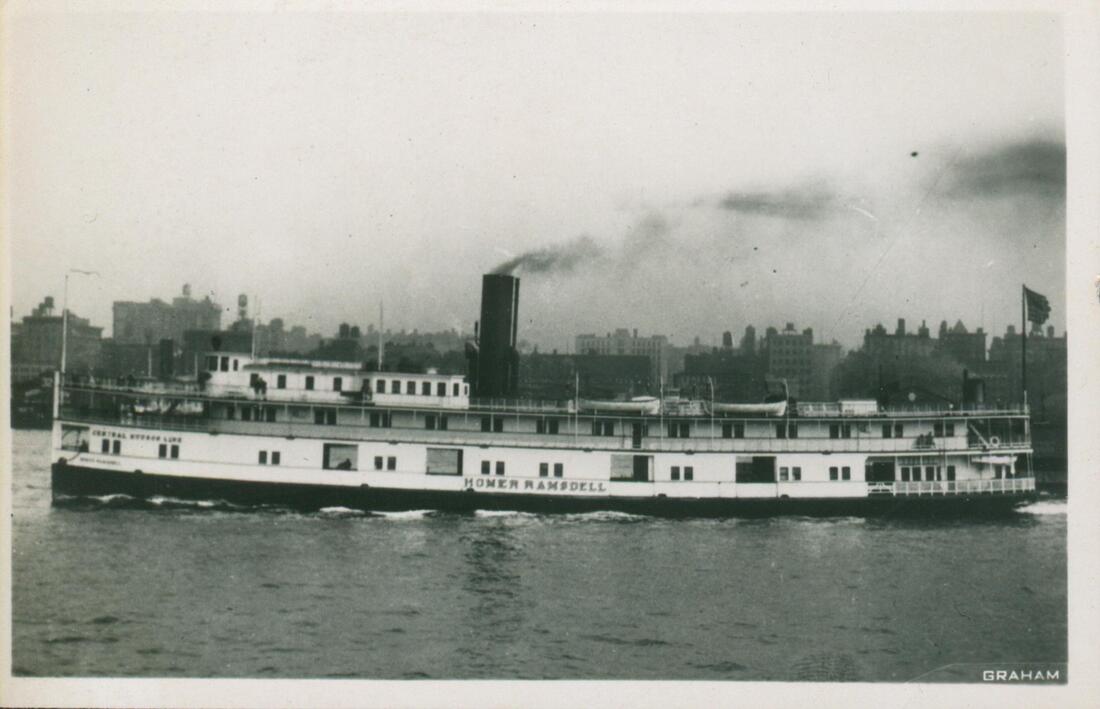 Steamboat "Homer Ramsdell". Richard V. Elliott Collection, Hudson River Maritime Museum By William O. Benson as told to Ann Marrott SLEIGHTSBURGH — Labor Day on the Hudson signified the last runs of the excursion steamers for the summer — especially for the people who had come up from New York City to spend the summer around the Catskill Mountains and Kingston. It always seemed that on Labor Day, people didn’t appear so happy — especially the children. When you saw the boats come up in early June or July, the children would be so happy. But when getting on the boats going back Labor Day Weekend, they would all be nice enough, but there would be no joy. Labor Day was one holiday I hated as a boy, because the next day I had to go to school. The Hudson River Day Line would run extra boats on Saturday and Sunday and Labor Day. And if you were out on Kingston Point on that holiday there would be a number of boats coming out of New York to bring the people back. Everyone wanted to get home the day before school started. All those boats would be loaded going to Bear Mountain. The Central Hudson Line would be running boats up to Beacon, Newburgh and Poughkeepsie. Labor Day was also the last excursion of the “Homer Ramsdell” and it would be advertised in the papers. Now, if you brought the New York World back then you would see two whole pages full of steamboat listings. There would be steamboats listed there that people today have probably never heard of, such as the “Grand Republic,” the “Commodore,” the “Benjamin Franklin” and the “Sea Gate.” The “Sea Gate” could carry 500 to 600 people. But the bigger boats you would see would be the “Benjamin E. Odell,” the “Robert Fulton,” the “Albany,” the “Onteora,” and the “Clermont.” Some of the big Day Line boats could carry 3,000 or 4,000 people. The “Washington Irving” could carry 6,000 people. I remember one Labor Day on the “Albany.” A lot of people got off her at Bear Mountain and this poor, stout woman came rushing down the pier, screaming and yelling. Her children were on the boat and it was already leaving. So the mate yelled back to her, “We'll put them off at Newburgh in charge of the dockmaster there. You'll have to get them at Newburgh.” Anyway, the purser took them under his wing and when they got to Newburgh the dockmaster took care of them. I’m not sure how they made out, but I’m sure they were fine. You used to see that all the time!! The[n] after Labor Day the boats would get back to their regular schedules. Most of the captains on those boats, especially George Greenwood, the captain of the “Benjamin B. Odell,” were always glad to see Labor Day come. George was always worried with so many people on the boat during the summer excursions, of a fire starting in the staterooms. Some of the boats did run after Labor Day on a Saturday or a Sunday to carry passengers to Bear Mountain or an excursion out of Kingston, but they wouldn’t have the big crowds. I looked forward to Labor Day, too, when I worked on the boats. You knew the boats were going to only run another day or two. Then she was headed for the Rondout Creek to tie up for the winter and you could go home. All during the summer you never got home much on those boats. Whatever boats were the most expensive to run were tied up first — right after Labor Day. The Day Line, after the holiday, operated only two boats. Sometimes for two weekends in September they would have, for example, the “Robert Fulton” ready to come out for a fall excursion to see the Hudson River fall foliage. When the boats were tied up we worked on them until the first of November cleaning the boat and painting her. Then of course you were laid off for the winter. In those days if you saved $150 to $200 during the summer you would have it made. You could live very comfortably all winter long. Some of us would get jobs ashore, which I used to do. I always looked forward to spring, when I could get back on the boats. After Labor Day — during the fall and winter — was the busiest time for workmen in the Cornell Steamboat Company shops. When the river was freezing over and navigation was closing, that’s when they started to repair and clean up the boats. Sometimes they would employ 400 or 500 men during the winter. They had the boiler gang, machinists, sawyers, painters, blacksmiths, the coaling gang and the bull gang—they did all the heavy work. They also had a lot of white collar workers. Everyone worked to get the boats ready for the next season. AuthorCaptain William Odell Benson was a life-long resident of Sleightsburgh, N.Y., where he was born on March 17, 1911, the son of the late Albert and Ida Olson Benson. He served as captain of Callanan Company tugs including Peter Callanan, and Callanan No. 1 and was an early member of the Hudson River Maritime Museum. He retained, and shared, lifelong memories of incidents and anecdotes along the Hudson River. If you enjoyed this post and would like to support more history blog content, please make a donation to the Hudson River Maritime Museum or become a member today!
0 Comments
Editor’s Note: The following text is a verbatim transcription of an article featuring stories by Captain William O. Benson (1911-1986). Beginning in 1971, Benson, a retired tugboat captain, reminisced about his 40 years on the Hudson River in a regular column for the Kingston (NY) Freeman’s Sunday Tempo magazine. Captain Benson's articles were compiled and transcribed by HRMM volunteer Carl Mayer. See more of Captain Benson’s articles here. This article was originally published February 6, 1972. 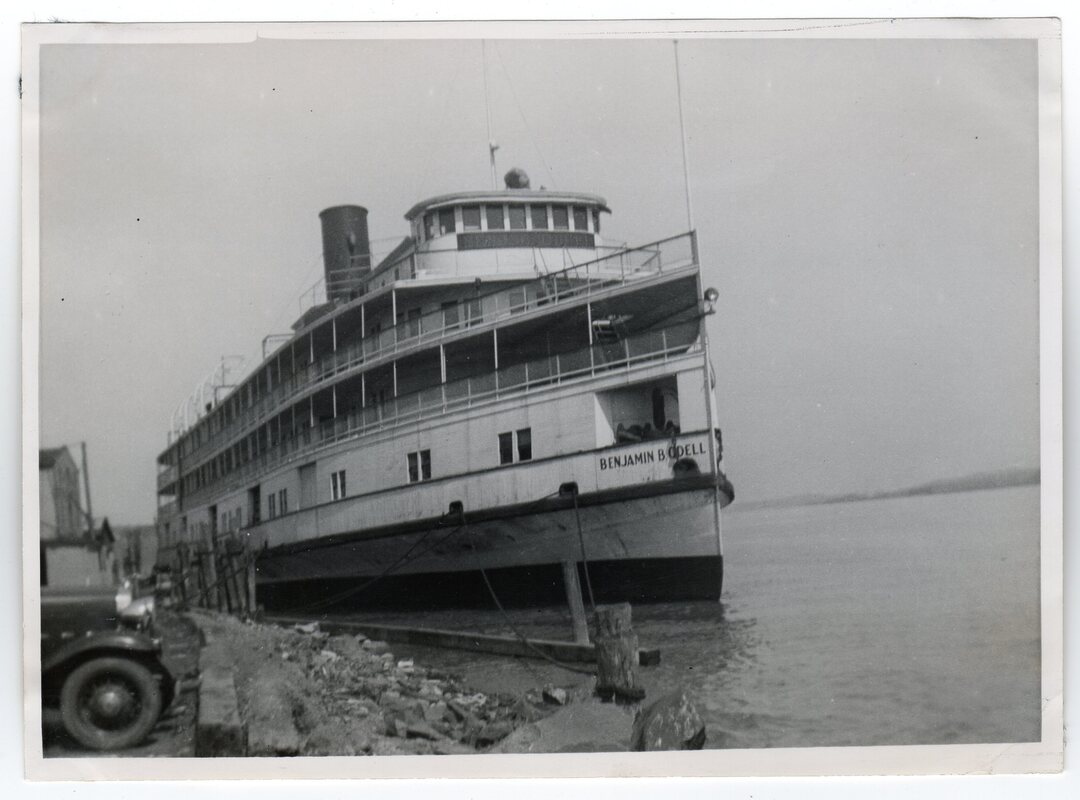 Steamboat "Benjamin B. Odell" at Newburgh in July 1936. Tracey I Brooks Collection, Hudson River Maritime Museum. When steamboating was in its heyday, anyone living in Rondout, Ponckhockie, Sleightsburgh or Port Ewen never needed a clock or a watch. They could always tell what time it was by the steamboat whistles. First, there was the huge steam whistle on the Rondout Shops of the Ulster and Delaware Railroad that boatmen always said came from the big sidewheel towboat ‘‘Austin.” There would be one long whistle at 8 a.m., 12 noon, 12:30 p.m. and 4:30 p.m., telling the men at both the U. and D. shops and the Cornell Steamboat Company shops to start work, eat their noon meal and to stop for the day. When the U. and D. shops were torn down in the early thirties, this whistle was then installed on the Cornell shops. Three Long Blasts Then, every afternoon at 3:25 p.m. three long blasts of a steam whistle would be heard along Rondout Creek as either the ‘‘Benjamin B. Odell,” “Homer Ramsdell,’’ ‘‘Newburgh” or “Poughkeepsie” of the Central Hudson Line prepared to leave their dock on Ferry Street for the start of the evening trip to New York. During the summer, on Saturday mornings at 10:55 a.m., one would hear the wonderful whistle of the “Benjamin B. Odell” as she prepared to leave Rondout. Then in the evening could be heard the ‘‘Homer Ramsdell” as she came in the creek. She would blow at about 8 p.m. just as she was passing the gas plant at Ponckhockie. Every summer Sunday morning, the “Homer Ramsdell” would leave Rondout at 6:30 a.m. on an excursion to New York. The three long blasts on her whistle at 6:25 a.m. sounded twice as loud in the still morning air. From May until early October one always heard the Day Line boats blowing for the landing at Kingston Point. The one long, one short, one long blast of the down boat’s whistle was always heard just before 1 p.m. Then shortly before 2:30 p.m. would be heard the landing whistle of the north bound steamer. Phil Maines of Rondout, the former mate of the “Mary Powell,” was then the dockmaster at Kingston Point. From the ‘Tremper’ At about 10:30 a.m. on alternate days, one would hear the “Jacob H. Tremper” coming in Rondout Creek on her way to Albany. Then the next day, she would blow for Rhinecliff at 2 p.m. and by 2:45 p.m. she would be coming in the creek and blow again for Rondout. | In the evening about 8 p.m. one would hear three long whistles out in the river. One would be the Saugerties Evening Line steamer “Robert A. Snyder” or “Ida’’ blowing for their landing at Rhinecliff on their sail to New York. Before World War I, the finest sound of all was the mellow whistle of the ‘‘Mary Powell” as she prepared to leave the dock at the foot of Broadway in Rondout at 6 a.m. Then in the evening would be heard her whistle out in the river on her return from New York, just before she entered the creek. Also, all during the day at 10 minute intervals, except when stopped by ice, could be heard one short whistle from the ferry ‘‘Transport.” 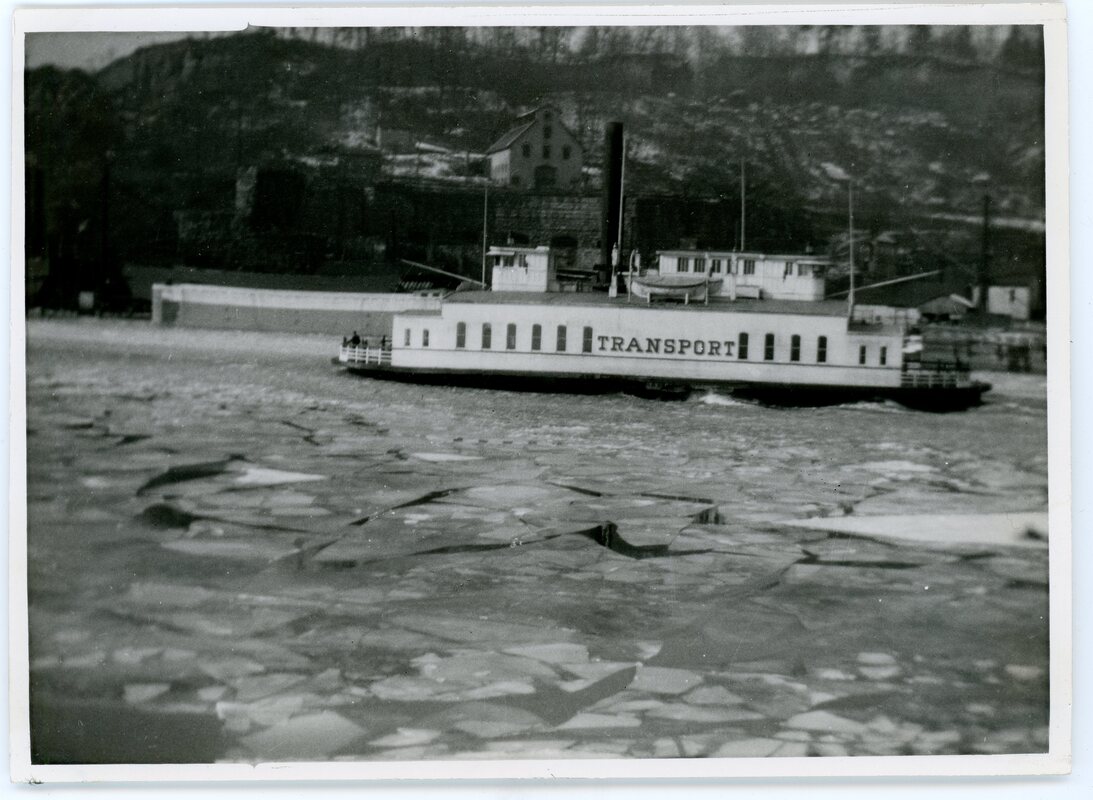 Steam Ferry "Transport" in Rondout Creek. Tracey I Brooks Collection, Hudson River Maritime Museum. AuthorCaptain William Odell Benson was a life-long resident of Sleightsburgh, N.Y., where he was born on March 17, 1911, the son of the late Albert and Ida Olson Benson. He served as captain of Callanan Company tugs including Peter Callanan, and Callanan No. 1 and was an early member of the Hudson River Maritime Museum. He retained, and shared, lifelong memories of incidents and anecdotes along the Hudson River. If you enjoyed this post and would like to support more history blog content, please make a donation to the Hudson River Maritime Museum or become a member today!
Editor’s Note: The following text is a verbatim transcription of an article featuring stories by Captain William O. Benson (1911-1986). Beginning in 1971, Benson, a retired tugboat captain, reminisced about his 40 years on the Hudson River in a regular column for the Kingston (NY) Freeman’s Sunday Tempo magazine. Captain Benson's articles were compiled and transcribed by HRMM volunteer Carl Mayer. See more of Captain Benson’s articles here. This article was originally published August 27, 1972.. 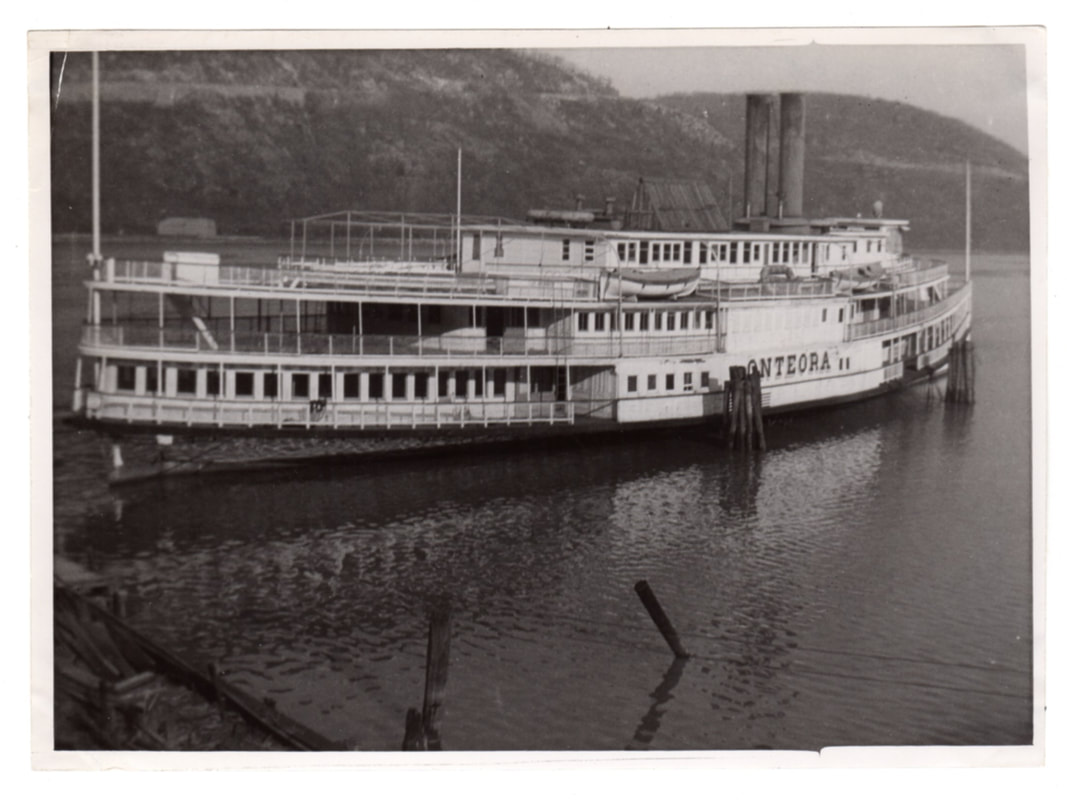 Steamboat "Onteora" tied at Bear Mountain in April 1935. Tracey I. Brooks Collection, Hudson River Maritime Museum. When I was a boy of nine, my father took me to spend a weekend on the steamboat “Onteora" on which my older brother, Algot, was the mate. The visit was made during the last weekend of August 1920 and made a tremendous impression on me. I kept notes on the trip, and made a list of every steamboat I saw. At that time, the "Onteora" made a round trip daily between 125th Street, New York, and Bear Mountain — and was in her first year of excursion service. She previously had been a night boat of the Catskill Evening Line. We crossed Rondout Creek from Sleightsburgh on the old chain ferry "Riverside," better known as the "Skillypot," which was still in service awaiting the opening of the then new Rondout Creek bridge. From Rondout we took the open trolley car to Kingston Point where we talked to Phil Maines, the dockmaster, who had formerly been the mate of the “Mary Powell" when my father was her ship's carpenter. While waiting for the down Day Boat, my father remembered he had left his cigars in Jacobson’s store on the Strand and hurried back on the trolley to get them. I thought sure we would miss the boat, but he got back just as the “Robert Fulton” was landing. As we were passing Esopus Island, I saw the wreck of the steamboat "Point Comfort" on the north end of the island where she had piled up the previous September. South of Crum Elbow, we passed the "Hendrick Hudson” of the Day Line on her way to Albany and after leaving Poughkeepsie, down off Camelot, we passed the “Benjamin B. Odell” of the Central Hudson Line going to Poughkeepsie. River Activity Down at Newburgh, I remember seeing the steamboats "William F. Romer” and “M. Martin” in the process of being broken up. Off West Point, we passed the Cornell tugboat "George W. Washburn” going up with a large tow and the tugs "W. N. Bavier" and "Hercules" helping her. The ferry "Highlander" was crossing the river to Garrison. When we approached Bear Mountain, the steamboats “Mandalay,” "Seagate" and "Sirius" were lying at the pier to be used by the “Robert Fulton.” They all pulled out into the river so the "Fulton" could land. The other pier at Bear Mountain was also crowded with steamboats and, as a little boy, I could not take my eyes off them. At the spiles [sic] that had been put in specially for the "Mary Powell” during her last years in service, lay the "Onteora.” I thought what a wonderful boat she was. It was the first time I had ever seen her. At the pier were the steamboats “Grand Republic,” "Trojan," “Highlander,” “Clermont” and "Monmouth.” There were hundreds of people all around and bands playing on some of the steamers. It was a sight never to be forgotten. Then we went aboard the "Onteora" and met my brother. The way he looked to me in his uniform, I thought he was greater than the President of the United States! When we left Bear Mountain that night on the "Onteora" at about 7:30 p.m. all of the other steamboats had already departed. Later, as we were down off Haverstraw, eating our supper in the dining room, my brother said, "Look out there, Bill." When I looked out the starboard windows, there was the Day Liner "Albany" passing us, the big walking beam reaching, reaching and reaching, her white paddle wheels splashing the water — a truly wonderful sight to my boyish eyes. I still can remember Mike Rafferty of Kingston, the mate, standing in the gangway and waving his hand. As we were nearing Yonkers, I must have fallen asleep on the leather upholstered locker in the pilot house because the next thing I remember we were tied up at the 125th Street pier. Ike Schermerhorn, the pilot, let us have his room in the pilot house block on the top deck but I slept hardly a wink all night. The 125th Street ferries running back and forth to Edgewater would blow their whistles as they left their slip right next to our pier and kept me wide awake. The next morning how good that breakfast tasted to me. My brother let me get down and have my breakfast in the deckhand's mess hall with Henry Emmick and Horace Lehman, two of the deckhands from Kingston. Then he took me across the pier to see three of the Coney Island boats of the Iron Steamboat Company that were tied up there — the “Cepheus,” “Perseus” and “Taurus.” I can remember the “Washington Irving," the flagship of the Hudson River Day Line, landing at the end of the pier on her way to Albany. Next came the “Trojan” of the Hudson River Night Line landing at 132nd Street on her Sunday trip to Newburgh. Then came my pride and joy, the big "Benjamin B. Odell,” to land at the end of the pier for her Sunday excursion to Highland Falls, Newburgh, Beacon and Poughkeepsie. I could see the lookout come out and hook open the pilot house door, so Captain George Greenwood could stand outside the pilot house to ring bells to the engine room to land her. After she left with a full load of people, in came the "Mandalay” and did the same thing. 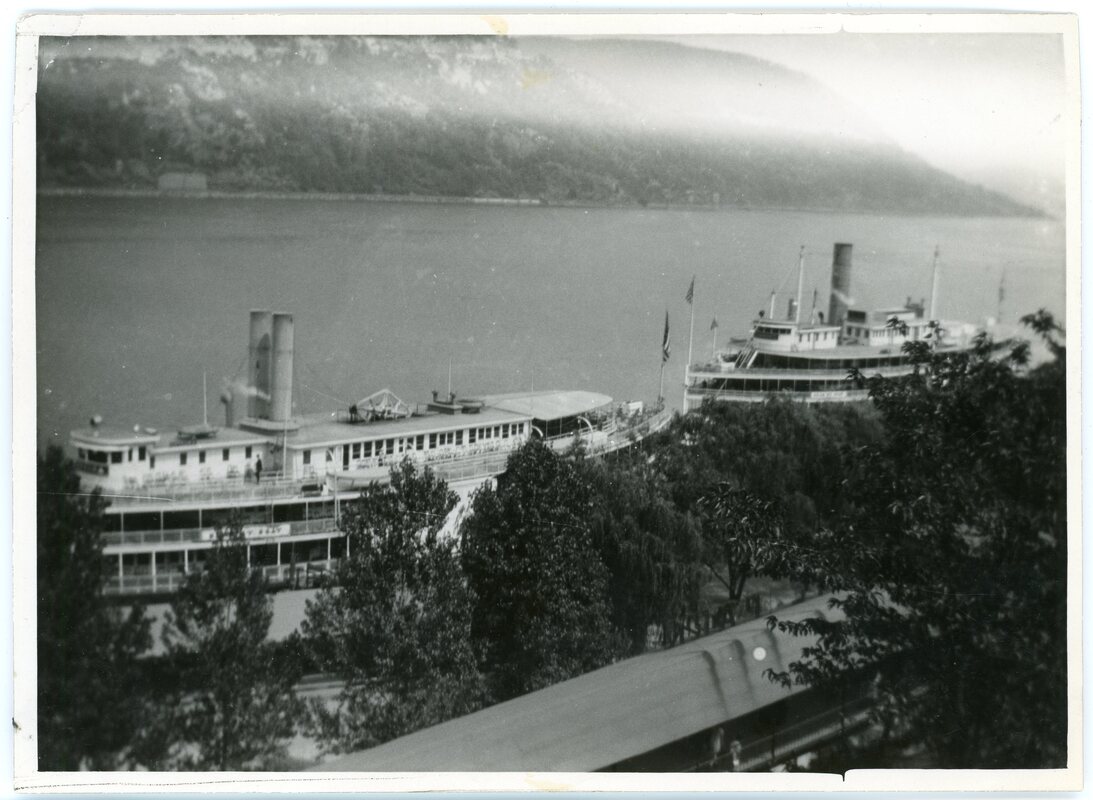 Steamships "Onteora" and "Clermont" at Bear Mountain In July 1928. Tracey I Brooks Collection, Hudson River Maritime Museum. Feeling Important Next, the “Albany" came in on her way to Poughkeepsie. I can remember I was standing in the "Onteora’s” pilot house, my brother having told me to stay there. I suppose he was afraid I would get lost among all the people. I hollered over to Mike Rafferty, the mate, who was standing in the “Albany's” gangway. When he hollered back,”Hello, William, are you having a good time?” it made me feel very important. Ike Schermerhorn, the “Onty’s” pilot, said, “How do you know him?" — and I answered, “I go over on her in the winter when she is tied up in Rondout Creek. My father does the carpenter work on her." Next came the "Poughkeepsie,” but she did not stop and went right on by. A few minutes later we were blowing to let go and started for Bear Mountain. As we were leaving, the “Grand Republic” was coming up the harbor, getting ready to land at 132nd Street on her way to Bear Mountain. As we were passing Fort Washington Point, I saw the Cornell tug “Eli B. Conine” coming down light, probably on her way to Edgewater. Later off Tarrytown we passed the tugboat “J. C. Hartt" with the down tow, the Cornell tugs “J. G. Rose” and “Ellen M. Ronan” helping her. The “Hartt” blew one long, one short and the “Onteora” answered with one long and two short blasts on her whistle. The captain of the “Onteora” was Ben Hoff, Jr. and his father, Ben Hoff, Sr., was captain of the “Hartt.” When we arrived at Bear Mountain, the “Mandalay” was already there as was the “Seagate,” the “Seagate” having an excursion from Poughkeepsie. That afternoon, my father said, “Well, Bill, I guess it’s about time to go home.” So we boarded the West Shore train at Bear Mountain for the trip to Kingston. As we passed over the bridge that spans Popolopen Creek, just above Bear Mountain, there was the replica of the “Half Moon” that had been used in the Hudson-Fulton Celebration of 1909, snuggled between the high hills bordering the creek. And, so, a great time for me came to an end, one I shall never forget. AuthorCaptain William Odell Benson was a life-long resident of Sleightsburgh, N.Y., where he was born on March 17, 1911, the son of the late Albert and Ida Olson Benson. He served as captain of Callanan Company tugs including Peter Callanan, and Callanan No. 1 and was an early member of the Hudson River Maritime Museum. He retained, and shared, lifelong memories of incidents and anecdotes along the Hudson River. If you enjoyed this post and would like to support more history blog content, please make a donation to the Hudson River Maritime Museum or become a member today!
Editor’s Note: The following text is a verbatim transcription of an article featuring stories by Captain William O. Benson (1911-1986). Beginning in 1971, Benson, a retired tugboat captain, reminisced about his 40 years on the Hudson River in a regular column for the Kingston (NY) Freeman’s Sunday Tempo magazine. Captain Benson's articles were compiled and transcribed by HRMM volunteer Carl Mayer. See more of Captain Benson’s articles here. This article was originally published June 18, 1972. 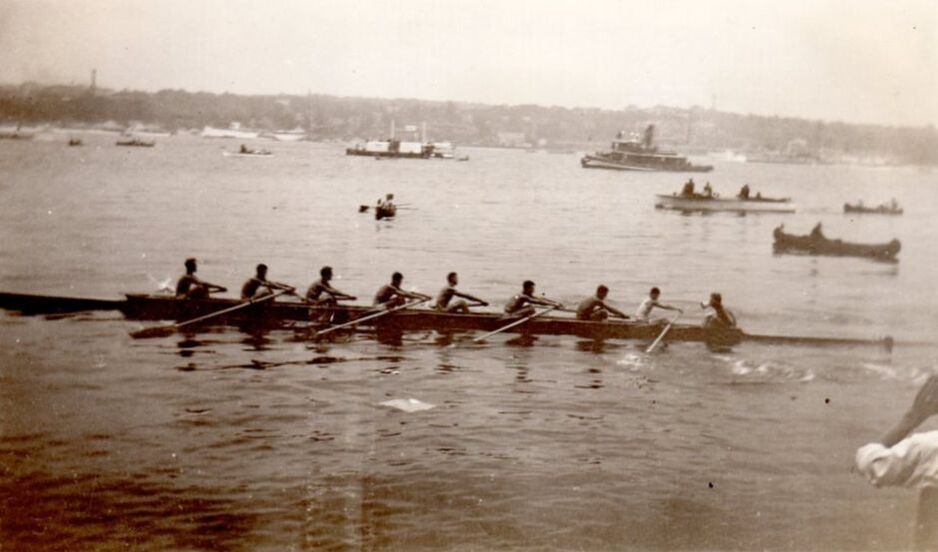 1926 Poughkeepsie Regatta, 4 mile race, varsity, won by Columbia. Hudson River Maritime Museum Collection. When the intercollegiate crew races used to be held at Poughkeepsie every year during the latter part of June, the Cornell Steamboat Company would indirectly be involved. Both Frederick and Edward Coykendall were graduates of Columbia University and always had a great interest in the crews of their alma mater. During the 1930’s and 1940's, Frederick Coykendall was also chairman of Columbia Board of Trustees. As a result of their interest in Columbia and rowing, the Coykendalls would use one of their tugboats to transport Columbia's shells to Poughkeepsie; on occasion would have an invited party of guests at the boat races on one of their tugs; and would maintain an old canal barge that on boat race day was used as the "finish boat.” Transporting Shells The crews of the various colleges used to train for the races on the river at Poughkeepsie for a week or two prior to the regatta. For years, one of the Cornell helper tugs used to take the Columbia shells from their boat house on the Harlem River in New York up the Hudson to the Columbia boat house, which was located north of Highland on the west shore just below Krum Elbow. Then a day or two after the regatta, a tug would take the shells back to New York. On boat race day, particularly before the Depression, the river at Poughkeepsie used to be filled with all types of spectator steamboats, yachts and sometimes Navy destroyers with midshipmen aboard to watch the regatta. Generally, there used to be two Day Liners, at least one boat of the Central Hudson Line, and others. One year, when Judge Alton B. Parker was still alive and maintained his estate "Rosemont" at Esopus, the Coykendalls had the large Cornell tugboat "George W. Washburn” ready to take their families and friends to Poughkeepsie to see the boat races. On the way down river from Kingston, Edward Coykendall said to Al Hamilton, captain of the "Washburn," "Captain, stop at the Esopus landing and pick up Judge Parker and his family. We are going to take them along with us.” 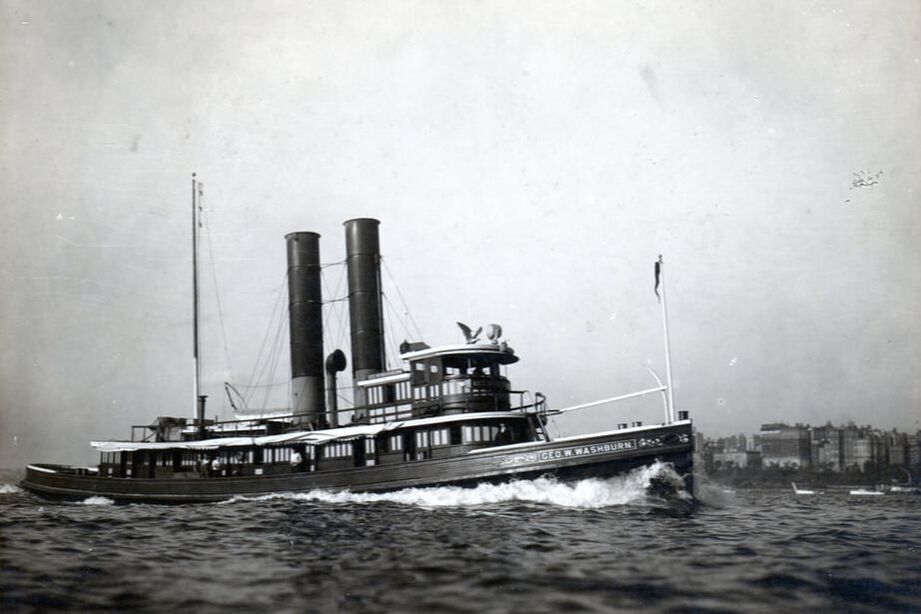 The tugboat "George W. Washburn" off of New York City. Donald C. Ringwald Collection, Hudson River Maritime Museum. Water Worries Captain Hamilton said, "Mr. Coykendall, there’s not enough water at that dock for this boat. We might break our wheel.” Coykendall replied, “Get in there any way you can. I want to pick them up as they will be waiting for us.” So, Captain Hamilton put the “Washburn” into the dock at Esopus, and when he went to back down, clip went the wheel on a rock and bent two of the propeller's flukes: However, when the “Washburn” left Esopus for Poughkeepsie — instead of shaking all over as normally would be the case with a bent propeller — she went as well, if not better, than when the propeller was in good condition. Everybody thought the flukes must have been broken off, but when she was put on drydock, the flukes weren’t broken but only bent. I heard Coykendall relate this story himself one day in 1939 in the pilot house of the "Jumbo." Also, for years, the Coykendalls would furnish the “finish boat,” an old D. & H. canal boat they maintained just for this purpose. The little barge would be anchored fore and aft with two anchors at the finish line of the races. A large board would be mounted on the deck of the barge and, after a race, would give the order of finish and the official times. The information on the board would be visible to the people on shore and those on the observation train that used to move along the West Shore railroad tracks as the crews moved down river from the starting line to the finish line. 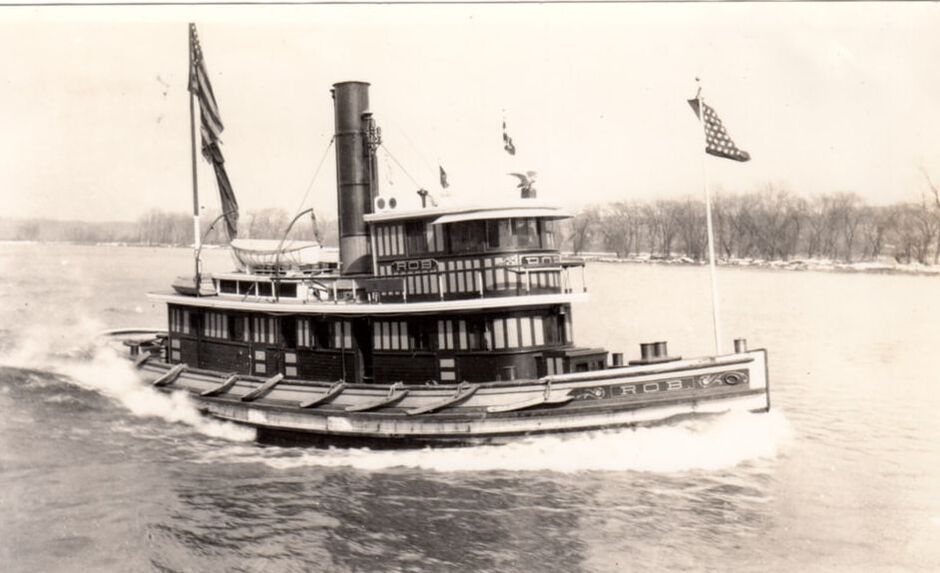 The tugboat "Rob," flags flying, under way on the Hudson River. Tracy I. Brooks Collection, Hudson River Maritime Museum. The Rob's Job The Barge would be painted at the Cornell shops and at dawn on boat race day, the tug “Rob" would tow the “finish boat" from Rondout to Poughkeepsie and anchor it at the proper place. After the last race, the anchors would be pulled up and the “Rob” would tow the canal boat back to Kingston for other year. John Lynn of Port Ewen, captain of the "Rob," used to invite friends of his and their families to watch the regatta. These people would go out to Kingston Point and take the down Day Liner to Poughkeepsie.After the Day Liner left, the "Rob" would come chuffing into the finish line where she would stand by the "finish boat." These people probably had the best view of the end of the races of anyone at the regatta. After the last race, all the boats at the regatta would get underway at once and almost all of them headed for New York. Almost all except the “Rob,” which with the "finish boat" alongside would head for Rondout Creek where she would arrive at about 11 p.m. AuthorCaptain William Odell Benson was a life-long resident of Sleightsburgh, N.Y., where he was born on March 17, 1911, the son of the late Albert and Ida Olson Benson. He served as captain of Callanan Company tugs including Peter Callanan, and Callanan No. 1 and was an early member of the Hudson River Maritime Museum. He retained, and shared, lifelong memories of incidents and anecdotes along the Hudson River. Editor’s Note: The following text is a verbatim transcription of an article featuring stories by Captain William O. Benson (1911-1986). Beginning in 1971, Benson, a retired tugboat captain, reminisced about his 40 years on the Hudson River in a regular column for the Kingston (NY) Freeman’s Sunday Tempo magazine. Captain Benson's articles were compiled and transcribed by HRMM volunteer Carl Mayer. See more of Captain Benson’s articles here. This article was originally published June 11, 1972. 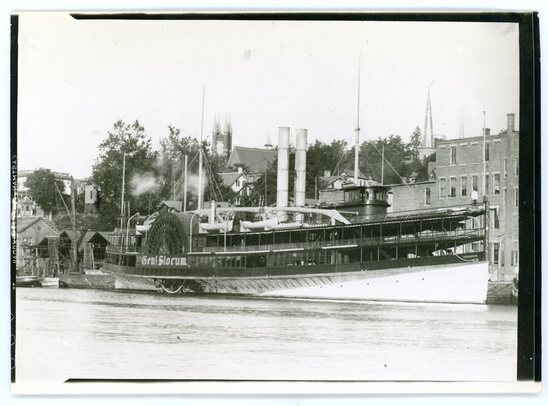 Steamboat "General Slocum". Tracey I. Brooks Collection, Hudson River Maritime Museum. On June 15, 1904 occurred one of the worst steamboat disasters of all time. On that sunny June morning, he New York harbor excursion steamer “General Slocum” caught fire and burned in the East River with a resulting loss of life of 1,021 people. The “General Slocum” was built in 1891 at Brooklyn to run between New York City and Rockaway Beach. She later ran as an excursion steamer on the Hudson River and Long Island sound, and — at the time — was the largest excursion steamboat out of New York. From time to time, she was chartered by local Ulster County groups and carried excursions out of Rondout Creek. On the day of the disaster, the “General Slocum” had been chartered by the Sunday School and members of the congregation of St. Mark’s German Lutheran Church of New York for an excursion to Locust Grove on Long Island. The vessel left a pier at the foot of East Third Street, Manhattan, shortly before 10 a.m. and proceeded up the East River. A Cabin Ablaze Off 97th Street, some of the deckhands on the lower deck observed wisps of smoke coming from the forward part of the vessel. Instead of notifying the captain, they tried to find the cause, apparently thinking they could put out the fire if there was one. They went below and found a cabin ablaze. Coming back on deck, they got the mate who immediately sent word to the captain and started to fight the fire. By this time the fire was beginning to gain momentum and spread. The East River, at the point where the fire was discovered, is deep and filled with treacherous tidal currents. The captain, William H. Van Schaick, thought his best course would be to reach shallow water and ordered the pilot to head at full speed for North Brother Island, approximately a mile ahead. The fire, unfortunately, spread rapidly, fanned by a breeze blowing from the north and the steamer’s speed through the water. Many passengers became panic stricken as everyone tried to crowd to the rear of the vessel away from the burning forward part of the steamboat. To add to the dire chain of events surrounding the tragedy, the steamer — on reaching North Brother Island — grounded forward. Her stern, however, where all the passengers were crowded, was still in water 30 feet deep. Many passengers, thinking the entire steamer was in shallow water, jumped overboard and were drowned. Due to the huge loss of life, the disaster naturally caused a great public furor and led to several investigations. There was strong criticism of the adequacy of the life saving and fire fighting equipment aboard the steamboat. As a result of the investigations, Captain Van Schaick was sentenced to prison. Almost all boatmen felt the captain was unjustly made a scapegoat for the resulting tragedy, instead of the owners of the steamer or the effectiveness of the life saving and fire fighting equipment then required — and the inspections of it by government inspectors. 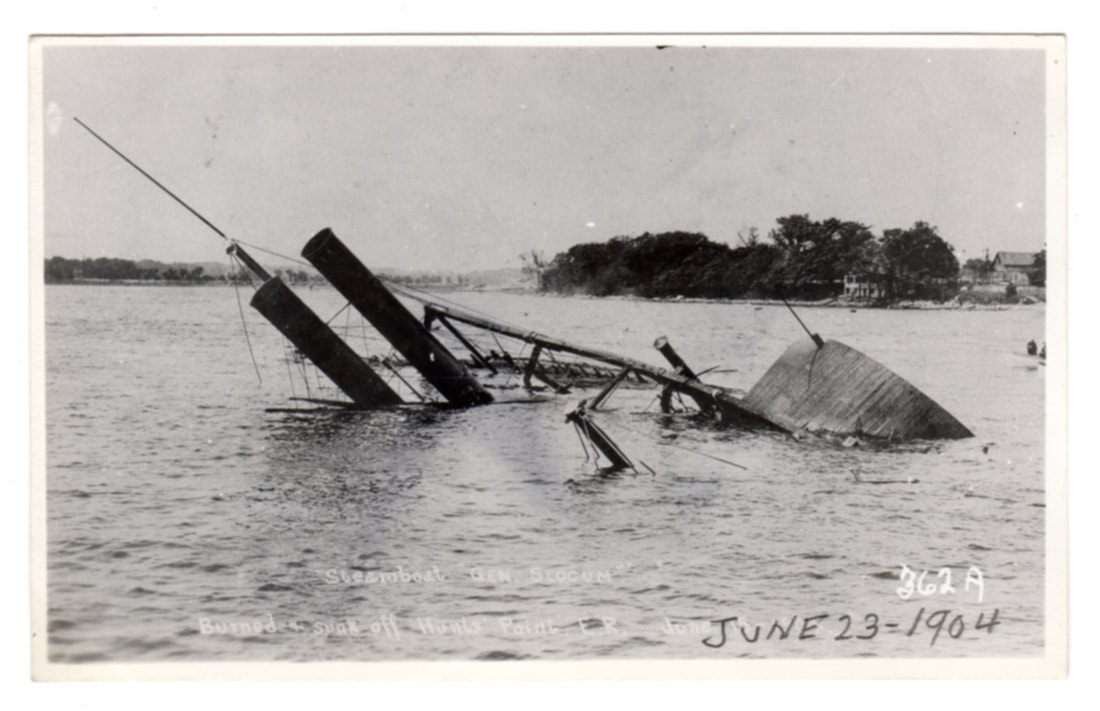 Steamboat "General Slocum" burned and sunk off Hunt's Point, East River, 1904. Tracey I. Brooks Collection, Hudson River Maritime Museum. Suffered Injuries Captain Van Schaick was severely burned as a result of the fire and his eyesight was permanently damaged by the intense heat of the flames as he vainly sought to direct efforts to combat the holocaust. When he was sentenced to prison, he was sent to Sing Sing at Ossining. At that time, the State was building what is now Bear Mountain Park operated by the Palisades Interstate Park Commission. Some of the inmates of Sing Sing were used for cutting down trees, and other work. Al Walker, who later was a captain of Cornell tugboats, was then captain of a little steamboat used to carry prisoners back and forth between Sing Sing and the new park. Captain Van Schaick was one of the prisoners who was sent to the park to do what he could. Al told me he would always take Captain Van Schaick into the pilot house and let him steer or do whatever he wanted to do as, like all other steamboatmen of that day, he felt Captain Van should never have gone to prison. Captain Van Schaick eventually was pardoned by President Taft and later died at the Masonic Home at Utica in 1924. Several members of his family were also steamboatmen. A brother was a captain of steamboats of the Iron Steamboat Company, the steamboat line that ran from New York to Coney Island until 1932. Captain Arthur Van Schaick, who I believe was a nephew of the “General Slocum’s" captain, was a pilot and later captain of the "Chauncey M. Depew’’ of the Hudson River Day Line. On the ‘Sirius’ Before Captain Van Schaick became captain of the "General Slocum," he had been captain of the steamer “Sirius” of the Iron Steamboat Company. Jack Dearstyne, Sr., who was later captain of a number of Hudson River steamboats, was at that time first mate of the ‘‘Sirius." Captain Dearstyne later told me that Captain Van Schaick always used to say his one wish was to be captain of New York’s largest excursion steamer. Well, he got his wish and, as it turned out, to his great regret. AuthorCaptain William Odell Benson was a life-long resident of Sleightsburgh, N.Y., where he was born on March 17, 1911, the son of the late Albert and Ida Olson Benson. He served as captain of Callanan Company tugs including Peter Callanan, and Callanan No. 1 and was an early member of the Hudson River Maritime Museum. He retained, and shared, lifelong memories of incidents and anecdotes along the Hudson River. Learn more at the June 8, 2022 lecture by author Edward T. O'Donnell "The 1904 General Slocum Disaster: New York's Deadliest Day before 9/11" If you enjoyed this post and would like to support more history blog content, please make a donation to the Hudson River Maritime Museum or become a member today!
Editor’s Note: The following text is a verbatim transcription of an article featuring stories by Captain William O. Benson (1911-1986). Beginning in 1971, Benson, a retired tugboat captain, reminisced about his 40 years on the Hudson River in a regular column for the Kingston (NY) Freeman’s Sunday Tempo magazine. Captain Benson's articles were compiled and transcribed by HRMM volunteer Carl Mayer. See more of Captain Benson’s articles here. This article was originally published May 21, 1972. 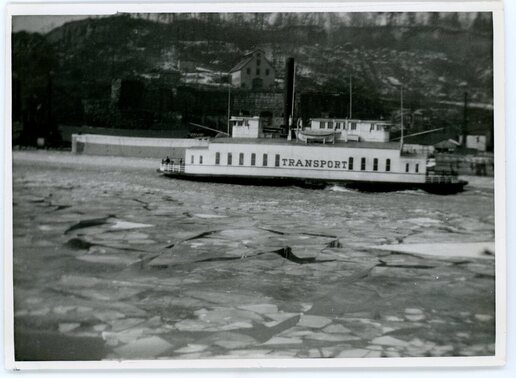 Kingston-Rhinecliff ferryboat "Transport". Tracey I. Brooks Collection, Hudson River Maritime Museum. On Saturday, May 19, 1928, in the early afternoon of a beautiful spring day, a collision occurred off Rondout Lighthouse between the ferryboat “Transport” and the steamer “Benjamin B. Odell” of the Central Hudson Line. At the time, I was deckhand on the steamer “Albany” of the Hudson River Day Line, helping to get her ready for the new season after her winter lay up at the Sunflower Dock at Sleightsburgh. On Saturdays, we knocked off work at 11:30 a.m. As I rowed up the creek in my rowboat to go home, the big “Odell” was still at her dock at the foot of Hasbrouck Avenue at Rondout. At 12:25 p.m. the “Odell” blew the customary three long melodious blasts on her big whistle, high on her stack, as the signal she was ready to depart. At home, eating lunch, I heard her blow one short blast promptly at 12:30 p.m. as the signal to cast off her stern line. From the Porch Following a habit of mine from a young boy, I went out on our front porch to watch her glide down the creek at a very slow pace past the Cornell shops, Donovan’s and Feeney’s boat yards, and the freshly painter [sic] “Albany.” The “Odell” looked to me like a great white bird slowly passing down the creek. At the time, I thought how in less than two weeks we would probably pass her on the “Albany” on the lower Hudson on Decoration Day, both steamers loaded with happy excursionists on the first big holiday of the new season. As the “Odell” passed Gill’s dock at Ponckhockie, I went back in the house to finish lunch. A few minutes later I heard the “Odell” blow one blast on her whistle, which was answered by the “Transport” on her way over to Rhinecliff, indicating a port to port passing. Hearing steam whistles so often in the long ago day along Rondout Creek was something one took for granted, assuming they would be heard forever. Then I heard the danger signal on the whistle of the “Transport” followed by three short blasts from the “Odell’s” whistle, indicating her engine was going full speed astern. Shortly thereafter, I could hear the “Transport” blowing the five whistle signal of the Cornell Steamboat Company of 2 short, 2 short, 1 short, meaning we need help immediately. I ran down to my rowboat tied up at the old Baisden shipyard, and looked down the creek. I could see the “Transport” limping in the creek very slowly, her bow down in the water, and her whistle blowing continuously for help. I also noticed several automobiles on her deck. Looking over the old D. & H. canal boats that were deteriorating on the Sleightsburgh flats, I could see the top of the “Odell” stopped out in the river. After a few minutes, she slowly got underway and proceeded on down the river, her big black stack belching smoke, so I figured she was not hurt. 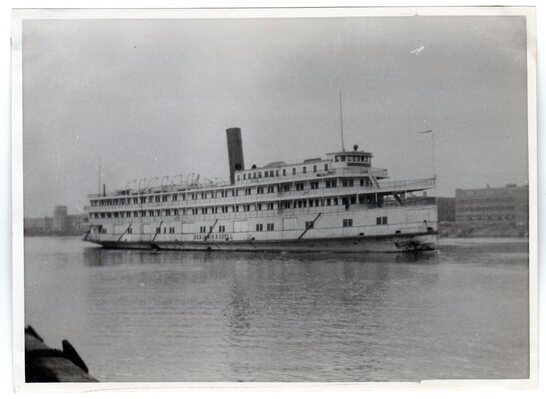 Steamboat "Benjamin B. Odell". Tracey I. Brooks Collection, Hudson River Maritime Museum Decision to Beach As the “Transport” approached the Cornell coal pocket, her captain, Rol Saulpaugh, decided to beach her on the Sleightsburgh shore. Nelson Sleight, a member of her crew, asked me to run a line over to the dock a the shipyard in the event she started to slide off the bank. I took the line and ran it from where the “Transport” grounded to the dock. In the meantime, the Cornell tugboat “Rob” came down the creek, from where she had been lying at the rear of the Cornell office at the foot of Broadway, and pushed the ferry a little higher on the bank. After taking the line ashore, I went back and asked if there was anything else I could do. Captain Saulpaugh asked me if I would row up to the ferry slip and get Joseph Butler, the ferry superintendent, and bring him over to the “Transport,” which I did. On the way over, Butler told me he had already called the Poughkeepsie and Highland Ferry Company to see if he could get one of its ferries to run in the “Transport’s” place. The afternoon about 5 p.m., the Poughkeepsie ferryboat “Brinckerhoff” arrived in the creek and began running on the Rhinecliff route. When we got back to the “Transport,” mattresses and blankets had been stuffed in the hole the “Odell” had slicked in the over-hanging guard and part of the hull. When she was patched, the “Transport,” with the “Rob’s” help, backed off the mud and entered the Roundout slip stern first - and the cars on deck were backed off. Then, the “Rob” assisted the ferry to make her way up to the C. Hiltebrandt shipyard at Connelley for repairs. There she was placed in drydock, the damage repaired, and in a week she was back in service on her old run. A Flood Tide The cause of the mishap at the mouth of the creek was a combination of a strong flood tide, a south wind and a large tow. Out in the river, the big tugboat “Osceola” of the Cornell Steamboat Company was headed down river with a large tow. She had just come down the East Kingston channel and at that moment was directly off the Rondout Lighthouse. When there is a strong flood tide, there is a very strong eddy at the mouth of the creek. The tide, helped by a south wind, sets up strong and when it hits the south dike, it forms a half moon about 75-100 feet out from the south dike and then starts to set down. As the “Odell” was leaving the creek and entering the river, the “Transport” was passing ahead of the tow, around the bow of the “Osceola.” The “Transport” probably hit the eddy caused by the flood tide. In any event, she didn’t answer her right rudder and took a dive right into the path of the “Odell.” The “Odell” couldn’t stop in time and cut into the forward end of the ferry about 6 or 8 feet. No one was hurt and there was no confusion on either boat. The “transport” bore the brunt of the bout; the only damage to the “Odell” being some scratched paint on her bow. I heard later from the Dan McDonald, pilot on the “Osceola,” that there would be the lawsuit as a result of the collision - and he had been served with a subpoena to appear as a witness. He never had to appear, however, as Captain Greenwood of the “Odell” later told me the case was settled out of court. The next year the Central Hudson Line, because of the inroads made by the automobile, went out of business. The “Benjamin B. Odell”, however, continued to run on the river for another company until February 1937 when she was destroyed by fire in winter lay up at Marlboro. The “Transport” continued running on the Rhinecliff ferry route until September 1938 when she was withdrawn from service. She was later cut down and made into a stake boat for the Cornell Steamship Company for use in New York harbor. AuthorCaptain William Odell Benson was a life-long resident of Sleightsburgh, N.Y., where he was born on March 17, 1911, the son of the late Albert and Ida Olson Benson. He served as captain of Callanan Company tugs including Peter Callanan, and Callanan No. 1 and was an early member of the Hudson River Maritime Museum. He retained, and shared, lifelong memories of incidents and anecdotes along the Hudson River. If you enjoyed this post and would like to support more history blog content, please make a donation to the Hudson River Maritime Museum or become a member today!
Editor’s Note: The following text is a verbatim transcription of an article featuring stories by Captain William O. Benson (1911-1986). Beginning in 1971, Benson, a retired tugboat captain, reminisced about his 40 years on the Hudson River in a regular column for the Kingston (NY) Freeman’s Sunday Tempo magazine. Captain Benson's articles were compiled and transcribed by HRMM volunteer Carl Mayer. See more of Captain Benson’s articles here. This article was originally published April 9, 1972. 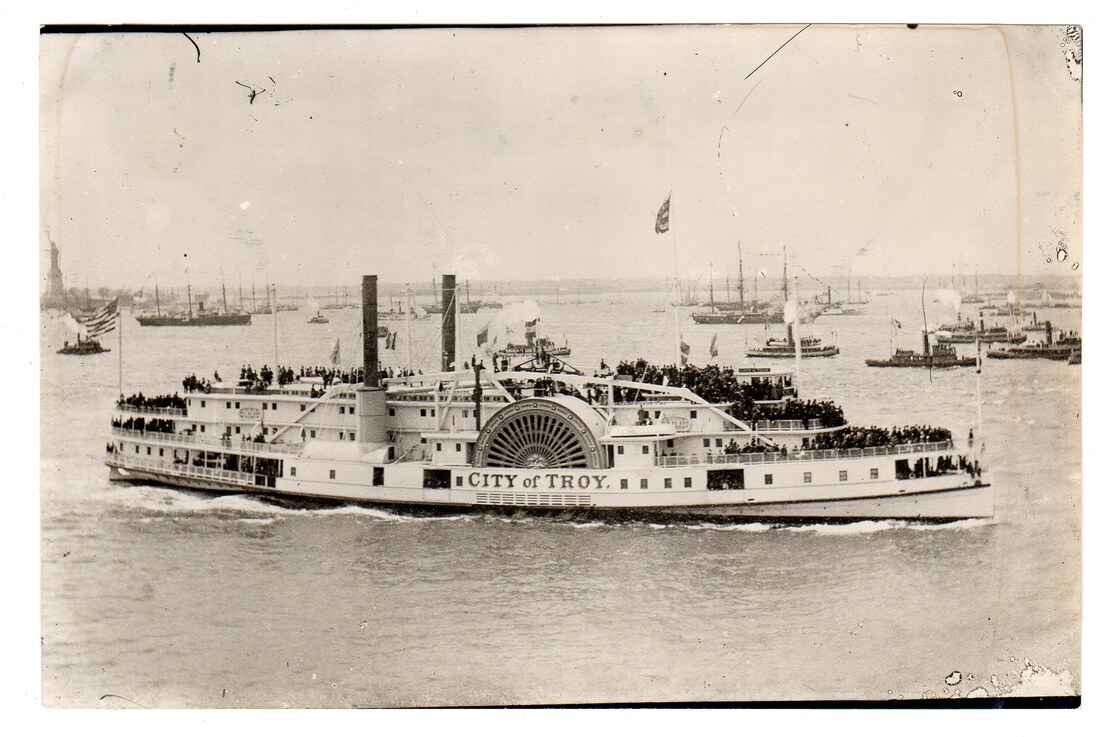 Passenger steamboat "City of Troy" laden with passengers and surrounded by other vessels in New York Harbor (Statue of Liberty in background at far left) for the 1892 Columbus Day celebration. Tracy I. Brooks Collection, Hudson River Maritime Museum. In General Grant's last term as President, the Citizens' Steamboat Company of Troy built a new and elegant steamboat called the "City of Troy." She was launched to take the place of the steamboat "Sunnyside," sunk the previous fall in the ice at West Park. The "City of Troy" was an overnight steamer designed for the New York to Troy run and made her first trip on June 15. 1876. The following year, the Citizens' Line brought out a sister steamboat named "Saratoga" -- and for 30 years these two steamboats provided overnight passenger and freight service to the collar city of the upper Hudson. The "City of Troy" and "Saratoga" partnership was to come to an abrupt end the evening of April 5, 1907 — 65 years ago last Wednesday. On that fateful evening on her regular up trip, the "City of Troy" caught fire and was totally destroyed alongside a -dock at Dobbs Ferry. The Last Trip At the time of her last trip, Charles Bruder of Schodack Landing was the captain, William Van Woert of Athens was first pilot and William Fairbrother of Port Ewen was chief engineer. On that April night in 1907, the steamer left her pier as usual at 6:15 p.m. She had on board 90 passengers and a good load of freight. Going north through the crowded New York harbor, both pilots and the captain were in the "City of Troy's" pilot house. After the steamer passed Fort Washington Point, First Pilot Van Woert retired to his room in the pilot house block to sleep. As was the custom, he would rest until Poughkeepsie was reached — it being the half way mark — and then he would take over until the steamboat arrived at Troy. The fire was first discovered on the freight deck forward about 7:30 p.m. when the steamer was off the northern end of the Palisades. In those days whenever an accident occurred, the Steamboat Inspectors would make an investigation, somewhat similar to today's investigations of commercial airplane accidents by Civil Aeronautics Board inspectors. The late Robert Fairbrother of Port Ewen, son of the "City of Troy's" chief engineer, gave me his father's copy of the findings of the investigation — and the report gives an excellent account of what occurred The decision of the investigation was "That there is no cause of action against any of the officers for failure to do their duty. Captain Bruder deserves great credit for the good judgment used in placing his steamer alongside of the first dock he could reach after the fire was discovered, and the fight made by himself, officers and crew to save the vessel." 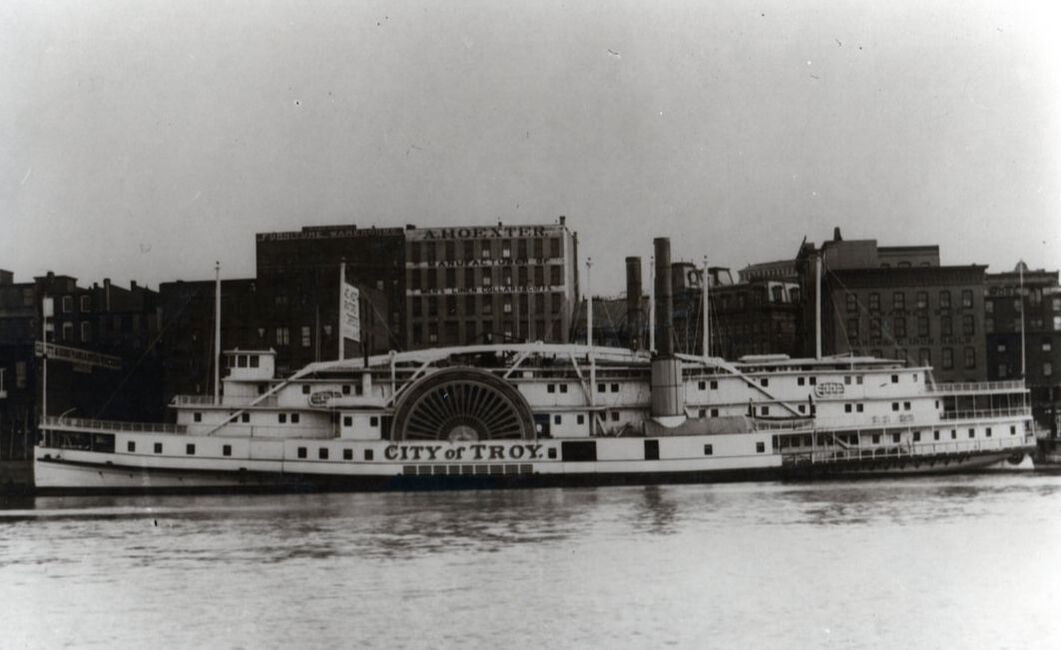 The passenger steamboat "City of Troy," at dock in Troy, NY sometime in 1906. Donald C. Ringwald Collection, Hudson River Maritime Museum. 'Splendid Conduct' Under remarks, the report states, "The Supervising Inspector of the 2nd District considers the conduct of the Captain, officers and crew of this trying occasion, so splendid, that he gives below further details in the hope that these examples may stimulate others to do as well. "The Captain. Charles H. Bruder, being told of the fire, went to the place where it appeared to be and found two streams already playing on the fire — and men cutting a hole in the deck above. He woke up the first pilot and told him to make a good dock at Dobbs Ferry. He then went back to the fire and had some cargo shifted, so they could cut another hole in the deck above it. "He approved the Engineer's suggestion to get out the gang plank while they could see. He approved the Purser's arrangements for calling the passengers and having them ready to land when he gave the word. Last to Leave "While the passengers were being landed the Captain was fighting the fire forward. He was the last man to leave the forward end of the boat. "The first pilot, William Van Woert, being called by the Captain, went to the pilot house and headed the steamer, then off the Palisades, for the east shore. He conferred with the second pilot, Mr. Bundy, and decided to make Gould's Dock, because there are no buildings there to which the fire might spread. "The pilots and quartermaster fought the fire for-ward after the steamer was made fast, until they were ordered ashore. They had then to climb down outside and walk ashore on one of the mooring hawsers by the aid of a line thrown to them. "The Chief Engineer, W. R. Fairbrother, when the fire was reported and he was told that the mate had one stream already going, gave additional steam to both pumps, and in five minutes there were three streams. Shortly afterwards there were seven streams at work. Outside Line of Duty "While he does not mention it, the Captain acted on Mr. Fairbrother's suggestion about the gang plank, and other officers testify to his rendering valuable assistance outside of his regular duty. The Purser, Charles G. Ambler, when notified of the fire, saw that the fire extinguishers were being properly used, and then went about among the passengers quieting them. "When the boat was made fast, he took his passenger list and went to each room telling the passengers to dress and get ready to go ashore with their baggage. "He then reported to the Captain, who told him to wait orders before having the passengers landed. He then made a second round of the rooms. All Passengers Ashore "When the gang plank was ready, lights were placed all along to the dock, and the Purser and freight clerk, Mr Greenman, assisted the passengers ashore. "Afterwards, Mr. Ambler went all around aft calling "All ashore," got his way bill from his office and, with the steward and three porters who were assisting him, started to go ashore. The smoke was too thick and they got out a small boat and rowed ashore, taking with them a passenger who had not heard the last call. "The testimony of the mate, Mr. Egnor, was not taken, but the Captain says the mate had two streams of water playing on the fire by the time he got there and men cutting a hole in the deck. "All testimony shows that he put his men at work immediately and maintained good discipline. His efficiency is demonstrated by the work done. Copies Were Sent "A copy of this bulletin will be sent to the Hon. Oscar S. Straus, Secretary of Commerce and Labor, and to the Supervising Inspector-General, as well as to the Associations of the Masters, Mates and Pilots and Marine Engineers in Albany-and New York." Bulletin No. 56, as the report was titled, was signed by Captain Ira Harris, Supervising Inspector, 2nd District. And so ended the career of the steamboat "City of Troy" on the Hudson River. 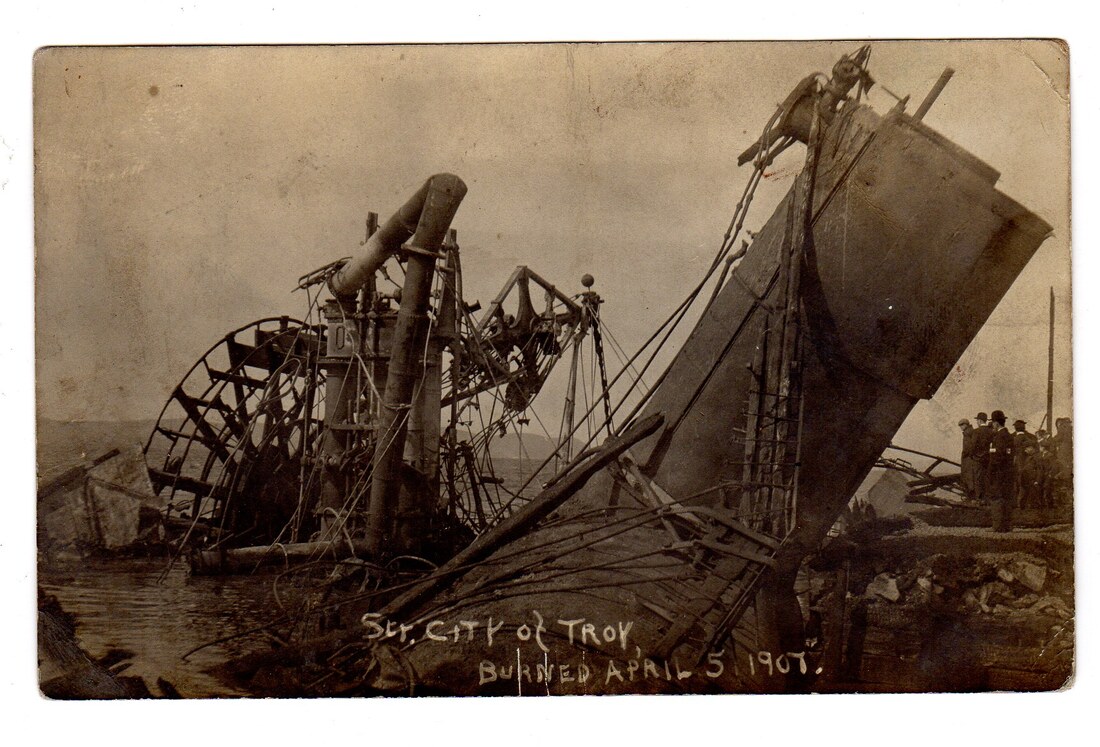 The burned wreck of the "City of Troy," burned at Ardsville, NY (today Dobbs Ferry), April 5, 1907. Tracy I. Brooks Collection, Hudson River Maritime Museum. AuthorCaptain William Odell Benson was a life-long resident of Sleightsburgh, N.Y., where he was born on March 17, 1911, the son of the late Albert and Ida Olson Benson. He served as captain of Callanan Company tugs including Peter Callanan, and Callanan No. 1 and was an early member of the Hudson River Maritime Museum. He retained, and shared, lifelong memories of incidents and anecdotes along the Hudson River. If you enjoyed this post and would like to support more history blog content, please make a donation to the Hudson River Maritime Museum or become a member today!
Editor’s Note: The following text is a verbatim transcription of an article featuring stories by Captain William O. Benson (1911-1986). Beginning in 1971, Benson, a retired tugboat captain, reminisced about his 40 years on the Hudson River in a regular column for the Kingston (NY) Freeman’s Sunday Tempo magazine. Captain Benson's articles were compiled and transcribed by HRMM volunteer Carl Mayer. See more of Captain Benson’s articles here. This article was originally published November 10, 1974. 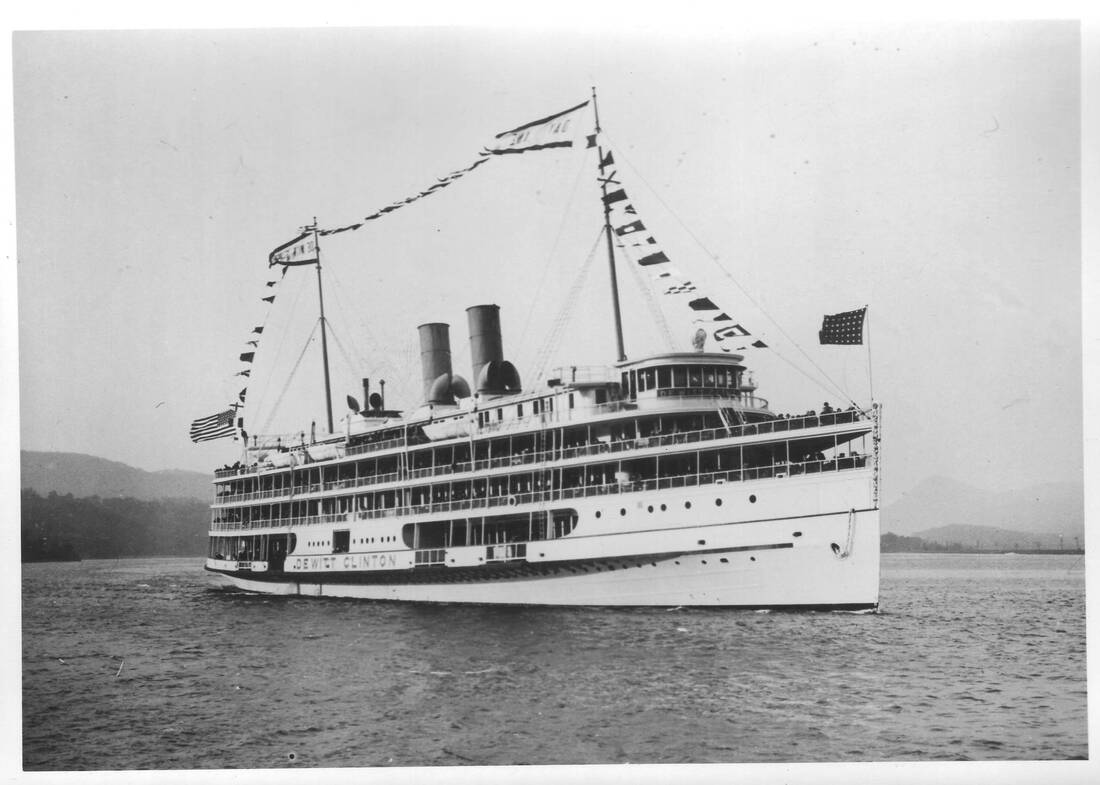 Hudson River Day Line Steamboat "DeWitt Clinton". Donald C. Ringwald Collection, Hudson River Maritime Museum “Steamboat racing was once a way of life ... when racing was banned due to accidents friendly ‘goes’ became popular.” Back in the 19th century, steamboat racing was a way of life. After a number of accidents traced directly to racing as the cause, steamboat racing was prohibited. This, however, didn’t prevent latter day steamboats from time to time having a friendly "go" if the conditions were right. One such incident took place in June 1922 between the "DeWitt Clinton” of the Hudson River Day Line and the “Benjamin B. Odell" of the Central Hudson Line. The story of the “race” was related by Lester “Happy” Diehl who was then the 1st Assistant Engineer of the "Odell.” At the time, I was coming across Rondout Creek on the "Skillypot" with my brother Algot who was home for a few days from his job as Chief Mate on the steamer “Onteora." We had gone to Rondout to get a copy of the old New York World, the newspaper my father always liked to read. "Happy" was also a passenger on the "Skillypot" and, on seeing my brother, said "Hey, Algot, you ought to see what we did to the "DeWitt Clinton" coming up on Sunday." As he told the story, I was all ears. It had been a beautiful summer’s Sunday. As boatmen used to say, both boats were crowded to the guards. The "Odell" was a soft coal burner in those days and the “Clinton" burned hard coal to make her steam. As the “DeWitt Clinton” was leaving her pier at Yonkers, the “Odell" was just a little ahead. A south wind was blowing making the flags, while underway, hang limp from the flag poles. The black smoke from the “Odell” went straight up in the air, as did the blue smoke from the "DeWitt." The "Clinton" was about one length of open water astern of the "Odell." Sometimes her bow was only fifty feet off the "Odell's" stern. But try as she would, she couldn’t get out of the "Odell's" back swell. Up the river they went, both dragging deep in the shallow waters of Tappan Zee and Haverstraw Bay. The only slow down for each steamer was, when passing a Cornell tow, and in those days there were plenty going up and down. At that time the "DeWitt Clinton" in her second year on the river was a very hard boat to keep steam on with hard coal. On the other hand, the "Odell" was always ready to blow off steam. Nevertheless, like a dog chasing a cat the two steamboats sped up the Hudson. Passengers on both steamers got into the spirit of the occasion, cheering their boat on when one or the other would gain slightly. At times, a slight shift in the wind would cause cinders from one to drop on the other. A fellow later told me he had stood on the dock at Haverstraw when they went by. How the Cornell tugs “Engels” and “H. D. Mould,” that were tied up there over Sunday, rocked and pulled on their lines from the drag of both these big steamers racing up through the bay. Some of the brick scows that were at the brick yards were only half loaded, otherwise he said they would have swamped. When arriving at Bear Mountain, the "DeWitt Clinton" had to temporarily give up as she had the landing to make. The "Benjamin B. Odell”, however, had a landing to make at Highland Falls. When the "Odell" was leaving Highland Falls, the “Clinton" was already underway and coming up fast. By the time the "Odell" was up to speed, she as a scant length in front of her adversary. Captain Greenwood of the "Odell" gave his engineer of the watch, "Happy" Diehl, the extra hook up signal to get around West Point and Magazine Point ahead of the Day Liner. Of course, when they got off the Military Academy both steamers had to slow down to get around West Point. By pure chance, the pilots of both steamboats blew their whistles at the same instant — the one prolonged blast required by the rules of the road when approaching a sharp bend in the river. Both boats had beautiful sounding steam whistles. How that pleasant sound must have pealed up through those old Highlands on that long ago day. As the two steamers came up to Little Stony Point north of Cold Spring, there was a Cornell tow on the way down in charge of the tugboat “Edwin H. Mead" with her helper tug the "R. G. Townsend." When they passed the tow, both steamboats had to go dead slow, it was such a big tow. The "Odell" passed to the west of the tow and the "Clinton" to the east. The "Odell" slowed a little more than the "Clinton," so by the time they were clear of the tow the two foes were neck and neck up through Cornwall Bay. Both steamboats were scheduled to make landings at Newburgh and off New Windsor both began to slow down. As they did, both steamers started to blow off steam since the engineers on both the "Clinton" and “Odell” had their steam pressures at the upper limits. What a racket that must have made over Newburgh Bay and the streets of Newburgh. When the “Benjamin B. Odell" landed at Newburgh, Mr. Herbert R. Odell, General Manager of the Central Hudson Line, was on the dock and came aboard. He asked Captain Greenwood not to do that again. When he gave his admonition, however, Mr. Odell did so with a smile on his face. Years later I was talking to Jim Malia of the Cornell tug "R. G. Townsend" and asked him if he had been on the "Townsend" at that time. He said he was and remembered the incident well, as the “Clinton” did not slow down enough when passing on the port side in the tow and had done some damage to a canal boat in the tow owned by his uncle. Some chocks had been pulled out and other minor damage. Actually the “race" between the "DeWitt Clinton" and the “Benjamin B. Odell” from Yonkers to Newburgh had been pretty much of a draw, a brush between two evenly matched steamboats. The following winter, allegedly because of her reputation as a hard steamer, the "DeWitt Clinton" was converted from coal firing to oil burning, the first Day Liner to be so converted. After that, the single screw “Odell" with her 2,500 h.p. engine was no longer a match for the "Clinton" with her twin screws and 4,000 h.p. 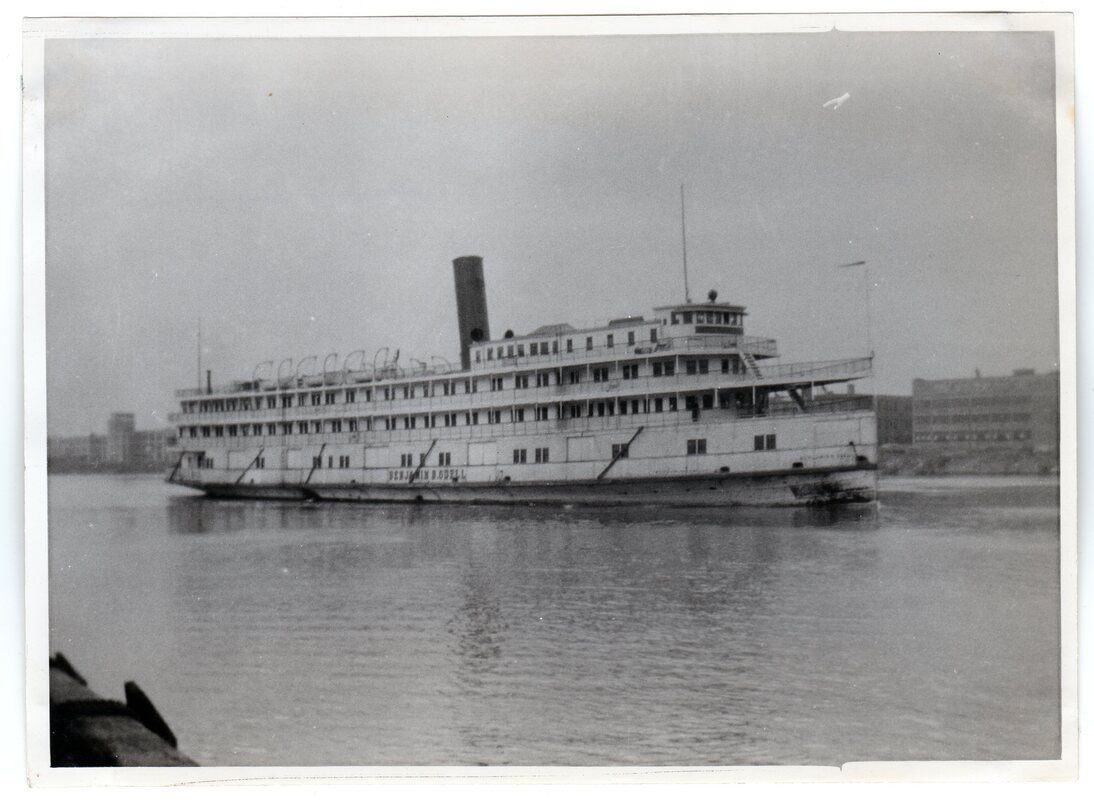 The "Benjamin B. Odell" of the Central Hudson Line arriving Albany, NY, September 1932. Tracy I. Brooks Collection, Hudson River Maritime Museum AuthorCaptain William Odell Benson was a life-long resident of Sleightsburgh, N.Y., where he was born on March 17, 1911, the son of the late Albert and Ida Olson Benson. He served as captain of Callanan Company tugs including Peter Callanan, and Callanan No. 1 and was an early member of the Hudson River Maritime Museum. He retained, and shared, lifelong memories of incidents and anecdotes along the Hudson River. If you enjoyed this post and would like to support more history blog content, please make a donation to the Hudson River Maritime Museum or become a member today!
Editor’s Note: The following text is a verbatim transcription of an article featuring stories by Captain William O. Benson (1911-1986). Beginning in 1971, Benson, a retired tugboat captain, reminisced about his 40 years on the Hudson River in a regular column for the Kingston (NY) Freeman’s Sunday Tempo magazine. Captain Benson's articles were compiled and transcribed by HRMM volunteer Carl Mayer. See more of Captain Benson’s articles here. This article was originally published March 25, 1973. 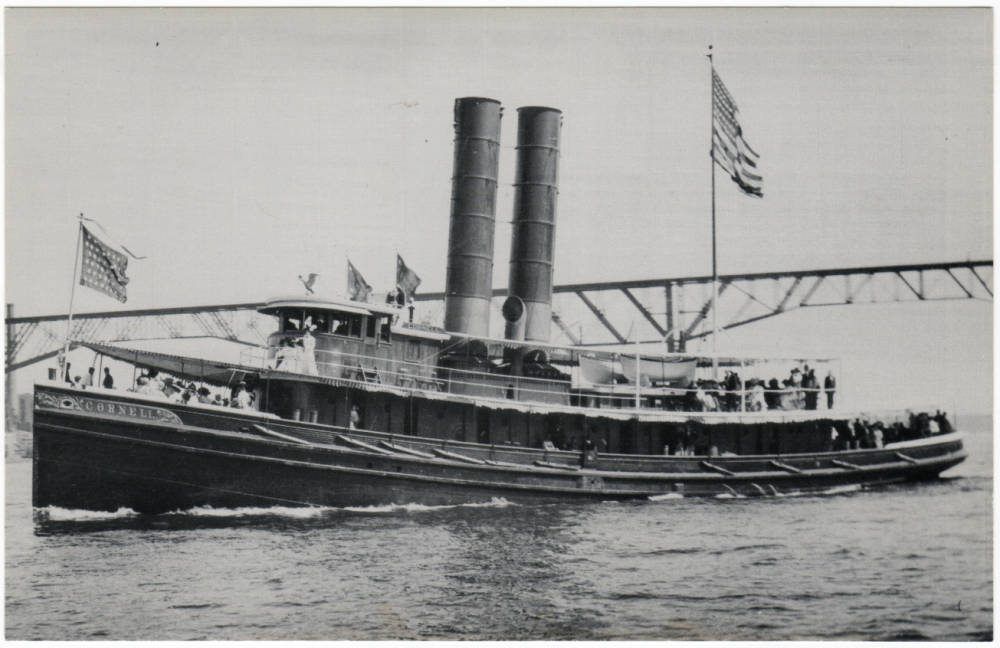 The tugboat "Cornell" on an excursion on the Hudson River, Poughkeepsie Railroad Bridge in the background. Hudson River Maritime Museum Collections. As the 19th century gave way to the 20th century, the Cornell Steamboat Company of Rondout was the largest and most progressive marine towing organization in the country. In 1902 they had built what was to be their largest and most powerful tugboat. When completed, it appropriately bore the name “Cornell.” By whatever standard of measurement, the “Cornell” was a most impressive tugboat. At a few inches less than 150 feet in length, she was 25 feet longer than any of Cornell’s other big tugboats. Her 1,400 h.p. engine exceeded by over 500 the horsepower of other units of the fleet. Boatmen used to refer to her as the "Big Cornell" and her two big boilers had a ravenous appetite for coal to make enough steam for her powerful engine. As a result, she had the reputation of being a very hard boat to fire. Many boatmen from Hudson River towns one would talk to in the early 1920’s would almost always say how at one time or another they had fired on the “Big Cornell.” Some would stay only a few hours, some a few days and rarely would she end the season with a fireman who had started out on her in the spring. On Lower River Because of her size and deep draft, she was used almost exclusively on the lower river. During her service on the Hudson, the channel north of Athens had not been dredged for deep draft vessels like it is today. During her career, the “Cornell” made only one trip to Albany and this trip was her most notable exploit while carrying the colors of the Cornell Steamboat Company. It took place in early March, 1910. The winter of 1910 had been an old fashioned winter with plenty of ice in the river. During late February and early March the weather turned unseasonably warm, causing high water at Albany as the result of the melting of the winter’s snow and ice in the Mohawk River. A huge ice jam formed in the river below Albany which caused the water to back up and flood the waterfront areas of Albany and Rensselaer. Fears were also expressed that the ice crowding the Albany railroad bridges might move them off their abutments. In order to relieve the ice and flood crisis at Albany, the federal government was asked to take action. The government's plan was to use dynamite on the ice jam to break it up and to charter the most powerful vessel they could find to go up river to break up the river ice so the broken ice could move down river. The “Big Cornell” was chosen for the job. The “Cornell" left Rondout Creek on March 3, 1910 with the tug “Rob" to follow and assist in any way possible. I have been told the whole operation was in charge of Captain Ulster Davis, Cornell’s agent at Rensselaer, and the regular crew of the “Cornell” whose captain was Tim Donovan and pilot Irving Hayes. Although the upper Hudson was at flood stage, the “Cornell” carried minimum amounts of coal and water in order to keep her draft at a minimum so she would have clearance over the shallow spots north of Athens. 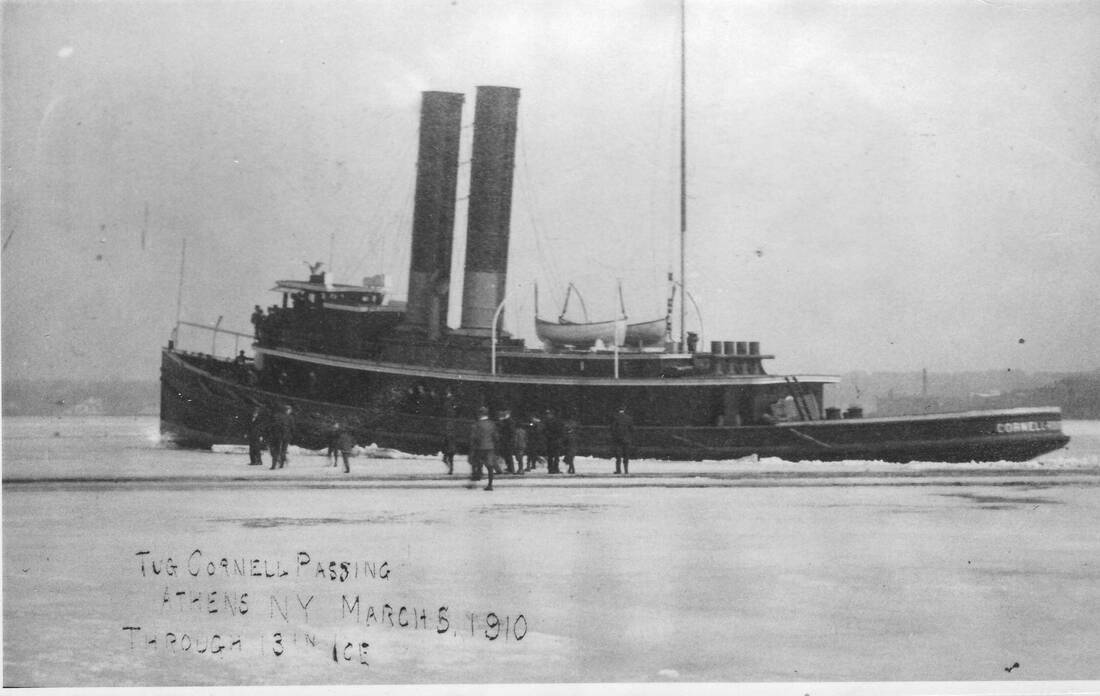 Tug "Cornell" passing Athens, NY, March 5, 1910, through 13 inches ice. Hudson River Maritime Museum Collection. Very Heavy Ice The “Cornell” encountered very heavy ice from Kingston to Athens, sometimes as much as two feet in thickness. The ice was so heavy, the “Cornell’s” steel hull plating was scalloped inward between her frames at the water line forward caused by her smash into the rock-like ice. At Athens, the "Cornell” went up the wider Athens channel rather than the deeper Hudson channel along the east shore, since men going ahead on foot had determined the ice in the west channel wasn’t quite as thick. She passed Athens through 15 inches of ice on March 5. All along the river, men and boys would come out on the ice to watch the “Cornell” go by. The “Cornell” arrived at Rensselaer on March 6, the river opened and the ice jam broken. Once the ice jam was broken, I have been told one could literally see the water begin to drop at Albany. Although the crisis to Albany was over, a new problem arose for the “Cornell.” The Company was afraid the water might drop so fast, they would not be able to get their big tug back down river in time to clear the up river sand bars and ledges. An Early Start The “Cornell” took on coal, fresh water and grub at Rensselaer as fast as she could. Due to the strong current in the river, when they started to turn the "Cornell” around for her return trip, the tug “Rob” had to push wide open against her stern in order to get the “Cornell” headed down stream. At first, they were going to wait for daylight all the way, but because of the falling water decided to start down as soon as possible. When they started back for Rondout, I have been told it was a clear, cold March night. The water in the river was running down stream so fast, they ran the “Cornell's” engine dead slow — just enough to keep steerage way. They were reluctant to run her any faster as they did not want to scrape or hit bottom and possibly smash her rudder shoe or break her propeller. They had had such good luck so far, they didn't want to tempt fate any more than necessary. Everything went fine until the two tugs came to Dover Platte Island off Coxsackie. Captain Donovan of the ‘'Cornell’’ knew there had always been a sand bar there and figured the freshet in all probability might have built up the bar higher than usual. When they reached that point, they stopped the “Cornell's” engine and just let her drift. Sure enough she fetched up on the bar, stopped and rolled over very slightly to port. To be sure there was only sand, they sounded all around with pike poles. Over the Bar Once they were certain there were no rocks on the bottom, they decided to have the “Rob” go up ahead and put a hawser on the “Cornell's” bow — and then to open up both tugs full throttle and to try and “bull” the ‘‘Cornell’’ over the bar. When all was in readiness, the “Cornell” gave the signal for full speed ahead and for the “Rob” to start pulling. I can readily imagine on that cold March night the load “chow chow” of the “Rob's” high pressure engine. They tell me when the “Cornell’’ hooked up, she lay down on her port side, her propeller part out of the water for a few moments. Some of her crew thought her towering smoke stacks would topple over, the starboard guy lines being incredibly taut and the port ones having about two feet of slack. However, in but a few minutes the ‘‘Cornell’’ had inched her way over the bar. Once she cleared the sand bar, though, the ‘‘Cornell’’ leaped ahead so fast before they could stop her engine she almost ran over the “Rob’’ pulling on her bow. Quick action by a deckhand on the “Rob” saved the day. By wielding a fast, sharp axe he cut the connecting hawser. From that point back to Rondout Creek they encountered no more difficulties. From Athens south, the river ice still held, but by following the channel they had previously made going northward the going was relatively easy. 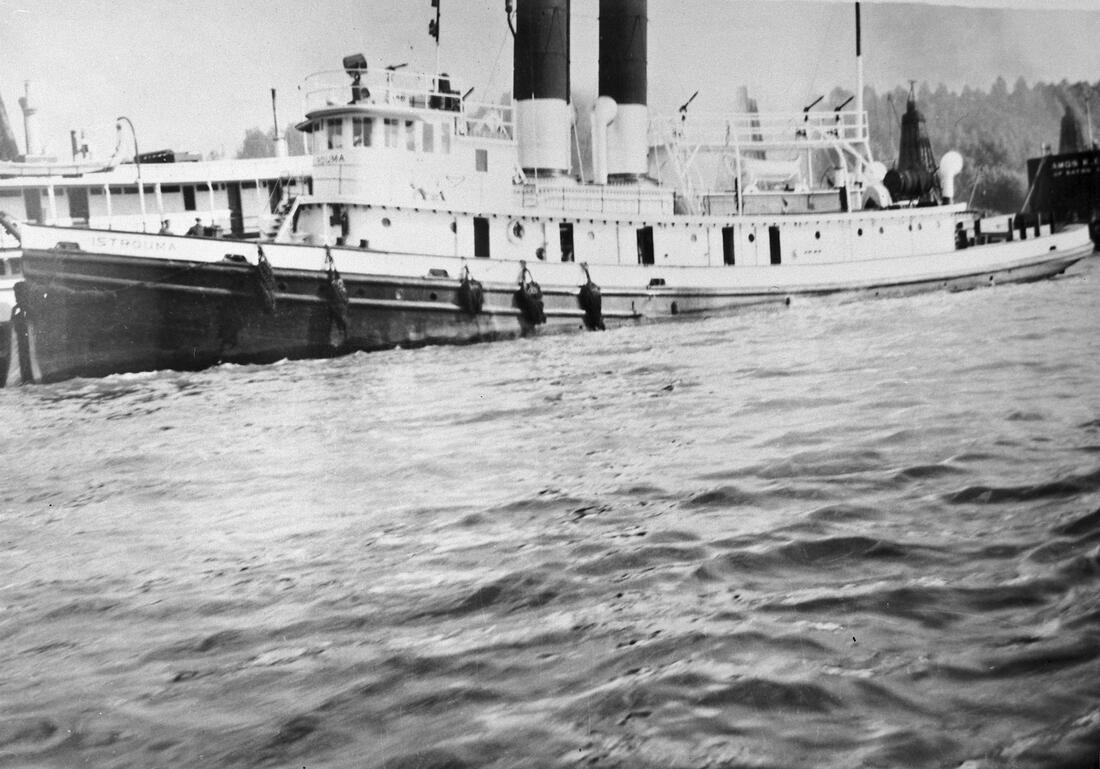 The "Istrouma," formerly the Hudson River tugboat "Cornell," used as a fireboat by Standard Oil Company. University of Wisconsin-La Cross Historic Steamboat Photographs Collection. Renamed Her The difficulty in keeping firemen on the “Cornell” continued to plague her and led to the end of her career on the Hudson River. Shortly before World War I she was sold to the Standard Oil Company of Louisiana. Her new owners renamed her “Istrouma,” converted her to an oil burner, and operated her on the Mississippi River out of Baton Rouge where she remained in service until the late 1940's. I have been told the Cornell Steamboat Company always maintained it was not feasible to convert the “Cornell” to an oil burner, since it wouldn't be possible to install sufficient oil storage capacity aboard her. It is my understanding before purchasing her, the Standard Oil people, unknown to Cornell, sent some men to Cornell who hired out on her as firemen. The masquerading firemen thoroughly examined the “Cornell” and apparently concluded she could successfully be converted to oil firing. In any event, she was — and remained in service for another 30 years. Many years later, during World War II, my friend Roger Mabie was the commanding officer of a submarine chaser in the U.S. Navy. One day his ship was in a shipyard at Algiers, Louisiana, across the river from New Orleans. There, in an adjacent dry dock was the “Istrouma,” the old “Cornell.” He went aboard. Her shell plating forward was still scalloped between frames from her bout with Hudson River ice in 1910. Her brass capstan caps were still inscribed “Cornell.” In her engine room, her steam and vacuum gauge faces still were etched ‘‘Cornell,” Cornell Steamboat Company, Rondout, N.Y. A few days later, Roger told me his ship was leaving New Orleans to go back to sea. Out in the river, the old ‘‘Cornell” was going upstream. He blew her a whistle salute, which the former “Cornell” answered with her old deep steam whistle. I thought it was a nice gesture, both a greeting to an old work horse from the Hudson River and a sort of salute to the maritime greatness that was once Rondout’s. 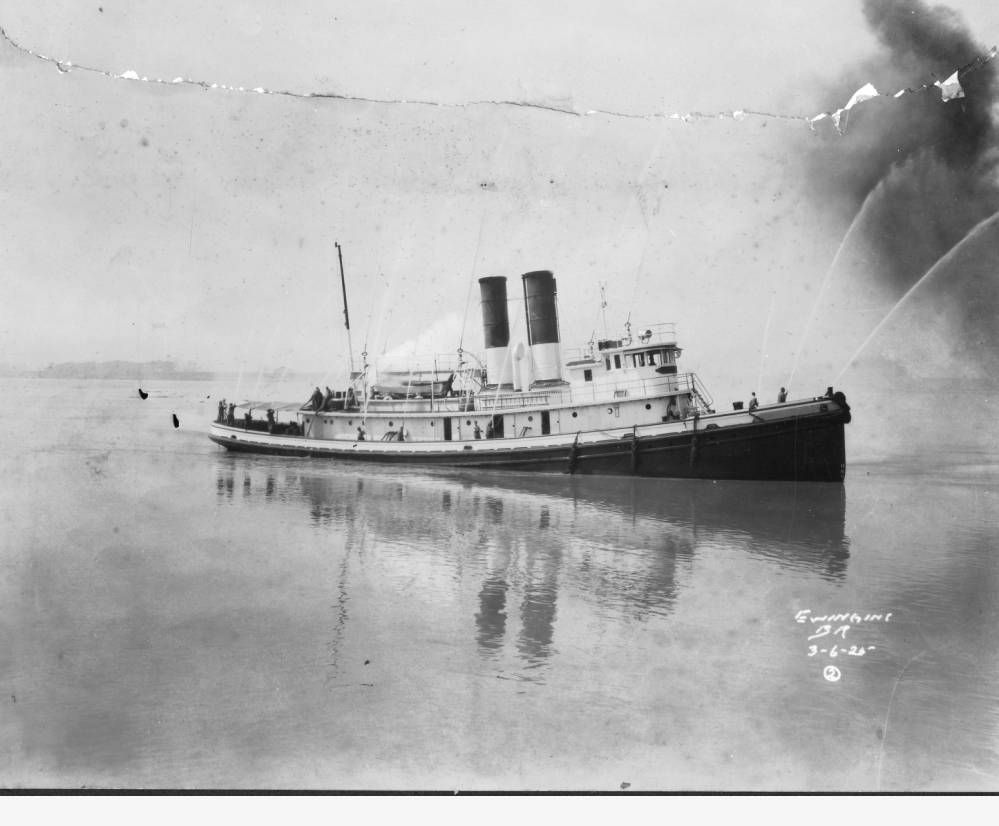 Undated photo of the tugboat "Istrouma," formerly the "Cornell," East Baton Rouge Library Collections. AuthorCaptain William Odell Benson was a life-long resident of Sleightsburgh, N.Y., where he was born on March 17, 1911, the son of the late Albert and Ida Olson Benson. He served as captain of Callanan Company tugs including Peter Callanan, and Callanan No. 1 and was an early member of the Hudson River Maritime Museum. He retained, and shared, lifelong memories of incidents and anecdotes along the Hudson River. The tug/fireboat "Istrouma" was scrapped in 1949. If you've seen a large red tugboat named "Cornell" on the Hudson River or New York Harbor, it's not the same as this "Cornell," but nearly as big! She was built the same year the "Istrouma" was scrapped. Learn more.
If you enjoyed this post and would like to support more history blog content, please make a donation to the Hudson River Maritime Museum or become a member today! Editor’s Note: The following text is a verbatim transcription of an article featuring stories by Captain William O. Benson (1911-1986). Beginning in 1971, Benson, a retired tugboat captain, reminisced about his 40 years on the Hudson River in a regular column for the Kingston (NY) Freeman’s Sunday Tempo magazine. Captain Benson's articles were compiled and transcribed by HRMM volunteer Carl Mayer. See more of Captain Benson’s articles here. This article was originally published February 27, 1972. 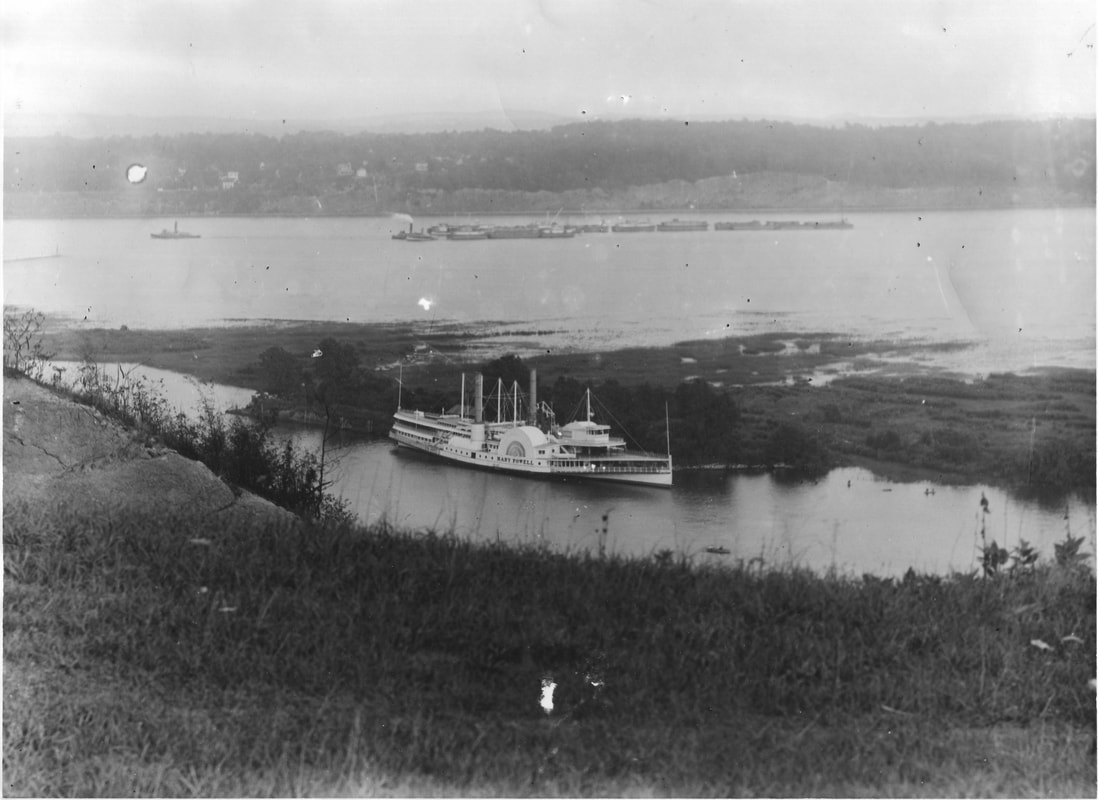 Undated photo of the "Mary Powell" at Sunflower Dock. Photo taken from Hasbrouck Park area, note the tugboats with the long string of barges on the Hudson in the background. Donald C. Ringwald Collection, Hudson River Maritime Museum. During the winter of 1920, both the “Mary Powell” and the “Albany” lay at the Sunflower Dock on Rondout at Sleightsburgh. The “Mary Powell” had been there since her last trip under her own power on Sept. 5, 1917. On Saturday, shortly before the ice went out of the creek, my brother Algot and I took my father’s lunch over to him on the “Albany” where he was working as a ship’s carpenter. Rumor was that just as soon as the ice broke up, the “Powell” would be towed to South Rondout to be broken up. Knowing this, my brother said, “Come on Bill, let’s take a walk over on the ‘Powell.’ It will probably be the last we ever be on her.” 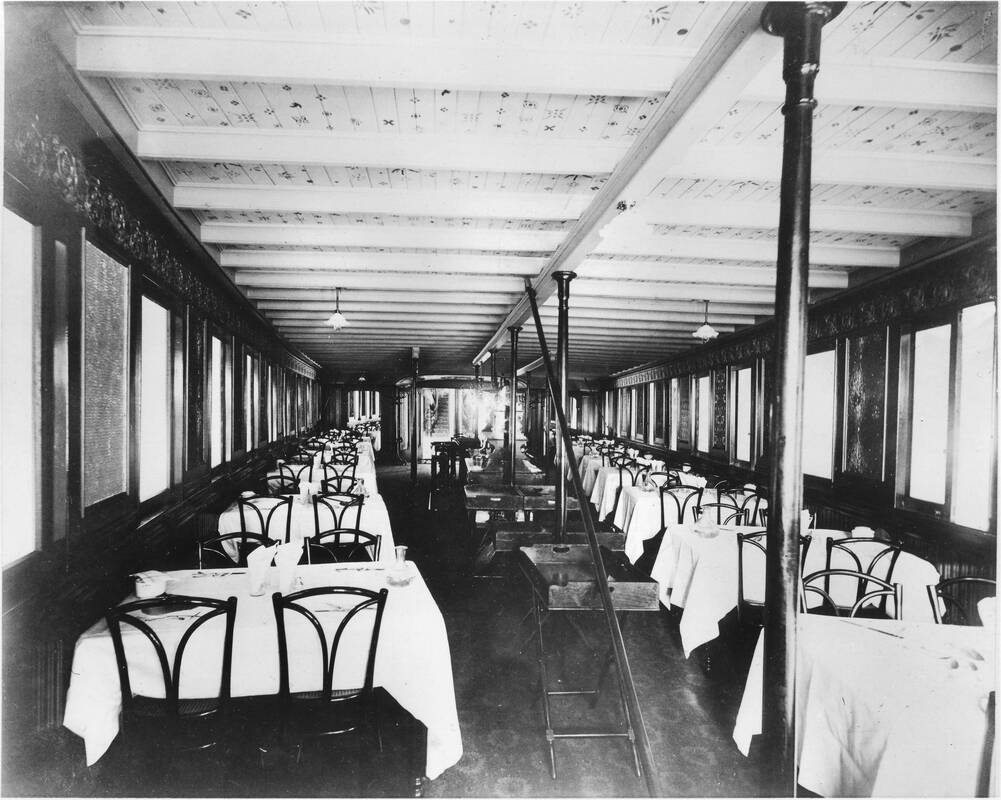 Photograph of the interior of the "Mary Powell" dining room. Donald C. Ringwald Collection, Hudson River Maritime Museum. Cold and Dark We went aboard the gangway right aft of the engine room. All her fine machinery was black from the grease that had been put on the engine when she layed up so it would not rust. All steamboat engineers always coated the bright work with grease in this manner when their boat was laid up at the end of the season. Everything was cold and dark and still. When we went back to the dining room at the rear of the main deck. Most of the tables and chairs had already been removed. Everything was very dusty. Up on the saloon deck, most of the carpeting had been taken up, with a few pieces remaining here and there. A few of the big easy chairs in the saloon where still there but most were gone. Some of the plate glass windows were cracked, and others broken - with canvas tacked over the openings. When we went up on the hurricane deck, my brother had to use a screwdriver to pry open the door to the pilot house. It was jammed, probably due to the fact that the “Powell's” stern rested on the bottom at low tide. The east end of the dock had been filling in and hadn’t been dredged since the “Powell” stopped running. 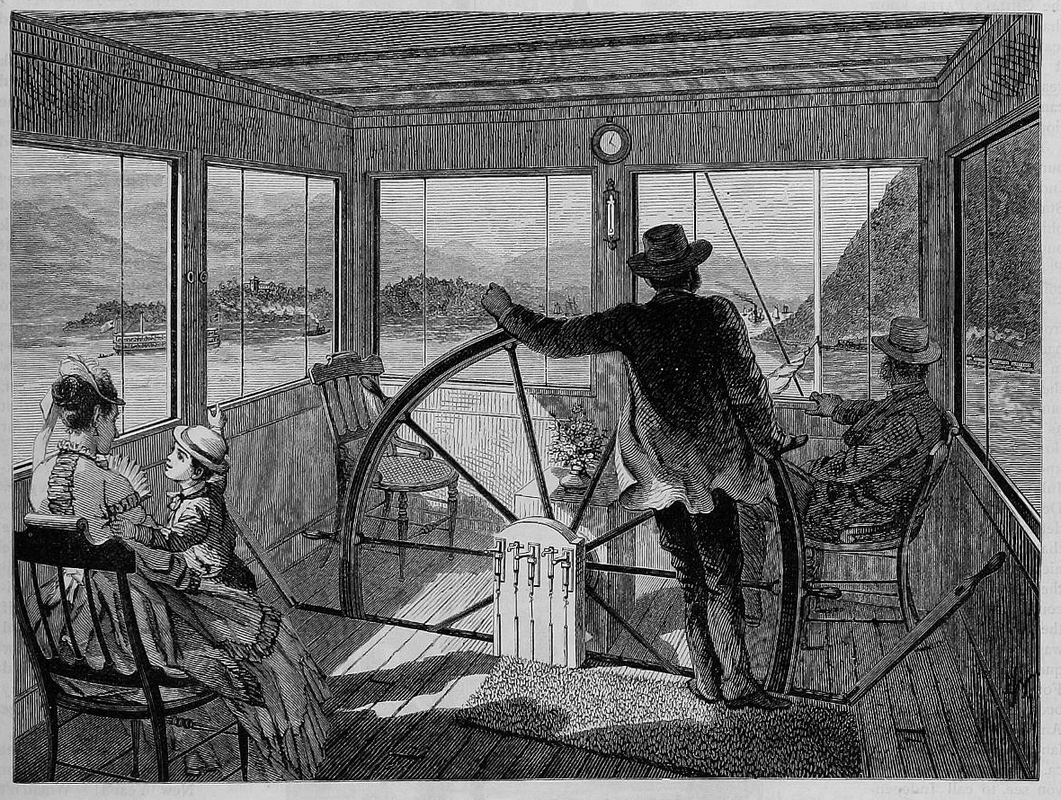 Illustration of the "Mary Powell" pilot house, with captain, pilot wheel, and visiting passengers. Published in "The Child's Paper," 1876. An Old Time Table In the pilot house, there was a long, low locker across the back. The top of the locker could be raised so that things like flags, pennants and pilot house supplies could be put inside. I found an old Catskill Evening Line time table, with a picture of the steamer “Clermont” on the cover, which I took with me. There were no chairs, since these had already been removed. The old side curtains on the pilot house windows were still in place. They would be pulled down on the side the sun would leaving Rondout on her flying trip to the metropolis to the south, or when the sun was going down behind the western hills on the up trip. The canvas that had covered her pilot house windows from the strong icy winds and snows, had been removed. The interior of the “Powell’s” pilot house was all varnished and it has turned very dark from the passing years and added coats of varnish. The big, hand steering wheel was only about half showing, most of the bottom half being concealed in a well in the deck. The top reached almost to the overhead of the pilot house. I noticed how the round turned spokes of the steering wheel were flattened out on both sides near the rim. I asked my brother what caused this. He said it came from the wear on the spokes caused by the pilot climbing the wheel like a ladder in order to turn the boat in a hurry. The old “Powell” never had a steam steering gear like the more modern steamboats. He Walked the Wheel “The pilot of the ‘Powell’ would have to climb the wheel coming into the Rondout Creek from the river on a flood tide,” Algot said. “When it is flood tide, there’s a very strong eddy at the mouth of the creek. The tide sets up strong and when it hits the south dike, it forms a half moon about 75 feet out from the south dike and then starts to set down. To keep steerage way on the ‘Powell’ the had to keep her hooked up until she entered the creek, because a side wheeler running slow or just drifting would have no rudder power. So the pilot in order to get the rudder hard over to port or starboard in a hurry would have to walk right up the steering wheel.” Algot, who had been quartermaster on the “Mary Powell” in her last years, pointed out that when the pilot got the steering wheel hard over he would then put the becket on the wheel to hold it. When the becket was taken off, the wheel would spin right back to midships. He added with a smile, “At times like that, the fatter and heavier the pilot, the easier the job.” Algot went on to point out to me the same act of walking up the steering wheel would take place on going around West Point and Anthony’s Nose and rounding up in New York harbor. In those long ago days when going down through the harbor on an ebb tide, a pilot had to get around very quick and find a hole in the heavy steamboat, tugboat, ferryboat and steamship traffic. On a steamboat like the “Mary Powell” with a hand steering gear, when going up or down through New York harbor, the pilot house was always fully manned. The captain or first pilot would be at the steering wheel, the second pilot standing with his hands on the bell pulls to the engine room or ready to grab the whistle cord, and the quartermaster as lookout on the forepeak. 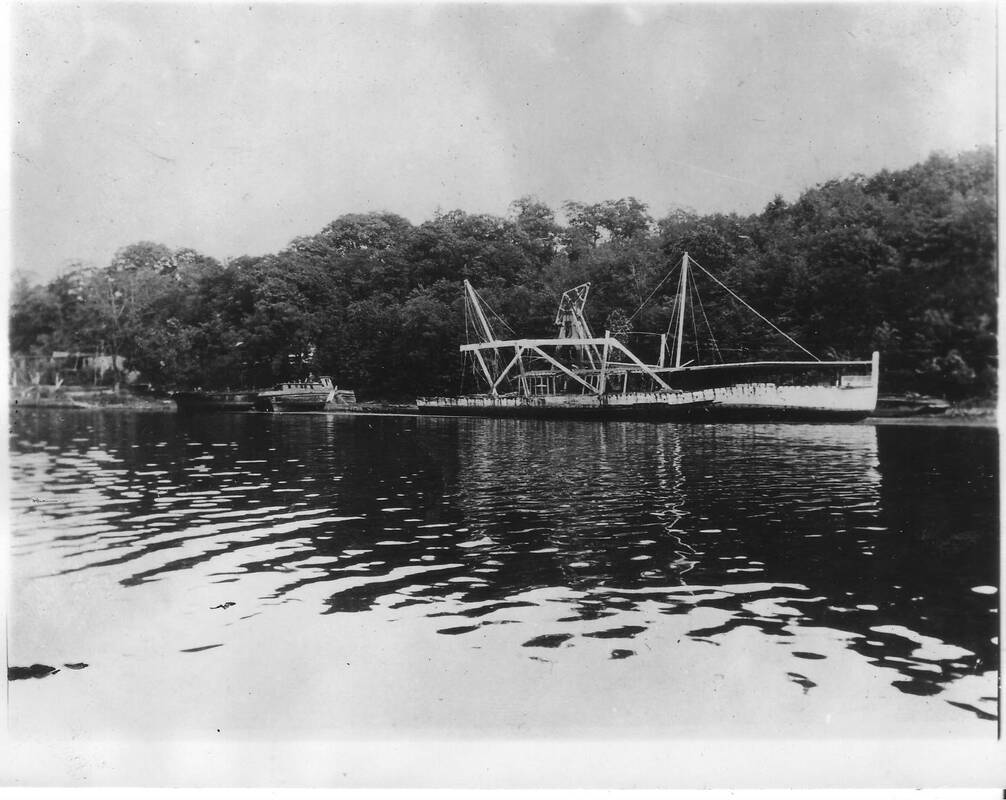 The mostly dismantled "Mary Powell" at Connelly, c. 1925. Her walking beam engine and the forward hogging trusses are still visible, but the pilot house and upper decks have been removed, and nearly the entire back half of the vessel is gone to the waterline. Donald C. Ringwald Collection, Hudson River Maritime Museum. Leaving Their Marks Later in life when I saw the hand steering wheels of the “Jacob H. Tremper” and the steamer “Newburgh” of the Central Hudson Line, the spokes were all worn down and loose the same way. It showed how former pilots and captains left their marks on their steamboats long after they were gone. We left the old Queen of the Hudson after out farewell visit in the bright sunshine of the late winter afternoon. On April 20, she was towed by the tug “Rob” on her final trip to South Rondout where she was dismantled. AuthorCaptain William Odell Benson was a life-long resident of Sleightsburgh, N.Y., where he was born on March 17, 1911, the son of the late Albert and Ida Olson Benson. He served as captain of Callanan Company tugs including Peter Callanan, and Callanan No. 1 and was an early member of the Hudson River Maritime Museum. He retained, and shared, lifelong memories of incidents and anecdotes along the Hudson River. If you enjoyed this post and would like to support more history blog content, please make a donation to the Hudson River Maritime Museum or become a member today!
|
AuthorThis blog is written by Hudson River Maritime Museum staff, volunteers and guest contributors. Archives
May 2024
Categories
All
|
 RSS Feed