History Blog
|
|

 Giving Tuesday is coming up next week, so for today's Media Monday post, we thought we would share our newly released trailer for the forthcoming film, "Seven Sentinels: Lighthouses of the Hudson River!" After a summer of recording footage and interviews for all of the seven remaining Hudson River lighthouses, we're going to spend the winter reviewing footage, editing, and starting to put together the film, with a planned release date of July, 2022. We are so excited for this project, but we can't do it without your help. For that reason, we've launched a crowdfunding campaign in hopes that those of you who love lighthouses as much as we do will help us tell their stories. Watch the trailer below for a taste of what's to come! Our crowdfunding campaign runs for the next two months. In that time, you'll be seeing more lighthouse content here on the blog as we share some of our coolest finds. Keep your eyes peeled for another sneak peak trailer, too! If you'd like to donate, we have some great perks. Click the button below and help us reach our goal of making it to the $5,000 mark by Thanksgiving! If you or your business would like to become a sponsor of the films or other film projects, please contact Sarah Wassberg Johnson at swassberg@hrmm.org. We're also doing a daily countdown to Giving Tuesday starting tomorrow on our Facebook page and Instagram account. Click the links and follow us to make sure you don't miss the updates. We'll leave you with a few behind-the-scenes photos from some of our trips this past summer. Thanks for your support!
0 Comments
2021 is the 100th anniversary of the Jeffrey's Hook Lighthouse installation, but a pair of lanterns on a tall pole (often called post lights) were the first aid to navigation at Jeffrey's Hook, which is a rocky outcropping at the base of Washington Heights and dangerously close to the shipping channel. Installed in 1889, the lanterns shone red to warn mariners away from the hook. Very few records of the keepers of the post light, and even the lighthouse itself, remain. However, when doing research for the upcoming lighthouse film, we ran across this intriguing pair of newspaper articles from 1891 featuring keeper Patrick Roach and his family. The articles below were published in the New York Herald on November 26 and 27, 1891 and are reproduced here in their entirety, transcribed by Sarah Wassberg Johnson. 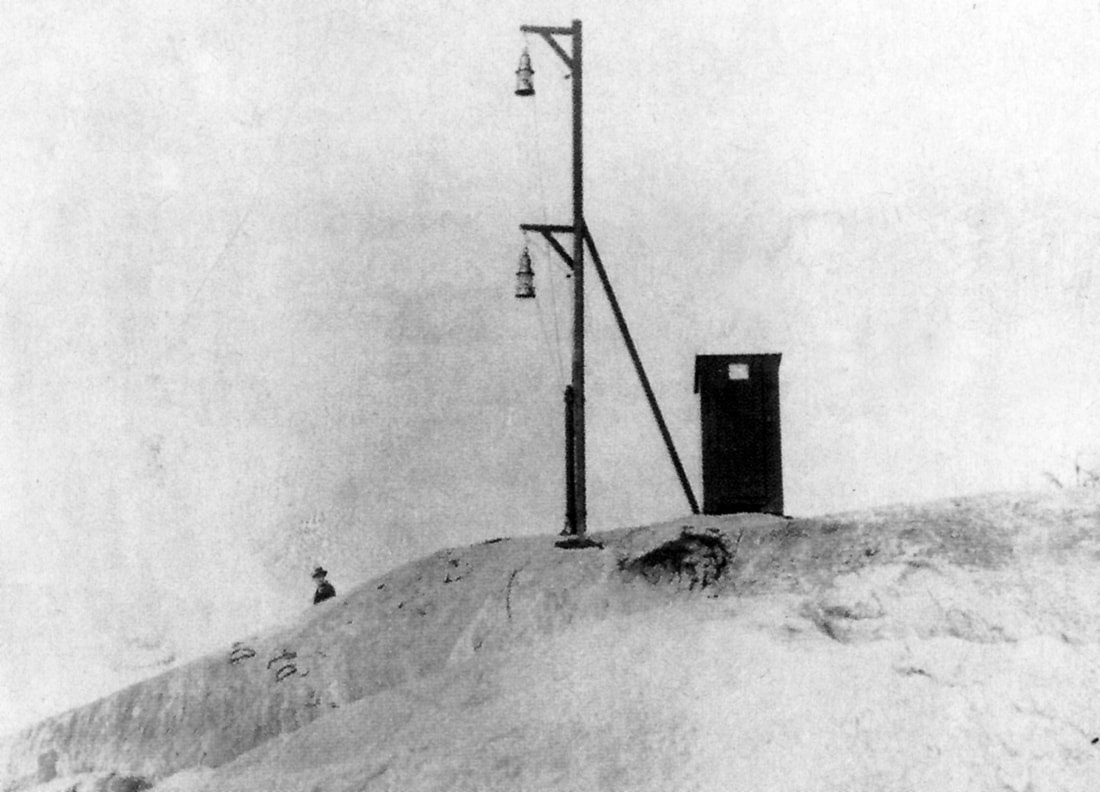 Post Light at Jeffrey's Hook, c. 1890. National Archives. “A Woman’s Leap From Fire: Husband and Daughter Dragged From Windows of the Burning Shanty” New York Herald, November 26, 1891 The family of Patrick Roach had a narrow escape last night from burning to death. Their home in 175th street, near Kingsbridge avenue, was set on fire, it is supposed, by young ruffians of the neighborhood who bore them a grudge. The house, a two story frame shanty, stood on a rock twenty feet high, just back from the street. Roach is keeper in Jeffrey’s Hook Lighthouse and he lived in the shanty with his wife, Bridget, and Mary, his nineteen-year-old daughter. The family spent last evening preparing for their Thanksgiving dinner. Roach left the kitchen early, and went to a room adjoining to lie down. A little later Mrs. Roach went upstairs to go to bed, and Mary was left alone. FLAMES ALL AROUND THE GIRL She sat in the corner of the kitchen reading by the light of a lamp on the table. Presently she heard a low rumbling sound in the opposite corner of the room and saw a flame shoot up from the floor. Other flames shot up all around her, and the terrified girl ran to the door leading up stairs and shouted to her mother that the house was afire. Then Mary, in an effort to get out, began to dodge the flames that were fast filling the room, Suddenly the window was thrown open and a man put in his arm and lifted Mary out. By this time Roach had awakened and skipped into the glazing kitchen. The smoke and flames were nearly suffocating him when a man came to his rescue and dragged him out of the window. Mrs. Roach tried to go down stairs, but the smoke drove her back. She went to the window. “Jump!” shouted the crowd that had gathered in the street. DO NOT KNOW THEIR RESCUER Out the window sprang Mrs. Roach and landed on the street thirty-five feet below, bruised and shocked, but with no bones broken. The fire burned up everything in the house and left very little of the house standing. Mary’s hands were badly burned and her father was burned on the hands, arms and legs. They refused to go to a hospital and sought shelter at a neighbor’s house. Neither knew the man who had rescued them, and he did not make his presence known after he got them safely out of the house. There may have been two rescuers for all Roach and his daughter knew. The Roaches told me that they had strong suspicions that the fire was started by a gang of young teamsters, known as the McDowell gang, who hang about the neighborhood, do mischief at night and play ball on Sunday. Sometimes their ball would be thrown into Roache’s [sic] house, and one day Mary kept it. The next day Mary was hit with a baseball thrown at her and she complained to the Washington Heights police, who stopped the ball playing. Since then the rowdies have talked of being recognized and the other night Mrs. Roach’s sister, while passing the gang, heard them say that they were going to “get even” with “Paddy” Roach. No arrests were made last night. “This Fire Still a Mystery” New York Herald, November 27, 1891 The Roach family, whose two story shanty on the rocks in 175th street, near Kingsbridge road, was burned Thanksgiving eve, insist that the house was set on fire. The police of the Washington Heights police station pooh-pooh the idea and are making no investigation. Roach and his daughter believe that members of the McDonald gang set the shanty afire. The family have had trouble with the gang and Miss Roach says the young fellows have threatened several times to force them to leave the neighborhood. How the person or persons who dragged the members of the family out of the burning building happened to be on hand so soon after the fire broke out is a mystery if the rescuers were not the incendiaries. The Roaches were too much excited to recognize the rescuers. Roach is keeper of the Jeffrey’s Hook lighthouse at Fort Washington. Some government papers were destroyed in the fire. Roach and his daughter were painfully but not seriously burned. They are being cared for by relatives. If you enjoyed this post and would like to support more history blog content, please make a donation to the Hudson River Maritime Museum or become a member today!
Last week Hudson River Maritime Museum staff were at the Jeffrey's Hook Lighthouse filming for our upcoming documentary film on Hudson River Lighthouses. But did you know? Yesterday was the Little Red Lighthouse's 100th birthday! So to speak. October 10, 1921 was the first day the Jeffrey's Hook lighthouse was lit and put into service. Now part of Fort Washington Park in Manhattan and managed by the Historic House Trust and New York City Parks, the Jeffrey's Hook Lighthouse is affectionately known as the Little Red Lighthouse, after the famous children's book by Hildegarde Swift. To learn more about the history of the lighthouse, check out our short history video from the RiverWise series, and keep your eyes peeled for more information about our upcoming documentary film series! And if you've never read The Little Red Lighthouse and the Great Gray Bridge, you can pick up a copy from your local library, or read along with the classic recording and images below. If you enjoyed this post and would like to support more history blog content, please make a donation to the Hudson River Maritime Museum or become a member today!
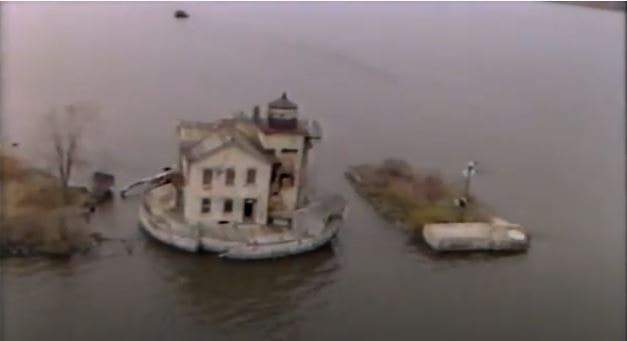 Aerial footage of the Saugerties Lighthouse before restoration. Still from "Hudson River Lighthouse" report from ABC News, c. 1980. When this ABC news special first aired in the 1980s, the few remaining Hudson River Lighthouses were in rough shape. Some, like the Saugerties lighthouse, were even in danger of collapsing. Thankfully, local governments and volunteer organizations stepped up to save them from total destruction. This video, hosted by ABC News reporter Roger Caras, features the Rondout Lighthouse and Hudson-Athens Lighthouse, with interviews with Elise Barry, who wrote the National Register nomination for all seven lighthouses, and Emily Brunner, daughter of Hudson-Athens keeper Emil Brunner. You can visit almost all the Hudson River Lighthouses today! For more information visit www.hudsonriverlighthouses.org. Tours of the Rondout and Esopus Meadows Lighthouses are available on our 100% solar-powered tour boat Solaris! Get tickets here. Do you have a favorite Hudson River lighthouse? Share in the comments! If you enjoyed this post and would like to support more history blog content, please make a donation to the Hudson River Maritime Museum or become a member today!
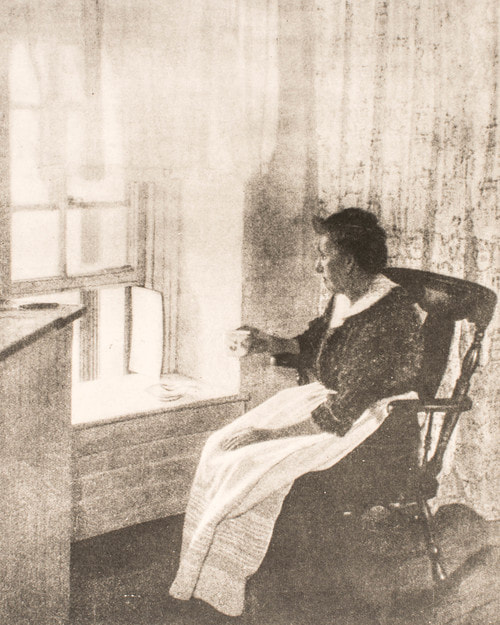 Kate at Robbins Reef - Photograph by Isaac Almstadt (1851-1921), c. 1900. Walker Family Collection, Noble Maritime Collection. Today's Media Monday is all about woman lighthouse keeper Kate Walker! Kate was the keeper at Robbins Reef Lighthouse from 1890 to 1919. Although she did not keep her lighthouse for as long as Catherine Murdock, Katherine Walker became just as famous. To learn more about Kate, check out this video by the U.S. Lighthouse Society's Historian. The Robbins Reef Lighthouse is currently owned by the Noble Maritime Collection in Staten Island. The Hudson River Maritime Museum is working on a documentary film about Hudson River Lighthouses, and Robbins Reef is one of them! You can help bring the museum's documentary film series to life by sponsoring or donating at www.hudsonriverwise.org/support. If you enjoyed this post and would like to support more history blog content, please make a donation to the Hudson River Maritime Museum or become a member today!
Today's Media Monday features a recent lecture at the Hudson River Maritime Museum - "Keepers of the Light: Women Lighthouse Keepers of the Hudson," given by Sarah Wassberg Johnson, Director of Exhibits & Outreach at the museum. For upcoming lectures, visit our Lecture Series page! If you'd like to learn more about Hudson River Lighthouses, visit our lighthouse website, or purchase the book, Hudson River Lighthouses, published by the Hudson River Maritime Museum! Hudson River Lighthouses Book
$21.99
Discover the intriguing history of Upstate NY lighthouses with this handsome and beautifully-illustrated volume. Written by Hudson River Maritime Museum staff, and published as part of the Images of America series, Hudson River Lighthouses contains rare photos from our museum archive. This item ships USPS Priority Flat Rate mail. Shipping available in U.S. only. Pickup on site available M-F, 10 AM to 5 PM free of charge. Wait for confirmation email then call 845-338-0071 ext. 10 upon arrival for curbside pickup. If you enjoyed this post and would like to support more history blog content, please make a donation to the Hudson River Maritime Museum or become a member today!
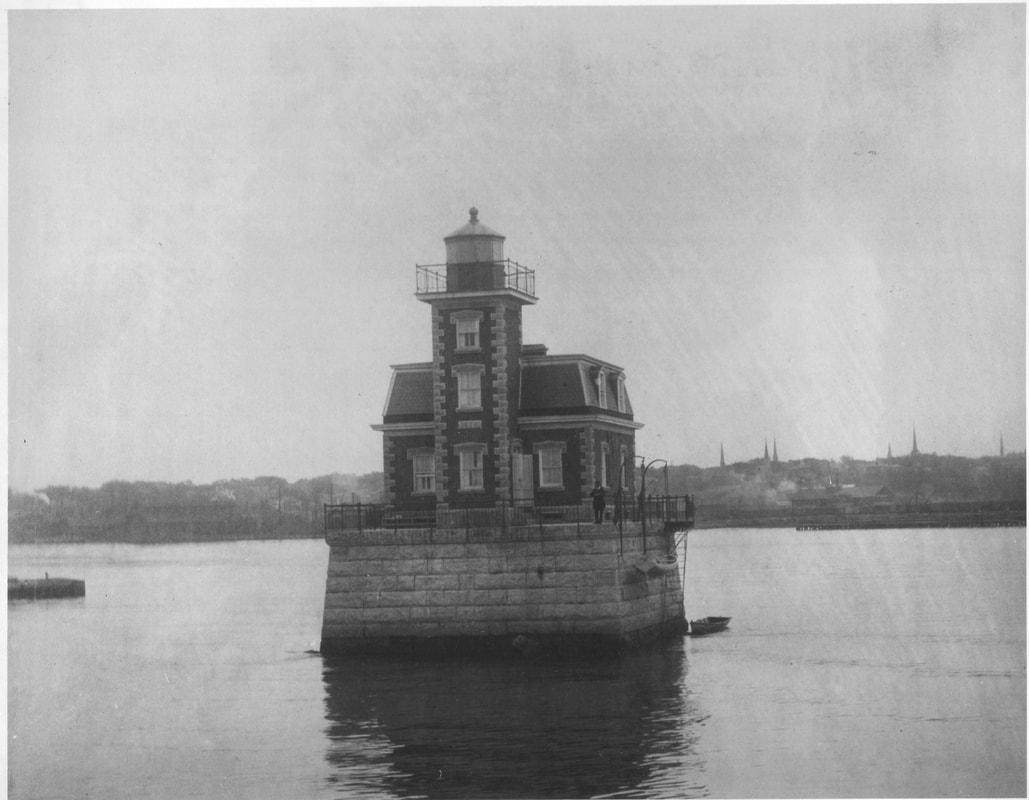 Hudson-Athens Lighthouse with unidentified keeper on the deck, c. 1900. Hudson River Maritime Museum collection. Completed in 1874, the Hudson-Athens Lighthouse marks the southern point of the Middle Ground Flats - a dangerous mud flat located smack between the sister cities of Hudson and Athens. Site of the famous wreck of the Swallow, a lighthouse had been requested to mark the flats - which at the time were submerged at high tide - since the 1830s. But it was not until after the Civil War that funds were appropriated and the lighthouse constructed. Henry D. Best was its first keeper, and was succeeded by his son Frank M. Best in 1893. However, not everyone was happy that Frank got the job. Sometime after June 7, 1894 (the article itself is undated), the Hudson Columbia Republican published an article entitled, "A Complete Vindication - Rebuke to Those Who Brought Charges Against Light-Keeper Best." You can read the original article for yourself: A COMPLETE VINDICATION Rebuke to Those Who Brought Charges Against Light-Keeper Best As the result of the examination conducted by H. W. Alden, Esq., upon May 31st in relation to certain charges preferred against Frank M. Best, light-keeper of the Hudson city light [sic], the Inspector of the Light-house Board, Third District, has made the following report and determination to the National Light-house Board at Washington, D.C., which completely vindicates Mr. Best’s good character and trustworthiness and exposes the falsity of the charges made against him. We publish the full text of the report, it being a matter in which all citizens of Hudson should be interested, as it discloses the unscrupulous methods adopted in the case, which same methods might at any time be put in operation to attack the character of any person, however up-right and honorable he might be, should he happen to incur the enmity of the ruling political faction: JUNE 7th, 1894. SIRS: - In reply to the Board’s letter of May 25th, 1894, transmitting a petition of Matthew Kennedy and others, of Hudson, N.Y., and several affidavits avering [sic] neglects of duty, for the removal of Frank M. Best, Keeper of Hudson City Light, charging that Mr. Best is a questionable character and was at one time arrested for stealing and destroying a boat, that he is generally untrustworthy, I would say that I sent Lieutenant-Commander C. H. West, Assistant Inspector, to Hudson on May 31st to investigate these charges as directed by the Board. Preliminary to this investigation I informed all parties of these charges that Mr. West would be in Hudson on the 31st day of May, just past, and requested them to be present with their testimony on that occasion. The investigation revealed the fact that Matthew Kennedy and Frank M. Best were fishermen some fourteen years ago on the Hudson river, and had quarreled about the methods and places where their respective seines should be hauled. Since that date they appear to have continued enemies, although Best left the business of fisherman and went into the employ of the Hudson River Railroad Company not long afterwards. While in such employ, a boat, or old rotten float used to secure a fish pound, was washed ashore on the bank of the river near the Hudson River Railroad Company’s tracks. Best finding this wreck at this point, regarded it as a flostaam [sic] thrown up by the river, and therefore broke it up and gave it to various railroad employees. It proved subsequently to have been the property of Matthew Kennedy, who had Best arrested and brought before a Justice who adjudged him guilty of destroying Kennedy’s property, and sentenced him (Best) to the limits of the town for a certain period. This action was a mere civil procedure, involving nothing whatever criminal against the said Best. Subsequently Best was Inspector of Elections, and also ran for Supervisor. In politics the two men differed, possibly, and the bad blood between them is the outcome of village quarrels which ought not to have been brought to the Board’s attention at all. Andrew Clow, who forwarded these charges to the Secretary of the Treasury, appears in the matter only as a shelter for Matthew Kennedy, who is the principal complainant and was chiefly instrumental in having the petition and other papers signed. Clow’s only desire was to get Best’s position when he gave it up voluntarily, but he did not wish to injure Best’s character. Best’s character is spoken of highly by the Hudson River Railroad officials as intelligent, honest and trustworthy, having risen in their employ from the lower grades of switchman and baggage master, to a confidential clerk’s position in one of the departments of the road where he collected ground rents and other monies for the company. His good standing, his general integrity of character and his entire trustworthiness in Hudson, where he lives, is testified by Rev. Mr. Yeisley, Treasurer Rainey, Cashier Boatwick, and Editor Bryan. Mr. Dennis Kennedy, brother of Matthew Kennedy, who seems to have been instrumental in all this matter, testifies to Best’s good character and to his general trustworthiness. The charge that his light was not lighted on the 15th and 20th of November, 1893, for a few minutes after sundown, appears to be a cumulative charge, and of little consequence. If these affidavits are true, the parties to this report ought not to have waited some seven or eight months to connect them with some other offense, before bringing them to the notice of the proper authorities, and in these matters, I would state, there is very little ignorance along the Hudson river. Notably in contrast, however, is the testimony of pilot McKnight, who made the affidavit of the light being out on the occasion mentioned. His present testimony is that the light is generally kept in a most creditable manner and is always bright and in good order, and that such is its reputation on the river. Mayor Miller and D. Doland admitted that they had signed the petition for Best’s removal without ever having read it, and that they knew nothing of the character of the paper, except that it purported to be a petition to get a light-house for a friend of Matthew Kennedy. Mayor Miller knew nothing of Best except form hearsay, and had signed the paper as a favor to Kennedy who was a friend. In view of such trifling, as these charges indicate, with the character of a worthy man, I attach no importance to the papers submitted, except to state that they are without reliability or support, and are malicious in intent. They indicate a small village quarrel that is thus sought to be interjected upon the Board for settlement by one set of parties exaggerating trifles almost to the point of lying, in order to secure the removal of a worthy man who is not without credit and trustworthiness in his home, and who, since his appointment, has been a uniformly good light-keeper. Very respectfully, (Signed) W. S. Schley, Captain U.S. N., Inspector. The Light-house Board, Washington, D. C. What do you think of Captain Schley's assessment? Frank M. Best remained keeper until his death in 1918. His wife Nellie stayed on as keeper for a few months, but found it was not to her taste. William J. Murray was brought on as replacement keeper at the end of 1918. If you enjoyed this post and would like to support more history blog content, please make a donation to the Hudson River Maritime Museum or become a member today!
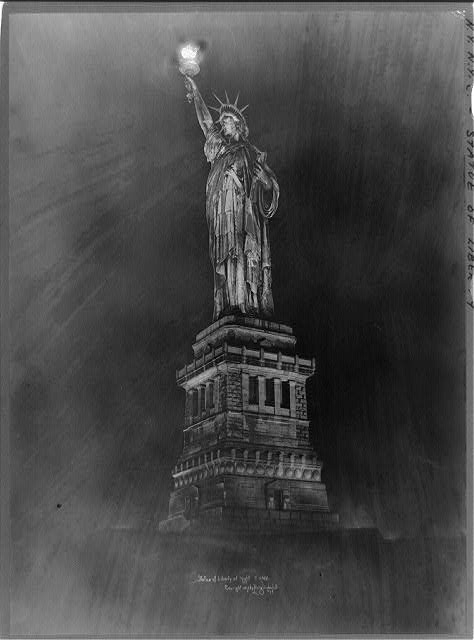 Statue of Liberty at night, 1917, Library of Congress. Did you know that the Statue of Liberty was an official lighthouse from its opening in 1886 until 1901, when it was transferred to the War Department. The Statue of Liberty was also the first electrically lit lighthouse in the country. To learn more about the history of the Statue of Liberty and her days as a lighthouse, check out the museum's RiverWise film, "When the Lady Was a Lighthouse." To learn even more about the Statue of Liberty's time as a lighthouse, including a list of keepers, you can visit her page on the Hudson River Lighthouses website. If you enjoyed this post and would like to support more history blog content, please make a donation to the Hudson River Maritime Museum or become a member today!
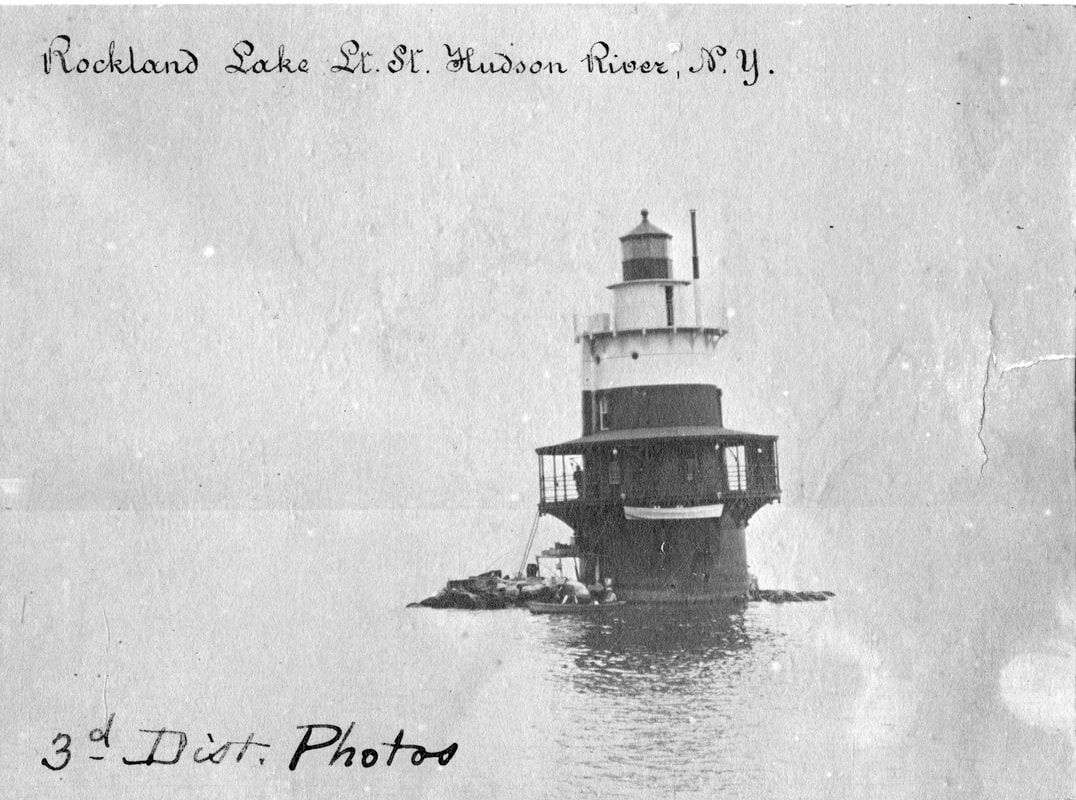 Rockland Lake Lighthouse, c. 1910, National Archives. Rockland Lake is a large, freshwater lake located quite close to the Hudson River, just across the river from the city of Ossining. Throughout the 19th century, it was the primary source of natural ice for New York City. South of Newburgh, the Hudson River is brackish - as a tidal estuary it contains a mix of fresh and salt water in the lower part of the valley, making it unsuitable for ice harvesting. Rockland Lake, on the other hand, was fed by a spring and remained largely unpolluted. In 1831, the Knickerbocker Ice Company formed at Rockland Lake, where it remained in operation until the turn of the 20th century. (Learn more about ice harvesting on Rockland Lake) 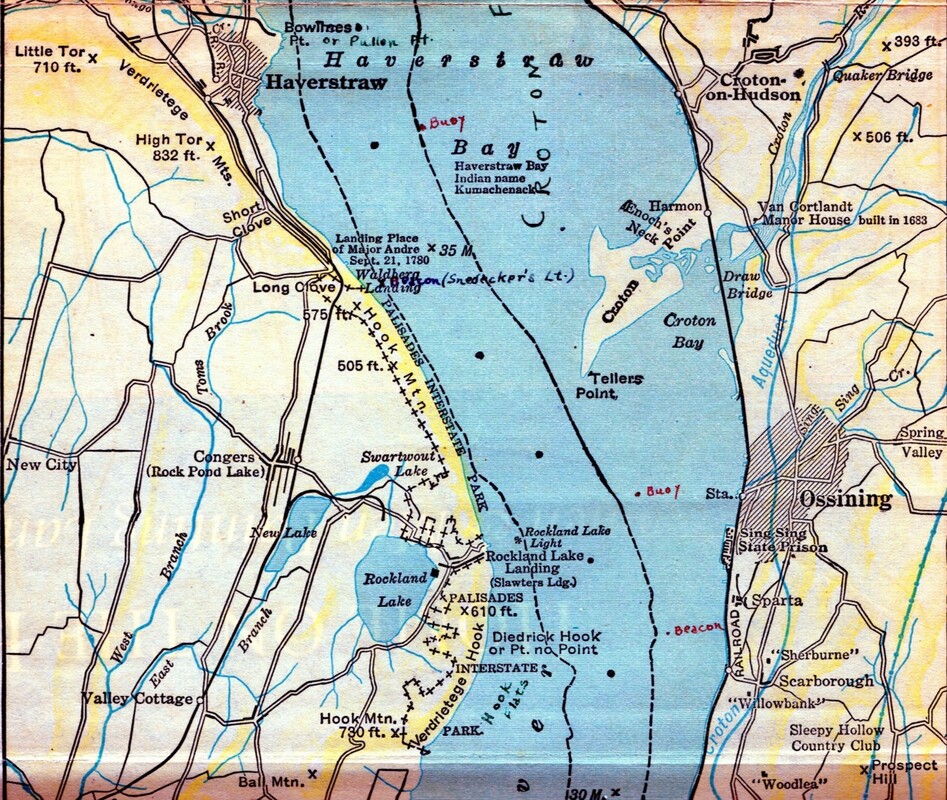 Rockland Lake, Landing, and Lighthouse noted on this 1924 Rand McNally travel map. Hudson River Maritime Museum collection. A large steamboat landing was built on the Hudson River near Rockland Lake to accommodate the ice trade. The need for a lighthouse at Rockland Lake was first reported in October of 1899 by the New York Herald, which noted that "many of the new steamers are propellers of such draught as to make the shoal dangerous." On December 7, 1892, the Brooklyn Union Daily Standard reported that an appropriation of $35,000 was made "[f]or establishing a lighthouse and fog signal at or near Oyster Bed Shoal," off of the Rockland Lake dock. The brief noticed continued, "Steamers lay their course near there, making an important turning point, and it is said that the placing of this lighthouse at that point may have an effect in preventing wrecks there." A year later, the New York Herald reported that the Lighthouse Board had completed the plans for what would become the Rockland Lake Lighthouse, to be located "1,100 feet northeast of the northeasterly end of Rockland Lake landing." In July, 1894, the Rockland County Times reported on the construction of the new lighthouse. "The structure, when finished, will be a facsimile of the Tarrytown lighthouse, with the addition of several recent improvements." The article noted, "There is at present no lighthouse between those at Tarrytown and Stony Point, and boatmen traveling between those two points are now troubled at times to find their bearings. This will be obviated by the Rockland Lake lighthouse, which will afford them a safe guide on the darkest nights." Before it could be completed, however, it was struck by the steam canal boat Richard K. Fox, which had four barges in tow and destroyed the wooden construction dock "together with the workshop and other buildings connected to the works." According to the August 1, 1894 report from the New York World, the steam canal boat Richard K. Fox managed to carry "away on its bow part of one of the buildings and an Italian laborer who was sleeping in his bunk." An article from The Sun on the same incident named him as Guiseppe Luigi. Other workers dove into the water or clung to the iron lighthouse caisson to escape the wreck, which destroyed their living quarters. The lighthouse workers speculated that the captain of the Fox must have been asleep at the wheel. The Richard K. Fox appeared largely unharmed, though some reports indicate she "lost her pilot house," and continued on her way to New York City. The New York World article ends with this sentence, "Hudson River navigators think the lighthouse a menace to navigation." The Sun indicates, "It [the lighthouse, upon completion] will then prove dangerous in foggy or misty weather, boatmen say." By September 5, 1894, notice was given to mariners that the light would be lit "on or about October 1, 1894, a light of the fourth order, showing fixed white for 5 seconds, separated by eclipses of 5 seconds." The cast iron caisson was to be painted brown on the lower half, and white on the upper. Like the lighthouses at Tarrytown and Jeffrey's Hook, the Rockland Lake lighthouse structure was pre-fabricated. 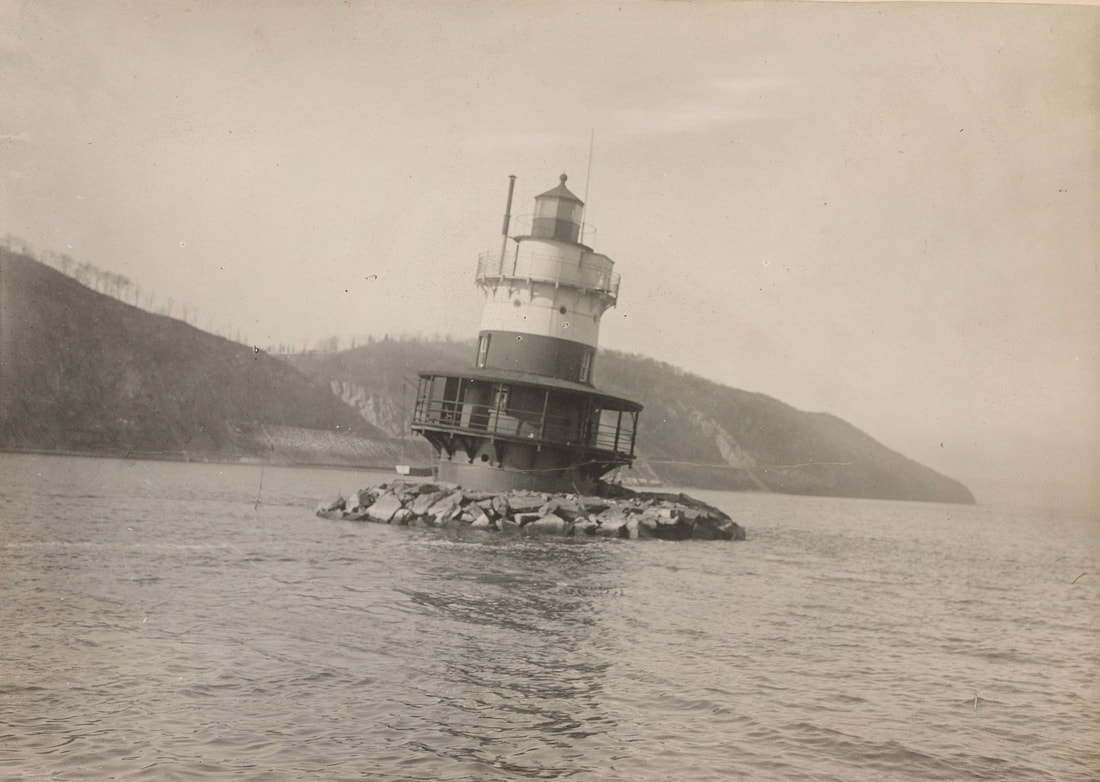 Rockland Lake Lighthouse in 1915, National Archives. By the 1910s, the Rockland Lake lighthouse had acquired a serious tilt. Most theories blame the oyster beds under the foundation. A the time, newspapers speculated that the shoals had washed out from under the lighthouse. Later historians speculate that the weight of the structure could have compacted the shoals, destabilizing them. Righting the lighthouse was considered too expensive a project, so the clockwork mechanism which turned the light was simply adjusted to account for the angle of tilt. One can only imagine what it was like to live there as keeper. By the 1920s, ice harvesting was also in decline, starting to be replaced by electric refrigeration. Perhaps this decline in traffic to the Knickerbocker Ice Company Landing played a role in the decision to decommission the lighthouse in 1923. That same year, a red-painted skeleton light was built adjacent to the lighthouse before that structure was demolished. A skeleton light still exists at that spot today. 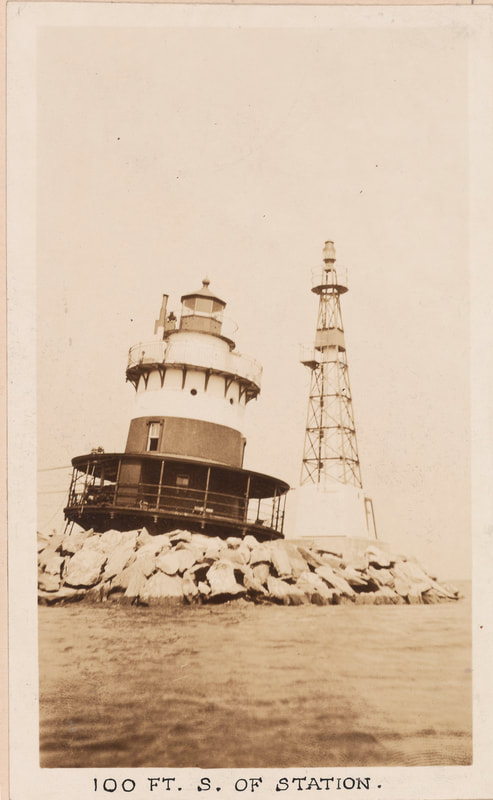 Tilting Rockland Lake Lighthouse with new skeleton light adjacent, August, 1923. National Archives. 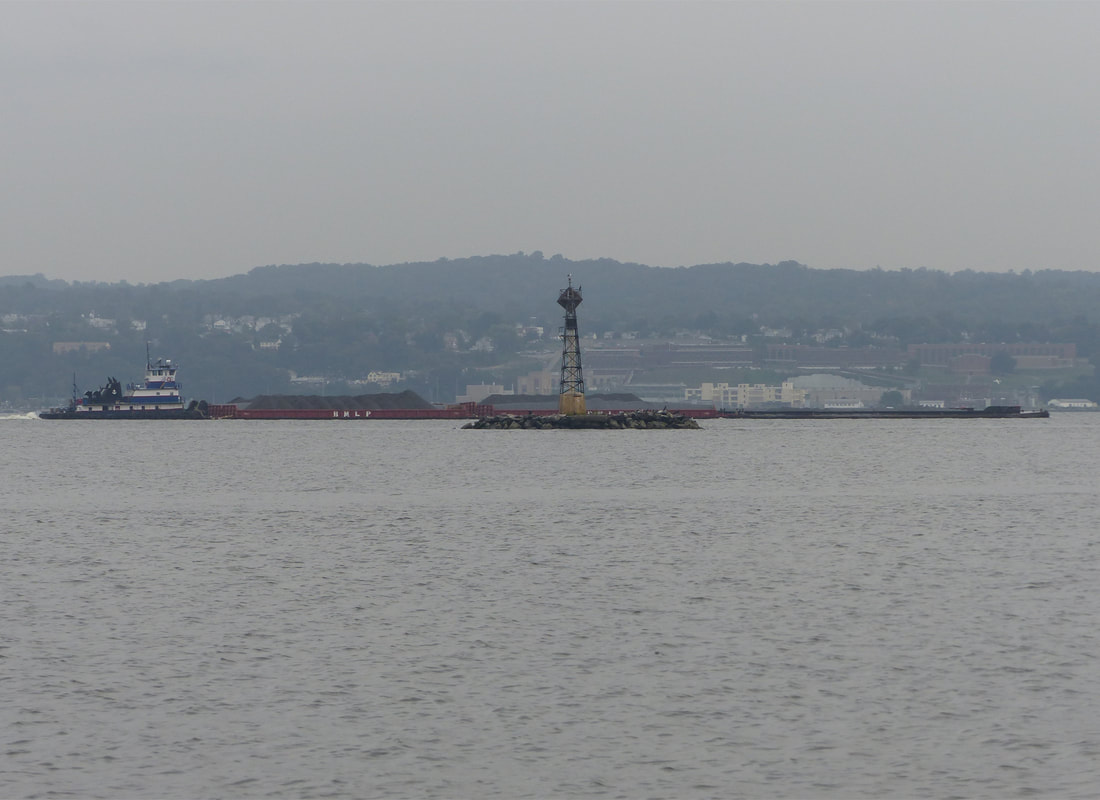 Photo of modern skeleton light on site of old Rockland Lake Lighthouse, taken October 4, 2018, by Joan Mayer. If you enjoyed this post and would like to support more history blog content, please make a donation to the Hudson River Maritime Museum or become a member today!
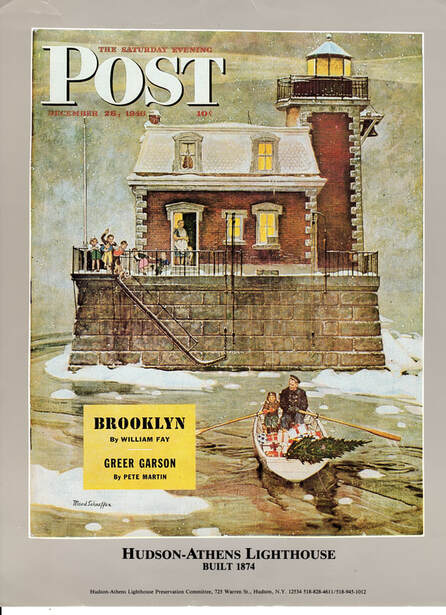 Editor's Note: This article was originally published on December 24, 1946 in The Knickerbocker News, Albany, NY. The tone of the article reflects the time period in which it was written. “Artist’s Picture Keeps Nation Posted on Hudson’s Glories: Lighthouse at Athens, Painted in July, Makes Magazine Yule Cover” By Katherine A. Van Epps Fame of the historic Upper Hudson reached a new high tide today when one of its picturesque landmarks – the lighthouse in mid-river between Athens and the City of Hudson – stepped from the commonplace to the cover of a national magazine. The little lighthouse, since the 1870’s a silent, unsung beacon of safety for the men who ply the fabled waterway and a subject of conversation for generations of excursionists, makes the cover of the Christmas-week issue of Saturday Evening Post. Sharing the national spotlight with the light are its lean, trim keeper, Boatswain’s Mate (lc) Edward Brunner of the U.S. Coast Guard and his family, who posed for the Christmas picture in July. The lighthouse’s claim to fame was assured when Mead Schaeffer, Arlington, Vt., artist, spotted the landmark from the window of a New York Central train approaching Hudson. Through the haze of July heat, Mr. Schaeffer’s artist’s eye saw the red brick lighthouse with spotless white trim as “something that should be under a Christmas tree” (to quote his own description). The idea of putting it on a holiday magazine cover came as he gathered his paints and easel for this unexpected stopover at Hudson. 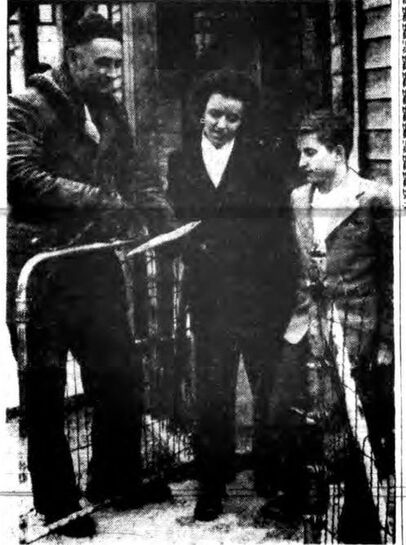 Mr. Brunner, provided by The Knickerbocker News with a preview of the picture painted by Mead Schaeffer, shows it to two of his five children during his visit to Athens where his family lives. In the picture are Emily Brunner, 21, who has just passed final examinations to become a nurse, and Bob Brunner, 14, who was born at the lighthouse. Mr. Brunner's family moved to Athens so the children could attend school regularly. Hurried Gathering of Family The picture, the result of a hurried gathering of the Brunner family, their dog, a fir tree and Christmas packages, shows Mr. Brunner and his son, Norman, rowing toward the lighthouse while the family waits in various poses of welcome. The snow-covered ice floating in the river was produced by Mr. Schaeffer’s imagination. When The Knickerbocker News rounded up Mr. Brunner on a day much like the one Mr. Shaeffer [sic] conjured up last July, with snow falling and ice floating in the black waters, it was found the artist’s imagination didn’t stop with the weather. Mr. Schaeffer had added three children to the Brunner’s family of five and moved the landing stairway from the east to the north side of the lighthouse “to make a better picture.” Mr. Brunner, slow-spoken with the easy humor of a riverman, said he “didn’t mind a bit about the children” but he wondered what the Coast Guard would say about changing the lighthouse. The keeper, veteran of 21 years “on lights,” has been at the lighthouse which straddles the two main Hudson channels just below “The Flats” since 1930. Since his family moved off the river into Athens so the children can get to school, he has kept his 22-hour-a-day, seven-day-a-week vigil alone. As he goes about his work polishing the huge gas beacon or setting the deep-throated fog bell in motion, Mr. Brunner has memories of the days when the lighthouse rang with the laughter of children and the exciting night 14 years ago when his son, Robert, was born and the doctor had to be brought by boat from Hudson. 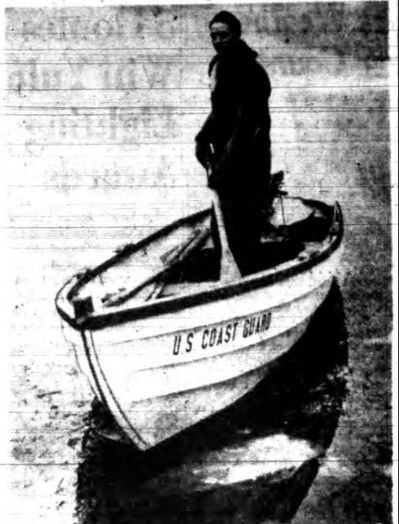 Boatswain's Mate (1c) Edward Brunner of the Coast Guard, keeper of the Hudson City Light since 1930, comes to Athens in his outboard motorboat for which he thinks will be his last visit until the river freezes over so he can walk ashore. Mr. Brunner has a Coast Guard radio on "the light," lhis only contact with the outside world when he is marooned by the floating ice or high water. 13 Years Since . . . It was soon after Robert’s birth that the family moved ashore and now it’s 13 years since Mr. Brunner has been home for Christmas. His home life depends on nature, and by Christmas there’s too much ice in the river for his outboard motor to break through and not enough to support a man’s weight so he can walk home. Older residents of Athens to whom the Hudson is both a source of livelihood and a neighbor tell countless stories about the little lighthouse, known as the Hudson City Light, in the lexicon of the rivermen. To Miss Nellie McKnight, town historian and daughter of a steamboat captain, the lighthouse, rising sheer out of the river, is an old friend. Story of Accident It is Miss McKnight who tells the story of the “Classic Accident of the Hudson,” handed down through her family. The accident occurred during a snowstorm in 1845 when the Hudson City Light was an unattended beacon years before the lighthouse had been built. The sturdy steamer Swallow, headed downstream, was nearing Athens when her captain mistook the lights of the town for the river beacon. He pulled right too soon to enter the channel on the Athens side of The Flats and the Swallow split in two on the rocks and burst into flames. There were 46 persons counted dead when the rescuers arrived – one of the worst tragedies in the history of the Hudson. To Mr. Brunner there’s nothing unusual about the lighthouse achieving nationwide fame. “The Hudson is the most beautiful river in the world,” he will tell you, explaining he saw his share of other lands during foreign service in World War I, “Why shouldn’t it provide inspiration for artists?” he added." If you enjoyed this post and would like to support more history blog content, please make a donation to the Hudson River Maritime Museum or become a member today!
|
AuthorThis blog is written by Hudson River Maritime Museum staff, volunteers and guest contributors. Archives
May 2024
Categories
All
|
 RSS Feed