History Blog
|
|

|
Editor’s Note: The following text is a verbatim transcription of an article featuring stories by Captain William O. Benson (1911-1986). Beginning in 1971, Benson, a retired tugboat captain, reminisced about his 40 years on the Hudson River in a regular column for the Kingston (NY) Freeman’s Sunday Tempo magazine. Captain Benson's articles were compiled and transcribed by HRMM volunteer Carl Mayer. This article was originally published November 21, 1971.. 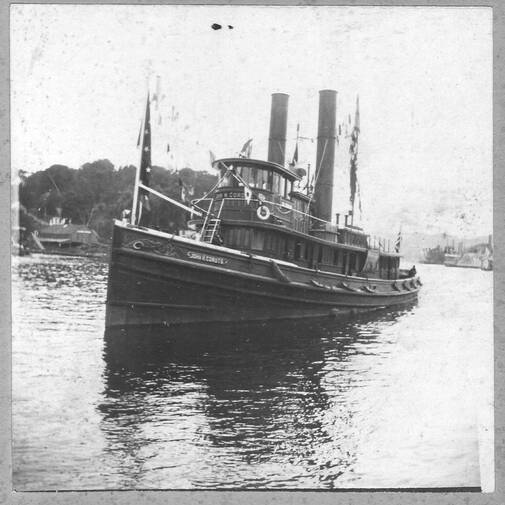 Cornell Steamboat Company tug "John H. Cordts" underway with original two stacks side by side Way back in the 1890’s, the Cornell Steamboat Company had a big tugboat by the name of “John H. Cordts.” And at that time, the steamboats, “New York” and “Albany” were the regular steamers of the Hudson River Day Line. One summer afternoon, the “Cordts” came out of Rondout Creek to run light to Hudson and to relieve the “Norwich” of a large tow of canal boats. At the same time, the “New York” was leaving Rhinecliff on her way up river, crowded with passengers. The “Cordts” pulled slightly ahead of the “New York” and as the “New York” got up her speed, the “Cordts” dropped back and then hooked up so she lay off the port side aft of the “New York.” The suction from the “New York” dragged the “Cordts” right along with her all the way to Catskill, where the “New York” made a landing. The “New York” and “Albany” were in that day and age very fast wide wheelers and ordinarily could outrun the “Cordts” like a rabbit would a turtle. However, when those side wheelers were in shallow water they would drag their stern down deep in the water and a bid suction wave would follow right along with them. Whatever lay off the after quarters on the Day Liners would go right along with them. Disbelief from Distaffers The “New York” and the “Albany” were advertised in the newspapers of the day as very speedy. Some ladies who were passengers on the “New York” that day wrote a letter to the Day Line saying they did not think the “New York” was so fast when a tugboat could stay right alongside her for so long a distance. A. Van Santvoord, a president of the Day Line, wrote a letter to S.D. Coykendall, president of the Cornell Steamboat Company, requesting him to please ask his captains to stop trying to race with the Day Line steamers. Of course, Van Santvoord and Coykendall knew what the score was, but passengers on the “New York” wouldn’t understand about shoal water, suction, etc. Coykendall called captain of the “Cordts”, Jim Monahan, on the carpet about the incident and told him not to do it again or he would be discharged. But the way it has been told to me, Jim Monahan was a very stubborn man. Sure enough, he tried it again and that was the last of Captain Monahan on the “John H. Cordts.” After leaving Cornell, Captain Monahan was captain of the steam lighter “Uriah F. Washburn,” carrying cement and lime all along the Hudson River and Long Island Sound. After that, until his death, he was captain of the steamer “Newburgh” of the Central Hudson Line. All river men agreed he was always a very good captain or pilot tugboats, steamboats or whatever he happened to be on, the sleigh rides and dismissal notwithstanding. AuthorCaptain William Odell Benson was a life-long resident of Sleightsburgh, N.Y., where he was born on March 17, 1911, the son of the late Albert and Ida Olson Benson. He served as captain of Callanan Company tugs including Peter Callanan, and Callanan No. 1 and was an early member of the Hudson River Maritime Museum. He retained, and shared, lifelong memories of incidents and anecdotes along the Hudson River. If you enjoyed this post and would like to support more history blog content, please make a donation to the Hudson River Maritime Museum or become a member today!
0 Comments
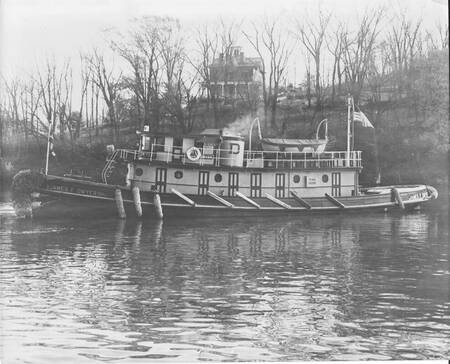 Tugboat "James F. Dwyer" on Rondout Creek. Hudson River Maritime Museum Collection Most steam and many diesel tugs were what were known as "bell boats". This means that the Captain in the wheelhouse - in charge of steering - had no direct control over the machinery in the engine room. The Captain communicated his orders to the Engineer - in charge of the speed - by using a code of sounds run on two bells which the captain rang with controls in the wheelhouse. Many companies had their own distinct bell codes. In general, the "gong" called for a change in engine direction and the "jingle" called for a change in engine speed. The engine room was very noisy so the bells had to be loud to be heard. 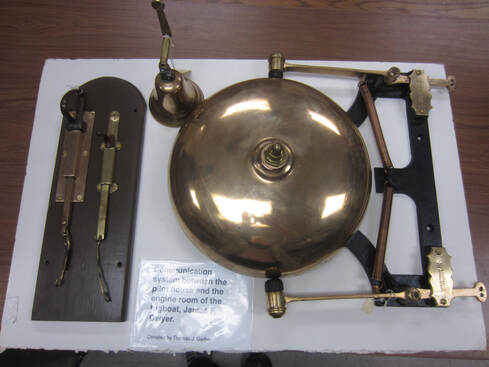 Communication system between the pilot house and the engine room of the tugboat "James F. Dwyer". Donated by Thomas J. Gerber. Hudson River Maritime Museum Collection. Simplified Bell Signals: When the boat was stopped: 1 gong - work ahead; 2 gongs - go astern When working ahead or backing: 1 gong - stop 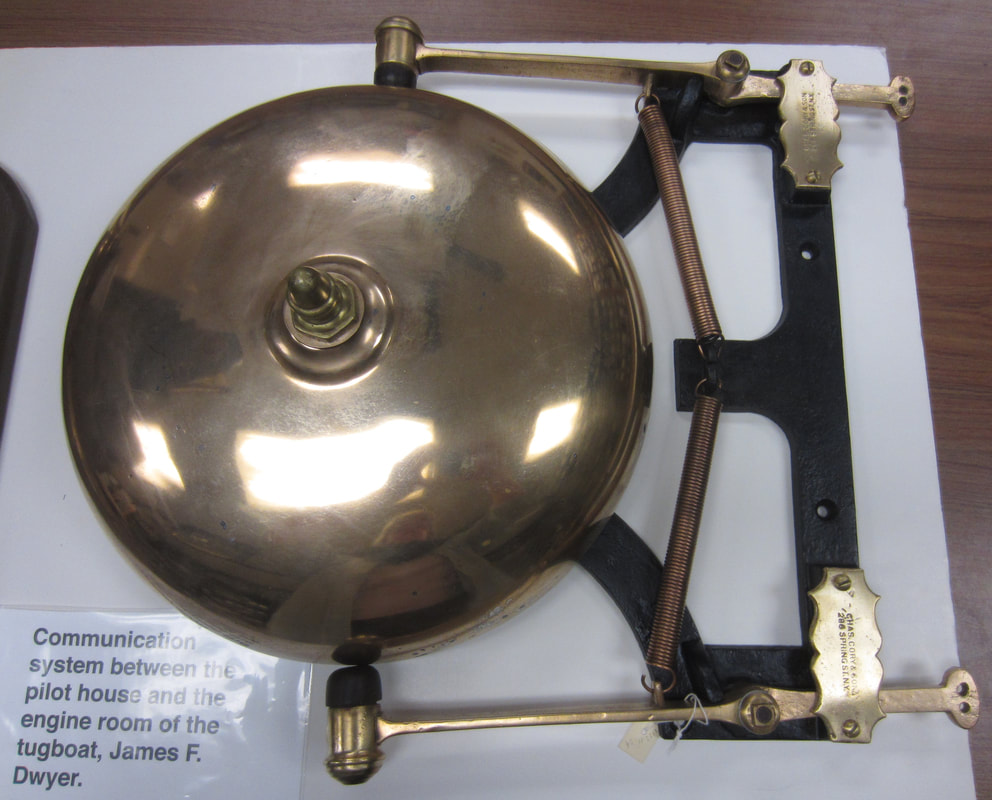 Donated by Thomas J. Gerber. Hudson River Maritime Museum Collection. 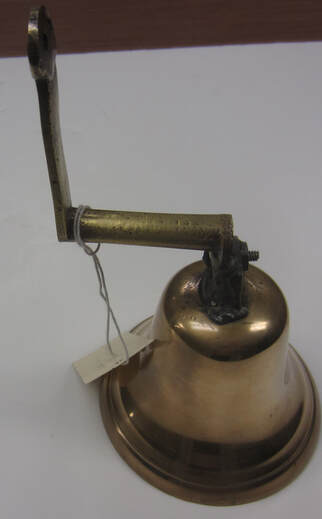 Donated by Thomas J. Gerber. Hudson River Maritime Museum Collection. Jingles change speed: 1 jingle - increase speed; 2 jingles - decrease speed 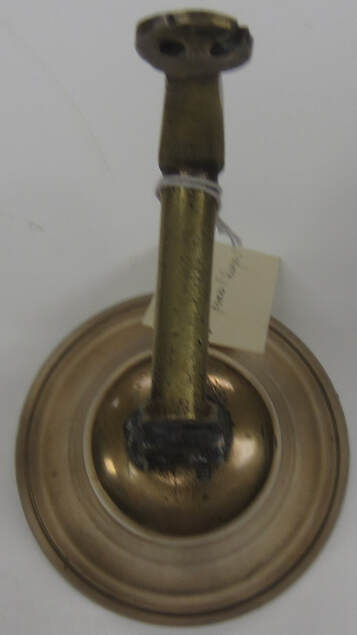 Donated by Thomas J. Gerber. Hudson River Maritime Museum Collection. Once the Captain got the attention of the crew in the Engine Room they were also able to communicate through speaking tubes. "Artifact donor Thomas Gerber was born and raised in downtown Kingston on Meadow Street. Tom’s interests were many but he was particularly interested in ships and tugs and spent a great deal of time, as a young boy, at the shipyards on the Rondout Creek. He said it was always so exciting to see a ship finally launched into the creek, ready for duty, after months and months in the making. His Uncle, Dan Murphy, who helped raise him, was an engineer on the tugs. Many summers, his Uncle Dan would take him along on the tug, the "James F Dwyer", and they would go up through the locks. Tom loved going on this two week (sometimes more) journey as he learned so much and got to spend time with his Uncle. Tom’s dad died when Tom was just 5 years old so his Uncle was more like his dad. When they were going to scrap the "James F. Dwyer", Tom wanted something to remember the tug by and was able to salvage the communication system between the pilot house and the engineer room which includes the bell, the large bell, which looks similar to a gong, and the pulls. He had them restored to their original luster by a great craftsman, William C. Washburn. Tom wanted this piece of history to be seen by many so donated them to the Hudson River Maritime Museum." Thank you for Melodey Daley for this history. Because of the growth of New York City into a major port and population center as immigrants poured into the city in the 19th century, the need for food and building materials soared. The Hudson Valley produced many of the products needed, and shipped them by sailing vessels called sloops and schooners for at least two hundred years from the beginning of settlement in the 1600s. Steamboats came on the scene gradually after 1807 carrying mostly passengers for many decades. Eventually steam towboats pulling multiple barges and canal boats took over the freight traffic on the Hudson. Though not speedy, these long tows were the cheapest way to ship bulk cargoes. Older passenger steamboats such as the Norwich were used at first as towboats. Sidewheel steamboats such as the Oswego were built as towboats starting around 1850. Propeller driven tugboats in the familiar shape that we know today began to be seen in the 1860s. If you enjoyed this post and would like to support more history blog content, please make a donation to the Hudson River Maritime Museum or become a member today!
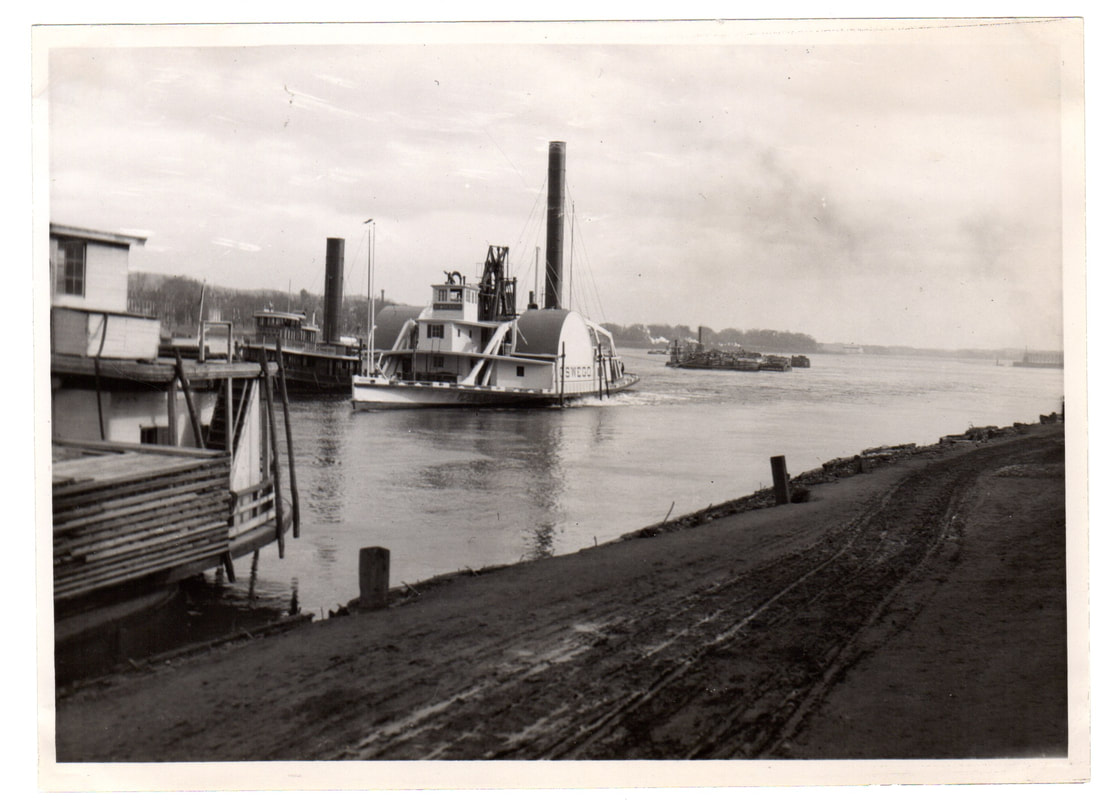 Steam towboat "Oswego" towing a line of barges. Tracey I. Brooks Collection, Hudson River Maritime Museum After the opening of the Erie Canal in 1825, the Hudson River-Erie Canal corridor immediately became one of the leading access routes to the mid-west. In addition to the movement of people, the transportation of freight and agricultural products in substantial quantities took places in both directions. It was a new and relatively easy method for the products of the west to reach the east coast of the relatively young country. At first the early steamboats provided the principal means of transportation on the river for both people and freight. However, as the variety and quantity of the freight products increased, barges began to be used. At times they were lashed alongside of the steamboat or towed singly astern. This method obviously slowed the passage of the steamer and barges in tows behind a towing vessel became the general practice. Early Albany entrepreneurs who recognized the monetary returns to be gained from towing were “Commodore” Alfred Van Santvoord, Samuel Schuyler with his Albany and Canal Towing Line, and Jerry Austin. All three used older side wheel steamboats that had lost their appeal to the traveling public but still possessed serviceable engines and boilers. These were converted to towing vessels by the removal of most of their superstructure and the installation of towing bitts and winches. The barge tows of the Albany trio traversed the entire length of the river and the competition was spirited. It would appear that Alfred Van Santvoord was perhaps the most foresighted of the Albany towing operators. In any event, in 1848 he undertook the construction of a side-wheel steamboat designed solely for use as a towboat. She was named “Oswego” and was the first of seven such vessels to be built for the towing of large barge tows on the Hudson River. In 1849, Van Santvoord followed with “Cayuga”, Samuel Schuyler in 1852 followed with “America”, and in 1853 Jerry Austin added “Austin”. All were 200’ to 213’ in length. “Anna”, the smallest of the seven, was built in 1854 for Van Santvoord, and “Syracuse” in 1857, at 218’ the largest, for Austin. To complete the septet, the “Geo A. Hoyt” was built in 1873 for Thomas Cornell. During the latter half of the 19th century, the steamboat operators traded vessels, somewhat like major league baseball teams trade players today. For example, in 1868 Van Santvoord traded the towboats “Oswego”, “Cayuga” and “New York” to Thomas Cornell for the passenger steamboat “Mary Powell”. 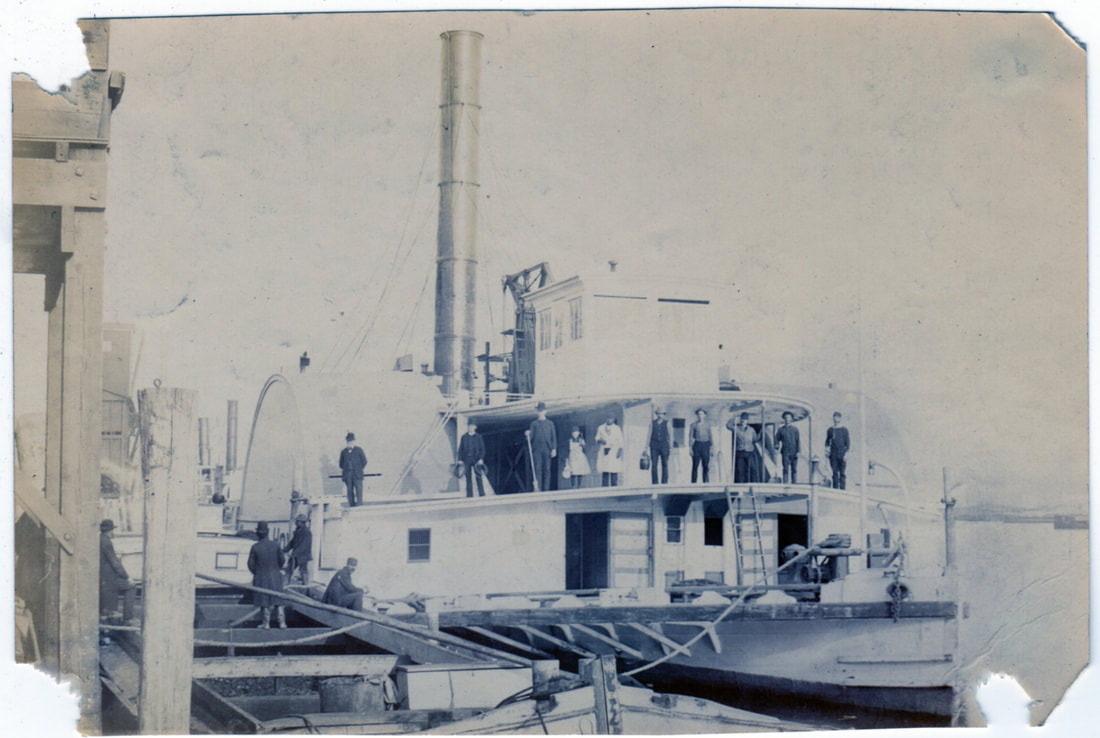 The towboat "George A. Hoyt" tied up to a canal barge with crew standing on deck. Hudson River Maritime Museum Collection During the decade preceding the Van Santvoord-Cornell trade of vessels, Van Santvoord had become more and more involved in the operation of passenger steamboats. With the completion of the trade, Van Santvoord got out of the business of towing entirely and devoted his efforts solely to that of passenger steamers, which in time became the famous Hudson River Day Line. Thomas Cornell, whose towing operations had been centered on the lower river south of Rondout, gained access to the upper river and the operation of towing over the river’s entire length. Thomas Cornell and his son-in-law, S.D. Coykendall were extremely aggressive competitors. By the last decade of the 19th century, their Cornell Steamboat Company had fashioned a virtual monopoly of towing on the Hudson River and their fleet of towing vessels was the largest in the nation. Steamboats, like people, during their life time achieve minor claims to fame. “Oswego”, the first of the seven built, lasted the longest and out lived all of her successors. She made her last trip in September 1918, 70 years after her launching. “Syracuse”, the largest of the group, was generally considered by boatmen to be the best looking of all the towboats that saw service on the river. “America”, perhaps because of her name, was the subject of more paintings by the famed maritime artist James Bard than any other vessel. The towboats were big and probably had generous accommodations for their crew. However, they were also cumbersome and in time were succeeded by the smaller, but more efficient and maneuverable screw-propelled tugboats. By the early years of the 20th century the towboats were history. They were, however, an important part of the maritime saga of the Hudson River and deserve to be remembered for the role they played in it. This article was originally published in the 2002 Pilot Log. Thank you to Hudson River Maritime Museum volunteer Adam Kaplan for transcribing the article. If you enjoyed this post and would like to support more history blog content, please make a donation to the Hudson River Maritime Museum or become a member today!
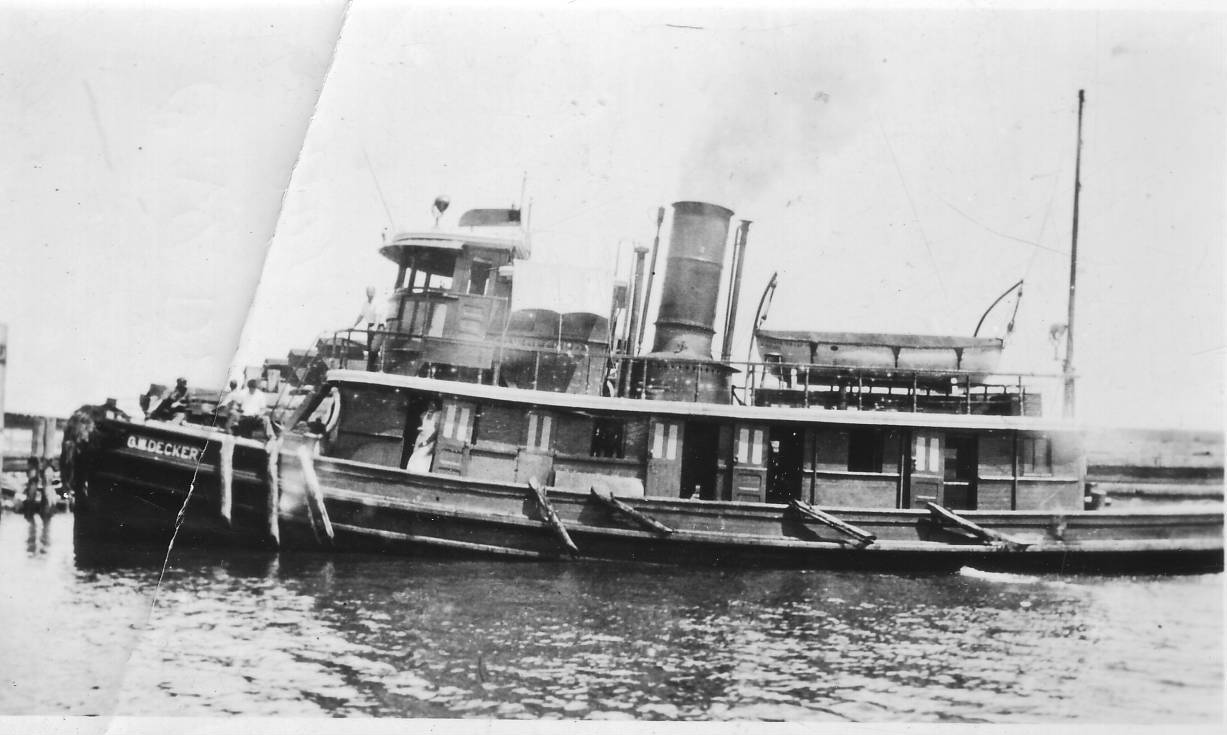 Cornell Steamboat Company tugboat "G.W. Decker", built at Newburgh, NY in 1900. Hudson River Maritime Museum Collection Since the Hudson River was first navigated by steamboats in 1807, there have been hazards- natural and man-made- that have plagued the captains and pilots of these vessels. Fog, low water level, treacherous currents and ice have all taken their toll over the years, as have the occasional cases of inattention to duty, confusing or misunderstood whistle signals between steamers- not to mention fires, boiler explosions or mechanical failure of engine or steering gear. Some of these accidents are well known, such as the loss of the steamer Thomas Cornell when she ran up Danskammer Point, north of Newburgh, in the fog on 27 March 1882 as she was making her regular trip from Rondout to New York. Many years later, the Hudson River Day Line’s flagship Washington Irving was lost as a result of a collision just after she left her pier in New York on 1 June 1926. She was struck on the port side by an oil barge in tow of the tug Thomas E. Moran and sank after she was hurriedly run across the river to shallower water on the New Jersey side. Most of the accidents or incidents have never had the dramatic impact of losses such as that of the Thomas Cornell or Washington Irving. Many of them didn’t result in the loss of the vessel. The Cornell tug G.W. Decker was an example. This small tug was for many years employed as a “helper” tug on Cornell’s tows- picking up or dropping off individual barges at intermediate points on the journey to or from New York. Many years ago, the many brickyards at Haverstraw sent their production to New York on barges, with the helper tug shuttling between the brickyard wharves and the tow. The depth of the river at Haverstraw Bay is not particularly deep, and the fact that the Decker’s bottom plates were eventually found to be very thin was ascribed- in part at least- to the cumulative action of Haverstraw Bay sand on her bottom. We shall never know for sure, but it is a reasonable theory. The river’s depth is very shallow on the wide reaches of Haverstraw Bay outside of the main channel, and on the upper river where dredging had to be accomplished to allow ships to reach the port of Albany. In March 1910, long before the upper river was dredged, the very large and powerful steel-hulled Cornell tug named Cornell- accompanied by her helper Rob- was sent to Albany to break up an enormous ice jam in order that the river might be opened for traffic. It was found that her draft was so great that she grounded from time to time on the northbound trip, but she eventually accomplished her task with no small measure of hazard to Cornell and her crew. It was never attempted again. Over most of the river’s course from New York to the start of the dredged channel north of Hudson the channel is of moderate depth, but in the Highlands- from Peekskill north to Cornwall- there is a lot of water, sometimes extending almost to the shoreline because of the mountainous nature of the area. At Anthony’s Nose, the depth reaches about 90 feet, and under the Bear Mountain Bridge we may find nearly 130 feet of depth. In the region around West Point is where we may find the deepest point on the entire river. Between West Point and Constitution Island, in that part of the river called World’s End, a depth of 202 feet was recorded during one survey many years ago- and that is at mean low water during the lowest river stages. A small steamboat- or “steam yacht” in river parlance- named Carrie A. Ward, built in New Baltimore in 1878, maintained a local service between Newburgh and Peekskill during the 1880s. In late July of 1882, she sank near Cold Spring and was raised. On Saturday, 29 July, she sank for a second time for reasons thus far unknown, again in the vicinity of Cold Spring. By Tuesday, 1 August, she had not been located. The Newburgh Daily Journal reported on that day under the headline “Is She Gone For Good?”: “It is said that the river bed consists of rocks in the locality where she went down, and that the water is of varying depth. It may be fifty [feet] deep in one spot, and nearly twice that a few yards off. Some boatmen have doubts if the Carrie will ever be found. They say she may have settled into a hollow between some of the rocks and her presence may never be discovered.” The situation was not quite as dire as the boatmen predicted. By the next day, she had been located in 60 feet of water. The Journal remarked, “Arrangements are under way to have the yacht raised again.” The Baxter Wrecking Company brought in their divers and equipment on 5 August, and in a short time, the Carrie A. Ward had been raised, repaired and back in service. The Hudson hasn’t always been that kind to its vessels. There have been scores of sail and steamboats, barges and other craft that have sunk in the river never to be raised. We shall unfortunately never know the tales told by their crews. AuthorThis article was originally written by William duBarry Thomas and published in the 2007 Pilot Log. Thank you to Hudson River Maritime Museum volunteer Adam Kaplan for transcribing the article. If you enjoyed this post and would like to support more history blog content, please make a donation to the Hudson River Maritime Museum or become a member today!
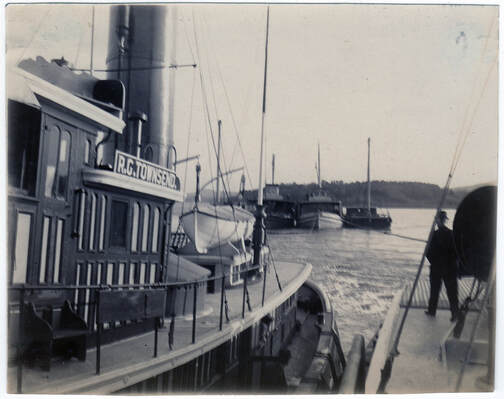 Tug "R.G. Townsend" with long tow. Saulpaugh Collection, Hudson River Maritime Museum Towing on the Hudson River undoubtedly began in earnest with the earliest steamboats once the Erie Canal began at the time of its grand opening on 26 October 1825.1 After that date, canal boats loaded with eastbound grain cargoes needed a way to deliver their cargoes to New York City. Nearly all of the towboats of that age were primarily side-wheel steamers which normally carried passengers. Little is known of how the concept of the dedicated towboat developed. As the traffic on the Canal increased, it was undoubtedly found that there was more traffic than could be handled by the passenger boats. It is surmised that this occurred sometime during the mid-to-late 1830s. It should be noted that the marine propeller did not exist at this time, so that all of this earliest towing was carried out by side-wheel steamboats. The side-wheel steamboats- whether engaged in towing or otherwise employed- were propelled by engines of two designs. One was the walking-beam engine, in which the connecting rod from a vertically-mounted cylinder was attached to one end of a diamond shaped cast iron beam. From the other end of the beam, a rod led to a crank in the transverse shaft that led to the paddle wheels. In this way, the paddle wheels turned as a result of the up-and-down movement of the engine’s piston. The other type of engine used on the side-wheelers was the crosshead engine, similarly configured to the beam engine except that instead of the walking beam, a crosshead moved vertically in guides at each side. The connecting rod movement from the cylinder caused the crosshead to move vertically and a second connecting rod rotated the crank on the transverse shaft in the same manner as that of the beam engine. The crosshead engine, common in the early days of the steamboat, virtually disappeared from production during the late 1850s. Most of the side-wheel towboats in use on the river were former passenger steamers which had been converted to towboats, mainly by the removal of the passenger quarters. During the entire history of the side-wheel steamboat, there were only seven such vessels built for towing purposes between 1848 and 1873. These vessels were Oswego (1848; Cayuga (1849); America (1852); Austin (1853); Anna (1854); Syracuse (1857) and George A. Hoyt (1873). All were built for well-known towboat operators- A. Van Santvoord, Samuel Schuyler, Jerry Austin and Thomas Cornell. The last named vessel was somewhat of an anachronism, built at the beginning of the propeller era. 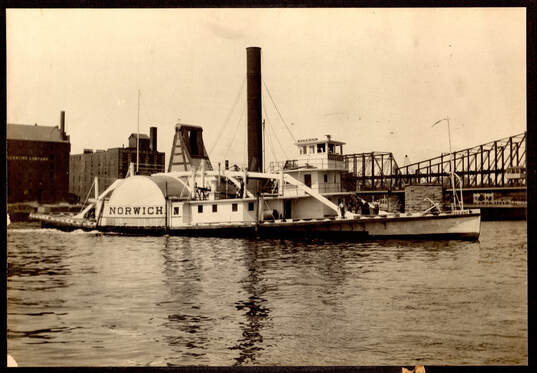 Towboat "Norwich" at Albany, NY. Donald C. Ringwald Collection, Hudson River Maritime Museum The last side-wheel towboat in operation on the Hudson was Norwich, built in 1936 beginning in 1848, she was a member of the fleet of Thomas Cornell (and later the Cornell Steamboat Company). A star performer in the 1909 Hudson-Fulton Celebration, she last operated commercially in 1917 and was dismantled in 1923. She was also the last vessel afloat powered by a crosshead engine. Small propeller tugs appear to have made their first appearance on the river at about the time of the Civil War. One of these pioneering craft, Wm. S. Earl, was around the river until the later 1940s. She had been built at Philadelphia for Albany owners in 1859. The appearance of these vessels at Albany was to provide a fleet of tugs was for two principal reasons: (1)to handle the towing of barges locally, and (2)to make up the increasingly more frequent and larger New York tows composed primarily of grain traffic through the Erie Canal. During the post-war period and beyond, the burgeoning City of New York required increasingly large amounts of materials to construct the buildings that made up the city. In those days, the principal materials of construction were bricks and mortar, both of which were manufactured along the river. A multitude of brickyards on the upper and lower portions of the river provided nearly all of the brick required for this undertaking, being carried to New York on 100-foot long wooden barges, nearly all of which were built in shipyards along the river. Another commodity that was significant in the pre-refrigerator days was ice, and before the era of manufactured ice, the Hudson River provided a very large percentage of New York’s ice needs for many years. Ice was harvested from the river during the river and stored in riverside ice houses. The ice was shipped to New York by barge, to be used during the warmer part of the year. As a result, ice became an important factor- alongside of brick- for many years in the river’s towing industry. There was still another commodity which required transportation to New York from the middle region of the river. This was coal- the only fuel available during the 19th century. Anthracite coal was brought from the Pennsylvania fields by the Delaware & Hudson Canal to Rondout Creek, where the Island Dock (especially built by the canal company for the purpose) became the entrepôt between canal boats and river barges or sailing vessels. Similarly, rail terminals at Newburgh and Cornwall provided the means for transfer of Pennsylvania coal to barges and seagoing vessels. From the 1870s onwards, the size of the propeller tugboat- and its power- increased continuously, and this was not lost on the Hudson River operators. Most, if not all, of the operators utilized side-wheelers, but only a single owner was able to foresee the day in which this type of motive power would be obsolete- and eventually non-existent. This was Thomas Cornell, an owner who had come to the river in the late 1830s operating passenger steamers. His towing business grew continually, and by 1872, he had taken delivery of two propeller tugs of then large size- Thomas Dickson and Coe F. Young, each powered by a single cylinder condensing engine of about 240 horsepower. This, it turned out, was a major step towards the future. 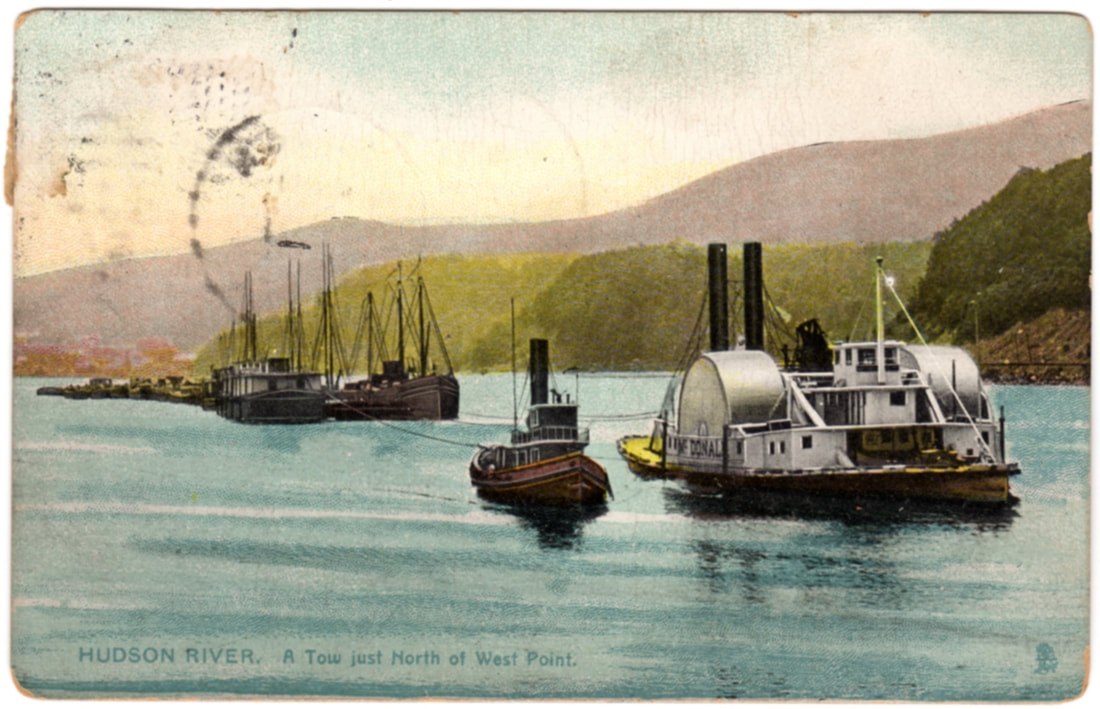 A tow just north of West Point. Hudson River Maritime Museum Collection During the 1880s, Cornell expanded his propeller fleet with a modest fleet, primarily built in Philadelphia, the largest being J.C. Hartt, which boasted a 750-horsepower compound engine. Still more technical accomplishments followed, beginning with the iron-hulled Geo. W. Washburn, built at the T.S. Marvel yard in Newburgh in 1890 (with a near sister, Edwin H. Mead, following two years later). Perhaps the only wrong decision of the era was Cornell’s construction of a then-enormous vessel, a 1400-horsepower behemoth named Cornell, at a Staten Island shipyard in 1902. She proved to have a draft too deep for service on the upper river and was sold to a New Orleans operator who kept her in service until the end of World War II. A handful of other operators built and operated modern vessels during this period, but they were no match for the Cornell fleet and their business method. Many abandoned their river operations, some selling their vessels to the Cornell organization, at this time headed by Samuel D. Coykendall, a son-in-law of Thomas Cornell. Some of the long-time workhorses of the Cornell fleet came from these absorbed businesses, such as Ronan’s Osceola and Pocahantas, built in 1883 at Newburgh and still in the Cornell fleet in the early 1930s. Another operator who failed in his tilt with Cornell was C.W. Morse, whose Knickerbocker Ice Company gave up river towing under the fierce Cornell attack. It was during this period of increasing barge traffic that the latter day concept of the river tow came into being. The main towing- either side-wheel or propeller driven- was in charge of the tow. As the New York-Albany tow progressed up or down the river, it was necessary to drop off or pick up barges at intermediate points along the route, such as at the brickyards, stone quarries or other industries that required barges. It was inconvenient, and in most cases, impossible for the towing steamer to accomplish this task, and in this way the concept of the “helper” tug came into being. This small tugboat would shift individual barges from the main tow to a shoreside destination without affecting the movement of the main tow. Similarly, barges were moved to the tow in the same way. In between these shuttle trips, the helper tug would provide its power to assist in moving the main tow, and under certain circumstances, such as rounding the potentially dangerous course change needed when rounding West Point, she would help in altering the course of the flotilla of barges. The sheer size of these tows during the peak period of barge towing on the river was astonishing. Some of the larger tows were made up of as many as 125 barges. Assuming that the average length and beam of individual barges was 100 feet by 25 feet, the area of the entire flotilla might amount to as much as seven acres! The diesel tug made its initial appearance on the Hudson shortly after the end of World War One. The Cornell Steamboat Company purchased two 100-foot tugs that had been cancelled members of the Shipping Board’s 100-vessel harbor tug fleet. These two- Jumbo and Lion- acquired in 1924 and 1925 respectively, were propelled by 600-horsepower Nelseco engines. These two line-haul tugs were joined during this period by four “helper” tugs- Cornell, Cornell No. 20, Cornell No. 21, and Cornell No. 41- all of which were converted steam tugs. One operational breakthrough in the Cornell company’s latter days was the construction and operation of the diesel-powered Rockland County, a pusher tug in the style of the western river-based towing fleets. Rockland County was built in 1960 by Dravo Corporation at its Wilmington, Delaware yard, and was used primarily to move crushed stone-laden barges (another longtime important cargo on the river) of the New York Trap Rock Company from its quarries on the lower river. The latest towboats seen on the river are powerful pusher tugs which move the oil barges to the upper river. These tugs, owned by K-Sea, Moran, McAllister and others, are typically of around 4000 or more horsepower, with elevated pilot houses to provide adequate visibility when moving an empty barge. Although these tugs are of a type that could never be imagined in the days of the side-wheel towboat, they are also a remarkable development that might have been unforeseen twenty-five years ago. Today, towing on the Hudson is but a shadow of its former self. Cornell went in the 1980s, when it sold out to New York Trap Rock (although the Cornell shop buildings are still standing in Rondout Creek). Ice, coal and brick disappeared as cargoes many years ago. Still with us are petroleum, crushed stone and cement, and a small quantity of container cargo is brought from New York’s container terminals to the Albany area by barge. One must remember, however, that Hudson River towboats and barges were of great importance in the development of the City of New York and the lower Hudson River virtually from the beginning of the powered vessel. Endnotes: 1. Adams, Samuel Hopkins, “The Erie Canal”, published in New York in 1953 by Random House, Inc. Editor's Note: This article was originally written by William duBarry Thomas and published in the 2009-2010 Pilot Log. Thank you to Hudson River Maritime Museum volunteer Adam Kaplan for transcribing the article. If you enjoyed this post and would like to support more history blog content, please make a donation to the Hudson River Maritime Museum or become a member today!
Editor’s Note: The following text is a verbatim transcription of an article featuring stories by Captain William O. Benson (1911-1986). Beginning in 1971, Benson, a retired tugboat captain, reminisced about his 40 years on the Hudson River in a regular column for the Kingston (NY) Freeman’s Sunday Tempo magazine. Captain Benson's articles were compiled and transcribed by HRMM volunteer Carl Mayer. See more of Captain Benson’s articles here. This article was originally published March 25, 1973. 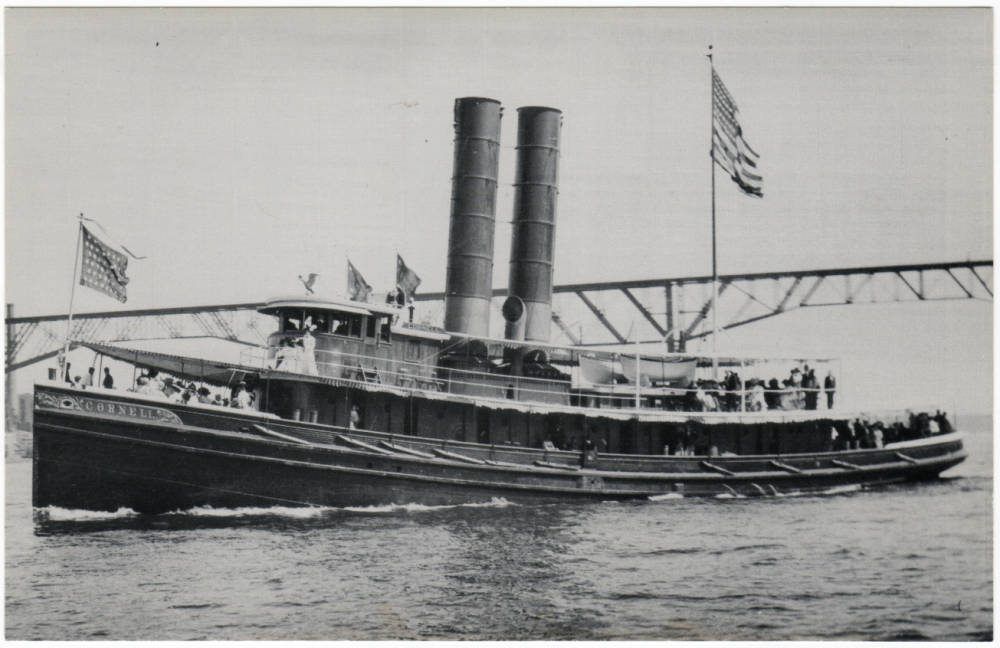 The tugboat "Cornell" on an excursion on the Hudson River, Poughkeepsie Railroad Bridge in the background. Hudson River Maritime Museum Collections. As the 19th century gave way to the 20th century, the Cornell Steamboat Company of Rondout was the largest and most progressive marine towing organization in the country. In 1902 they had built what was to be their largest and most powerful tugboat. When completed, it appropriately bore the name “Cornell.” By whatever standard of measurement, the “Cornell” was a most impressive tugboat. At a few inches less than 150 feet in length, she was 25 feet longer than any of Cornell’s other big tugboats. Her 1,400 h.p. engine exceeded by over 500 the horsepower of other units of the fleet. Boatmen used to refer to her as the "Big Cornell" and her two big boilers had a ravenous appetite for coal to make enough steam for her powerful engine. As a result, she had the reputation of being a very hard boat to fire. Many boatmen from Hudson River towns one would talk to in the early 1920’s would almost always say how at one time or another they had fired on the “Big Cornell.” Some would stay only a few hours, some a few days and rarely would she end the season with a fireman who had started out on her in the spring. On Lower River Because of her size and deep draft, she was used almost exclusively on the lower river. During her service on the Hudson, the channel north of Athens had not been dredged for deep draft vessels like it is today. During her career, the “Cornell” made only one trip to Albany and this trip was her most notable exploit while carrying the colors of the Cornell Steamboat Company. It took place in early March, 1910. The winter of 1910 had been an old fashioned winter with plenty of ice in the river. During late February and early March the weather turned unseasonably warm, causing high water at Albany as the result of the melting of the winter’s snow and ice in the Mohawk River. A huge ice jam formed in the river below Albany which caused the water to back up and flood the waterfront areas of Albany and Rensselaer. Fears were also expressed that the ice crowding the Albany railroad bridges might move them off their abutments. In order to relieve the ice and flood crisis at Albany, the federal government was asked to take action. The government's plan was to use dynamite on the ice jam to break it up and to charter the most powerful vessel they could find to go up river to break up the river ice so the broken ice could move down river. The “Big Cornell” was chosen for the job. The “Cornell" left Rondout Creek on March 3, 1910 with the tug “Rob" to follow and assist in any way possible. I have been told the whole operation was in charge of Captain Ulster Davis, Cornell’s agent at Rensselaer, and the regular crew of the “Cornell” whose captain was Tim Donovan and pilot Irving Hayes. Although the upper Hudson was at flood stage, the “Cornell” carried minimum amounts of coal and water in order to keep her draft at a minimum so she would have clearance over the shallow spots north of Athens. 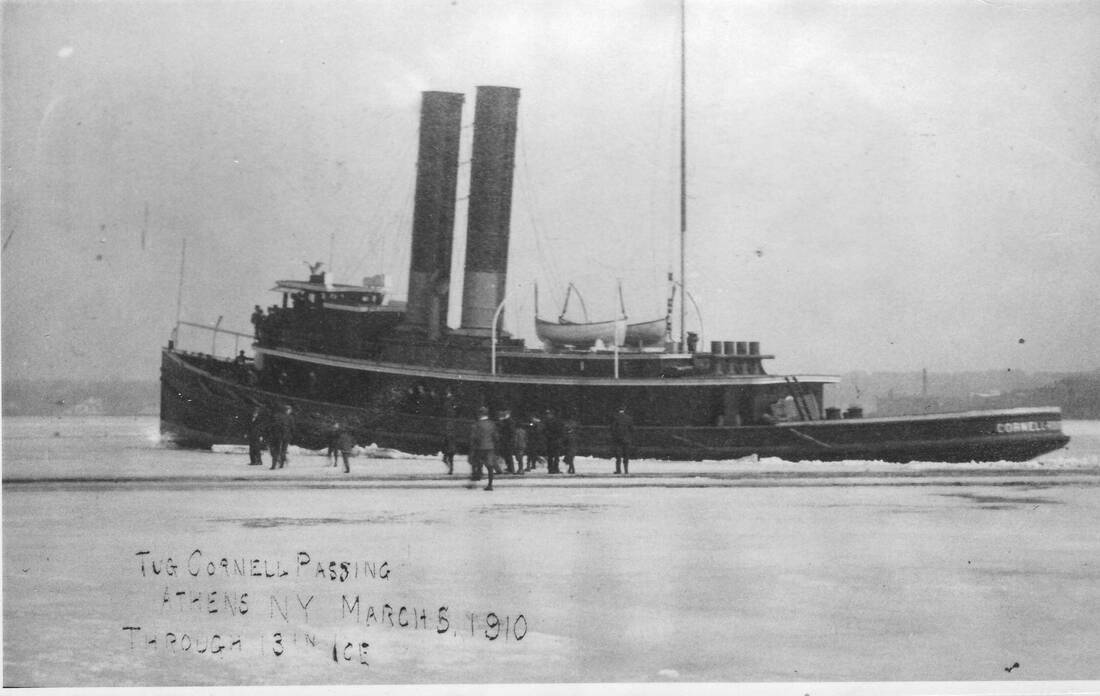 Tug "Cornell" passing Athens, NY, March 5, 1910, through 13 inches ice. Hudson River Maritime Museum Collection. Very Heavy Ice The “Cornell” encountered very heavy ice from Kingston to Athens, sometimes as much as two feet in thickness. The ice was so heavy, the “Cornell’s” steel hull plating was scalloped inward between her frames at the water line forward caused by her smash into the rock-like ice. At Athens, the "Cornell” went up the wider Athens channel rather than the deeper Hudson channel along the east shore, since men going ahead on foot had determined the ice in the west channel wasn’t quite as thick. She passed Athens through 15 inches of ice on March 5. All along the river, men and boys would come out on the ice to watch the “Cornell” go by. The “Cornell” arrived at Rensselaer on March 6, the river opened and the ice jam broken. Once the ice jam was broken, I have been told one could literally see the water begin to drop at Albany. Although the crisis to Albany was over, a new problem arose for the “Cornell.” The Company was afraid the water might drop so fast, they would not be able to get their big tug back down river in time to clear the up river sand bars and ledges. An Early Start The “Cornell” took on coal, fresh water and grub at Rensselaer as fast as she could. Due to the strong current in the river, when they started to turn the "Cornell” around for her return trip, the tug “Rob” had to push wide open against her stern in order to get the “Cornell” headed down stream. At first, they were going to wait for daylight all the way, but because of the falling water decided to start down as soon as possible. When they started back for Rondout, I have been told it was a clear, cold March night. The water in the river was running down stream so fast, they ran the “Cornell's” engine dead slow — just enough to keep steerage way. They were reluctant to run her any faster as they did not want to scrape or hit bottom and possibly smash her rudder shoe or break her propeller. They had had such good luck so far, they didn't want to tempt fate any more than necessary. Everything went fine until the two tugs came to Dover Platte Island off Coxsackie. Captain Donovan of the ‘'Cornell’’ knew there had always been a sand bar there and figured the freshet in all probability might have built up the bar higher than usual. When they reached that point, they stopped the “Cornell's” engine and just let her drift. Sure enough she fetched up on the bar, stopped and rolled over very slightly to port. To be sure there was only sand, they sounded all around with pike poles. Over the Bar Once they were certain there were no rocks on the bottom, they decided to have the “Rob” go up ahead and put a hawser on the “Cornell's” bow — and then to open up both tugs full throttle and to try and “bull” the ‘‘Cornell’’ over the bar. When all was in readiness, the “Cornell” gave the signal for full speed ahead and for the “Rob” to start pulling. I can readily imagine on that cold March night the load “chow chow” of the “Rob's” high pressure engine. They tell me when the “Cornell’’ hooked up, she lay down on her port side, her propeller part out of the water for a few moments. Some of her crew thought her towering smoke stacks would topple over, the starboard guy lines being incredibly taut and the port ones having about two feet of slack. However, in but a few minutes the ‘‘Cornell’’ had inched her way over the bar. Once she cleared the sand bar, though, the ‘‘Cornell’’ leaped ahead so fast before they could stop her engine she almost ran over the “Rob’’ pulling on her bow. Quick action by a deckhand on the “Rob” saved the day. By wielding a fast, sharp axe he cut the connecting hawser. From that point back to Rondout Creek they encountered no more difficulties. From Athens south, the river ice still held, but by following the channel they had previously made going northward the going was relatively easy. 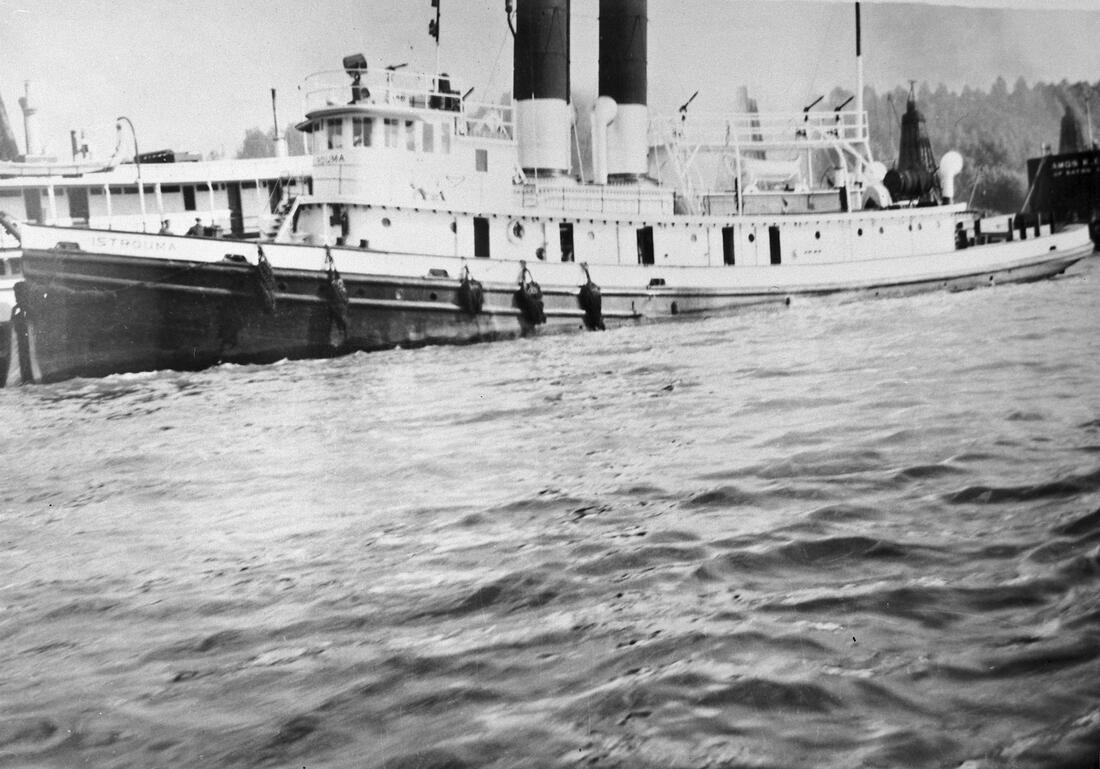 The "Istrouma," formerly the Hudson River tugboat "Cornell," used as a fireboat by Standard Oil Company. University of Wisconsin-La Cross Historic Steamboat Photographs Collection. Renamed Her The difficulty in keeping firemen on the “Cornell” continued to plague her and led to the end of her career on the Hudson River. Shortly before World War I she was sold to the Standard Oil Company of Louisiana. Her new owners renamed her “Istrouma,” converted her to an oil burner, and operated her on the Mississippi River out of Baton Rouge where she remained in service until the late 1940's. I have been told the Cornell Steamboat Company always maintained it was not feasible to convert the “Cornell” to an oil burner, since it wouldn't be possible to install sufficient oil storage capacity aboard her. It is my understanding before purchasing her, the Standard Oil people, unknown to Cornell, sent some men to Cornell who hired out on her as firemen. The masquerading firemen thoroughly examined the “Cornell” and apparently concluded she could successfully be converted to oil firing. In any event, she was — and remained in service for another 30 years. Many years later, during World War II, my friend Roger Mabie was the commanding officer of a submarine chaser in the U.S. Navy. One day his ship was in a shipyard at Algiers, Louisiana, across the river from New Orleans. There, in an adjacent dry dock was the “Istrouma,” the old “Cornell.” He went aboard. Her shell plating forward was still scalloped between frames from her bout with Hudson River ice in 1910. Her brass capstan caps were still inscribed “Cornell.” In her engine room, her steam and vacuum gauge faces still were etched ‘‘Cornell,” Cornell Steamboat Company, Rondout, N.Y. A few days later, Roger told me his ship was leaving New Orleans to go back to sea. Out in the river, the old ‘‘Cornell” was going upstream. He blew her a whistle salute, which the former “Cornell” answered with her old deep steam whistle. I thought it was a nice gesture, both a greeting to an old work horse from the Hudson River and a sort of salute to the maritime greatness that was once Rondout’s. 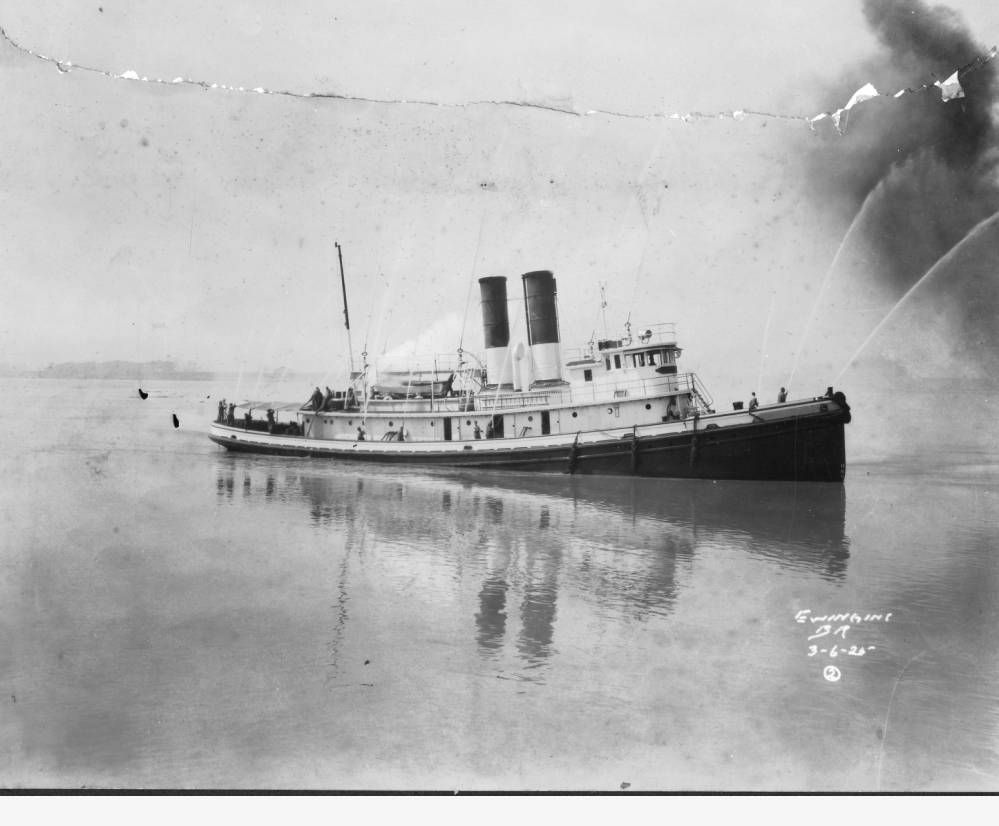 Undated photo of the tugboat "Istrouma," formerly the "Cornell," East Baton Rouge Library Collections. AuthorCaptain William Odell Benson was a life-long resident of Sleightsburgh, N.Y., where he was born on March 17, 1911, the son of the late Albert and Ida Olson Benson. He served as captain of Callanan Company tugs including Peter Callanan, and Callanan No. 1 and was an early member of the Hudson River Maritime Museum. He retained, and shared, lifelong memories of incidents and anecdotes along the Hudson River. The tug/fireboat "Istrouma" was scrapped in 1949. If you've seen a large red tugboat named "Cornell" on the Hudson River or New York Harbor, it's not the same as this "Cornell," but nearly as big! She was built the same year the "Istrouma" was scrapped. Learn more.
If you enjoyed this post and would like to support more history blog content, please make a donation to the Hudson River Maritime Museum or become a member today! 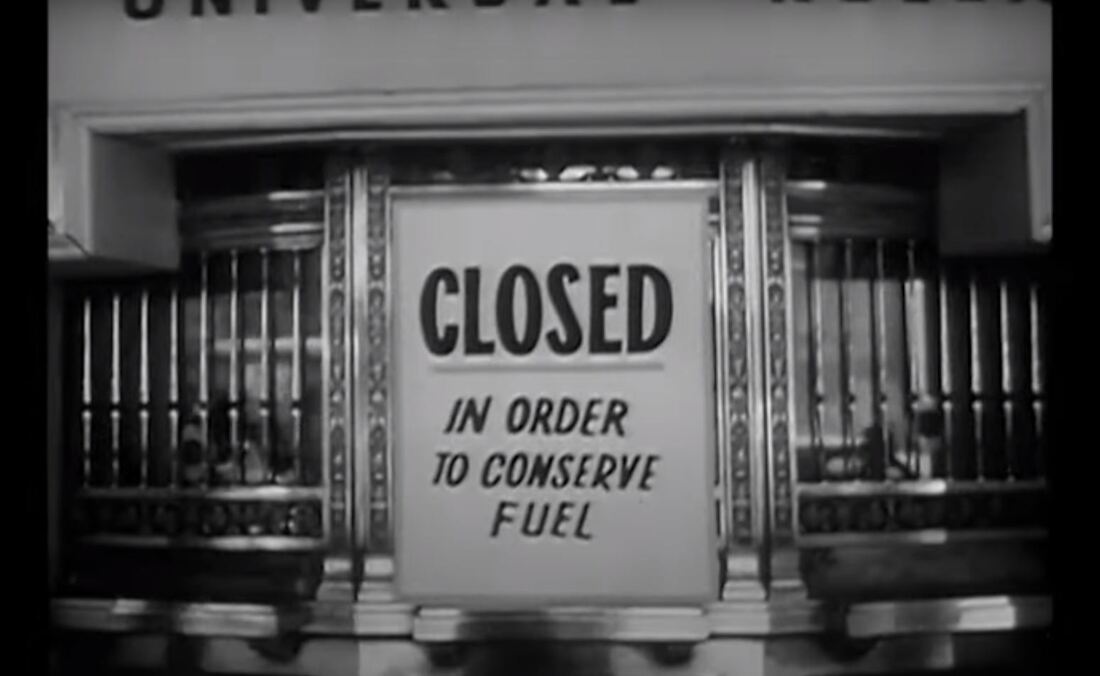 Still from the Universal Newsreel "Tug Strike Ties Up N. Y. for 18 Hours," depicting a movie theatre with a placard at the box office reading "Closed in order to conserve fuel." In February of 1946, tugboat crews in New York Harbor had had it. They had been trying since October, 1945 to negotiate an end to the wartime freeze on wages, to reduce hours from 48 per week to 40, to receive two weeks paid vacation per year, and perhaps most importantly, to end the practice of stranding workers in far-away ports and forcing them to pay their own way home, without success. Although the war was over, the federal government was still regulating the price of freight, which meant that shipping companies didn't want to raise wages. Frustrated, the tugboat workers struck. Starting February 4, 1946, tugboats did not move coal or fuel in the nation's busiest port. Manhattan is an island, and maritime freight played a huge role in supplying the city with fuel, food, and other supplies, as well as removing garbage by water. At the time of the strike, officials estimated the city has just a few days of reserve coal. The strike was covered in several newsreels at the time. British Pathe put together this short report on the strike: Universal put together this newsreel, sadly presented here without any sound: Newly-elected mayor William O'Dwyer did not react well to the strike. Facing a fuel shortage for one of the nation's most populous cities in midwinter was no laughing matter, but O'Dwyer implemented measures that many later deemed an overreaction to the strike. He essentially rationed fuel for the entire city, prioritizing housing for the sick and aged, but enforcing a 60 degree maximum temperature for all other building interiors, turning off heat in the subway and limiting service, shutting down all public schools on February 8, and by February 11 shutting down entirely restaurants, stores, Broadway theaters, and other recreational venues. The bright lights of Times Square and elsewhere were also turned off to conserve electricity, as illustrated in this second newsreel from British Pathe: After 18 hours of shutdown, the shipping companies and the tugboat unions agreed to end the strike and enter into third party arbitration for their contract. Tugboats started moving fuel again, and the lights turned back on. And that's the end of the story - or is it? On February 14, 1946, the New York Times published an article entitled "Lessons of the Tug Strike," whereby they largely blamed O'Dwyer for the costly shutdown. "New York tugboat workers and management have sent their dispute to arbitration after a ten-day strike that endangered life and property, cost business millions of dollars and paralyzed the whole city for a day. We may well breathe a sigh of relief and at the same time examine some aspects of this incident that offer guidance for the future," the Times wrote, and went on to ask that O'Dwyer never do that again "unless the need is clearly established." As for the tugboat workers, it would take nearly another year for the threat of a strike to fade completely. Negotiations continued throughout 1946, with little movement, until the threat of another strike emerged in December of 1946. It was avoided by additional arbitration with Mayor O'Dwyer's emergency labor board. Finally, the arbitrators won concessions from both sides, and on January 5, 1947, the New York Times reported that a settlement had been reached. The tugboat workers got their 40 hour workweek, but not the same wages as 48 hours of work. They did get an 11 cent per hour wage increase along with a minimum wage for deck hands, a five day workweek, and time and a half for Saturdays and Sundays. However, the contract was only for 12 months, and in December of 1947, another strike was on the table as workers struggled for another wage increase. The strike was averted with more concessions from the companies, including a ten cent raise, food allowances, and more. But in the fall of 1948, the contract was up again, and the specter of the February, 1946 shutdown arose as a strike was once again on the table as part of the negotiations. Strikes were common in the years following the Second World War, in nearly every aspect of American society. In particular, the Strike Wave of 1945-46 impacted as many as five million American workers across all sectors. The strikes, although sometimes effective in improving worker wages and conditions, were largely unpopular with the general public. In 1947, Congress overrode President Truman's veto of the Taft-Hartley Act, which limited the power of labor unions and ushered in an era of "right to work" laws. Learn more about the strike wave in this podcast from the National WWII Museum. If you enjoyed this post and would like to support more history blog content, please make a donation to the Hudson River Maritime Museum or become a member today!
Editor’s Note: The following text is a verbatim transcription of an article featuring stories by Captain William O. Benson (1911-1986). Beginning in 1971, Benson, a retired tugboat captain, reminisced about his 40 years on the Hudson River in a regular column for the Kingston (NY) Freeman’s Sunday Tempo magazine. Captain Benson's articles were compiled and transcribed by HRMM volunteer Carl Mayer. See more of Captain Benson’s articles here. This article was originally published January 16, 1972. 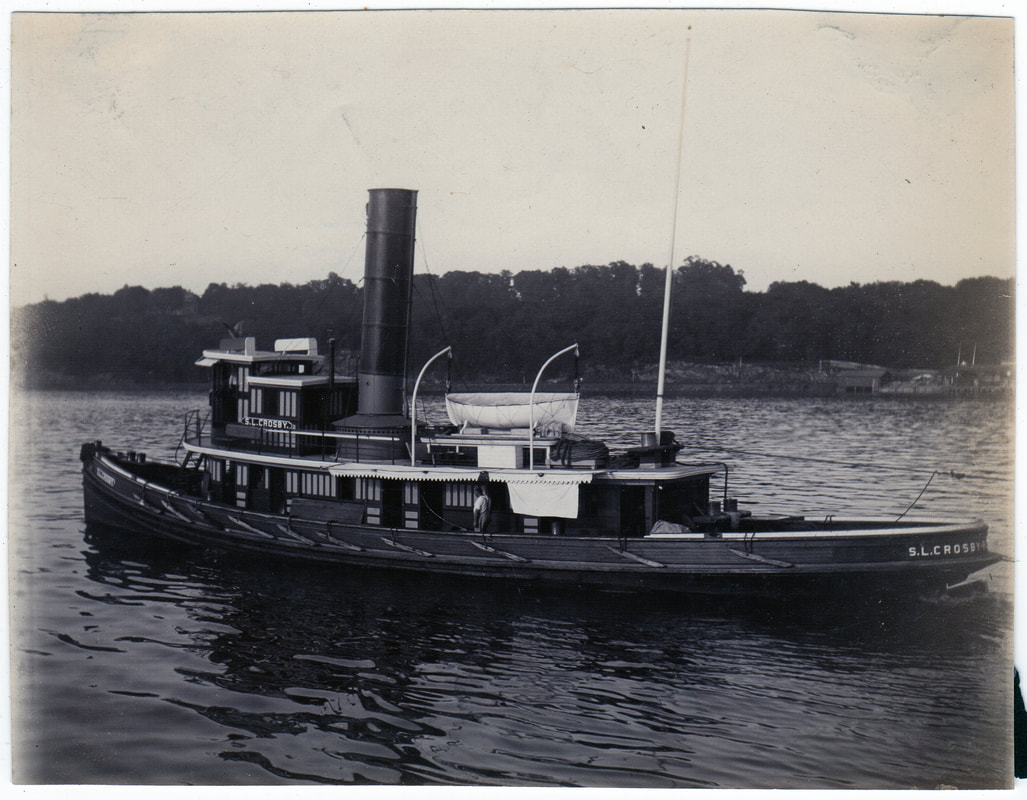 Tugboat "S.L. Crosby" in warmer weather. Saulpaugh Collection, Hudson River Maritime Museum During the early years of the 1900’s, there was a stone quarry at Rockland Lake, a few miles south of Haverstraw. The Cornell Steamboat Company towed the stone from the quarry on scows to the metropolitan New York market. The winter of 1912 was very severe with heavy ice in the lower river. Cornell tugs, however, continued their efforts to break the ice so the stone could be towed to New York for use by the construction industry. One one particular day that winter, the Cornell tugboats "S. L. Crosby” and "Hercules" were in the river off the quarry breaking ice — trying to get into the dock to break out the loaded scows that were frozen in. First, one tug would slam into the ice, which at the time was seven to eight inches thick, until she was stopped cold by the solid ice. Then that tug would back off and the other tug would slam into the track until she was stopped dead. Gradually, the two tugs were working their way towards the dock. Two Good Tries On one try the “Crosby” went ahead a short distance and stopped. On this try, however, she made a good crack in the ice. Next, the “Hercules" came up astern, hit the crack the “Crosby” had made, and plowed her way right up to the dock. The general manager of the Cornell Steamboat Company was standing on the dock at the time. And, admiringly, he said, “What a great ice breaker we have in the “Hercules”!” Quite obviously, he had not noticed the crack in the ice made by the “Crosby.” When spring came, Cornell had the "Hercules" sent to the Cornell repair shops at Rondout and ordered extra stout oak planking and steel straps put all around her bow. From that point on, the “Hercules" was thought to be the greatest ice breaker of them all. For years after, whenever ice was to be broken, the “Hercules” was sent out to do the job. At the time of the ice breaking at Rockland Lake, Aaron Relyea of Bloomington was the captain of the "Crosby” and Mel Hamilton of Port Ewen was captain of the "Hercules.” Nearly 20 years later, I worked for Captain Relyea as a deckhand on the "Crosby" and he was the one who related this incident to me. Captain Aaron A l w a y s maintained the “Crosby” was the better tug of the two in breaking ice. In later years, I also talked to Captain Hamilton about that day at Rockland Lake. Captain Mel said, "Aaron was right. Between the two tugs, the “Crosby” was the best in the ice. But,” he added with a wink, "never argue with the boss.” AuthorCaptain William Odell Benson was a life-long resident of Sleightsburgh, N.Y., where he was born on March 17, 1911, the son of the late Albert and Ida Olson Benson. He served as captain of Callanan Company tugs including Peter Callanan, and Callanan No. 1 and was an early member of the Hudson River Maritime Museum. He retained, and shared, lifelong memories of incidents and anecdotes along the Hudson River. If you enjoyed this post and would like to support more history blog content, please make a donation to the Hudson River Maritime Museum or become a member today!
Editor’s Note: The following text is a verbatim transcription of an article featuring stories by Captain William O. Benson (1911-1986). Beginning in 1971, Benson, a retired tugboat captain, reminisced about his 40 years on the Hudson River in a regular column for the Kingston (NY) Freeman’s Sunday Tempo magazine. Captain Benson's articles were compiled and transcribed by HRMM volunteer Carl Mayer. See more of Captain Benson’s articles here. This article was originally published January 21, 1973. 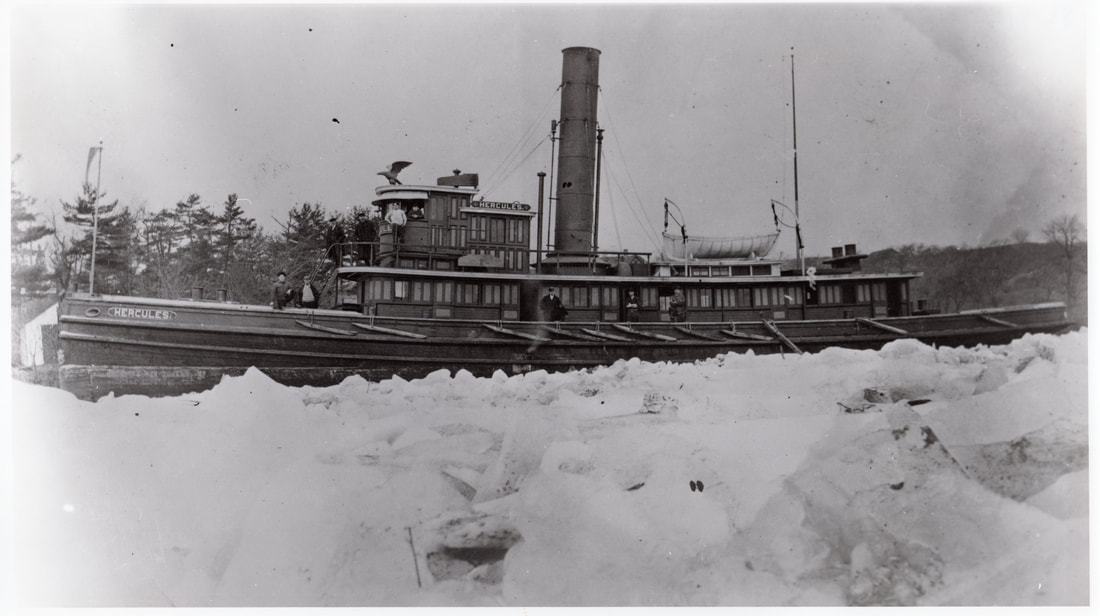 Cornell Steamboat Company tugboat "Hercules" in the ice, undated. Roger Mabie Collection, Hudson River Maritime Museum. Back around 1908, there was a stone quarry at Rockland Lake south of Haverstraw and the Cornell Steamboat Company towed the quarry's scows to New York from early spring until hindered by ice the following winter. At the same time, the steamers "Homer Ramsdell" and "Newburgh" of the Central Hudson Line were carrying milk on a year round basis between Newburgh and New York. In early January of that long ago time, the Cornell tugboats "Hercules" and "Ira M. Hedges" were sent up river to the quarry to bring down five loaded scows of stone. Ice had been forming in the river and, as any man who has worked on the river soon finds out, the river sometimes closes over night. He also discovers that at times salt water ice is harder to get through than fresh water ice. When the tugs arrived at Rockland Lake, the river was covered with ice from shore to shore and making more ice rapidly. It was now about 5 p.m., very dark with a northeast wind, and it looked as if a storm was brewing. Captain Mel Hamilton of the "Hercules" telephoned Cornell's New York office and suggested they stay there overnight. He knew by waiting until daylight to start down, he could better find open spots in the floating ice and that the "Ramsdell" and "Newburgh" on their milk runs would be breaking up ice and perhaps keep it moving. The Cornell office, however, would not listen to Captain Hamilton's suggestion and told him they wanted him to start out immediately and get the tow to New York as soon as possible. 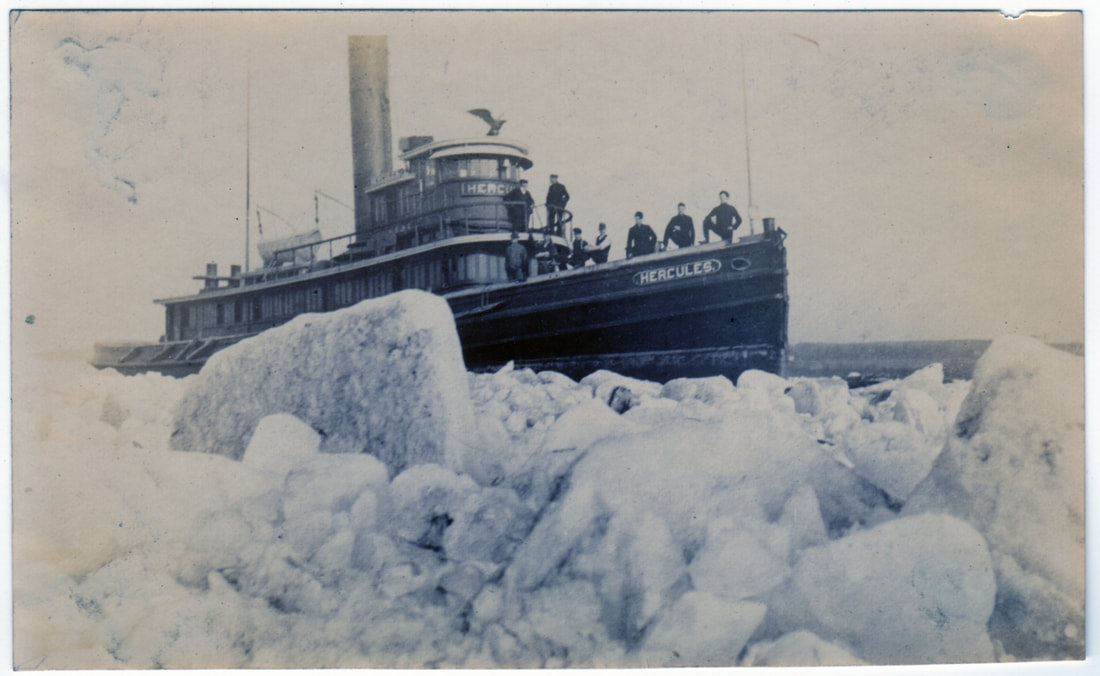 Cornell Steamboat Company tugboat "Hercules" in the ice of Coxsackie, her crew on deck. Saulpaugh Collection, Hudson River Maritime Museum. Trouble at Tarrytown On leaving Rockland Lake with five wooden scows, the "Hercules" was in charge of the tow and the "Hedges" was supposed to go ahead and break ice since she had an iron hull. The ebb tide was about half done and everything went all right until they were about two miles north of the Tarrytown lighthouse. The "Hedges” wasn’t too good as an ice breaker and she would get fast in the ice herself. The "Hercules" with the tow would creep alongside and break her out. After this happened a few times, both tugs tried pulling on the tow. Finally, the tide began to flood, jamming the ice from shore to shore, and the two tugs couldn't move the tow at all through the ice. The only thing to do was to lay to until the tide changed. After about an hour it started to snow from the northeast and the wind increased to about 20 m.p.h. Captain Hamilton of the "Hercules" told Captain Herb Dumont of the "Hedges” to go back to the tail end of the tow and keep an eye out for the "Newburgh" he knew would be coming down. The "Hercules" lay along the head of the tow on watch for the ‘"Ramsdell" on her way up river. Both tugs started to blow fog and snow signals on their whistles, as they lay in the channel and knew the Central Hudson steamers would be going through the ice and swirling snow on compass courses at full speed in order to maintain their schedule and not expecting to find an ice bound tow in their path. Neither tugboat captain relished the thought of his tug or the tow being cut in half by the "Ramsdell" or "Newburgh." 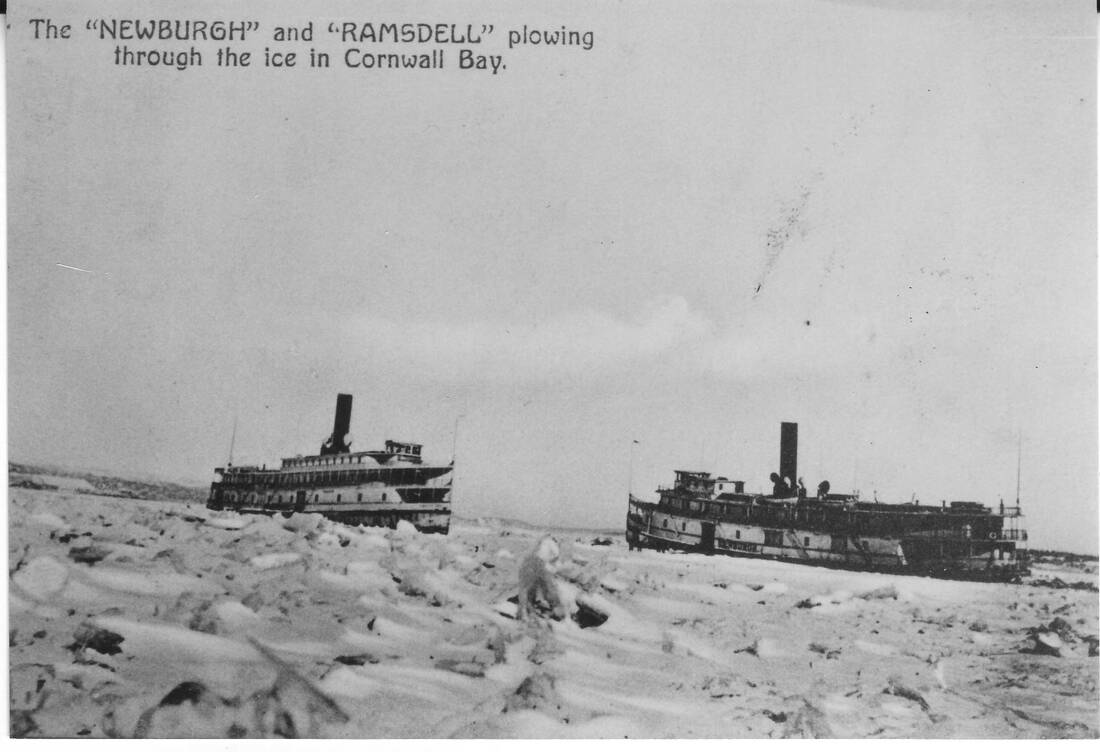 Steamboat "Newburgh" and "Ramsdell" plowing through the ice in Cornwall Bay, Hudson River Maritime Museum Collection. “Newburgh” Heard First The first of the two Central Hudson steamers to be heard was the "Newburgh” by the crew of the "Hedges." Coming down river with the wind behind her, the men on the tug could hear the "Newburgh" pounding and crunching through the ice and her big base whistle sounding above the storm. Both the "Hercules" and "Hedges" were blowing their whistles to let the "Newburgh" know they were fast in the ice and not moving. The snow storm had now become a blizzard. On the "Hedges" at the tail end of the tow, her crew was relieved when they could hear the crunching of the ice seem to ease off, indicating the "Newburgh" had probably heard their whistle and was slowing down. In a few moments, the bow of the "Newburgh" loomed up out of the blowing snow headed almost directly for the "Hedges." Above the storm, the men on the tugboat could hear the bow lookout on the "Newburgh" yell to the pilot house, "There's a Cornell tug dead ahead." The "Newburgh'' eased off to starboard and crept up along side of the tow. When abreast of the "Hercules," the captain, Jim Monahan, hollered through a megaphone to the "Hercules" captain, asking if he wanted "Newburgh” to circle around the tow and try and break them out of the ice’s grip. Boatmen always tried to help one another out, even though they might have been working for different companies. Moved and Stopped The "Newburgh" cut around the tow twice before continuing on her way to New York and disappearing into the swirling snow of the winter's night. The "Hercules" was able to move the tow about one tow’s length and was then again stopped. In about half an hour, the crew of the "Hercules” could hear the whistle of the "Homer Ramsdell" blowing at minute intervals as she was cutting through the ice on her way to Newburgh. On the "Herc," they were sounding her high shrill whistle to let the "Ramsdell" know they were in the channel. In those days, long before the radio telephones of today, the steam whistle signals were the boatman's only means of communication. The "Ramsdell" came up bow to bow with the "Hercules," backing down hard, the bow lookout yelling to the pilot house a tow was ahead. Coming to a stop with only a few feet separating the two vessels, Captain Fred Miller of the "Ramsdell" tramped out on his bow and yelled down to Captain Hamilton, asking if he could be of any help. When told the tow was fast in the ice, Captain Miller said he was ahead of time and would try and free the tow. Captain Miller took the "Ramsdell" around the tow twice and then continued on his way up river. This time, the "Hercules" was able to move the tow about two tow lengths and again came to a dead stop. All they could do now was wait for the tide to change. However, at least they knew no other steamers were moving on the river and they were relatively safe. 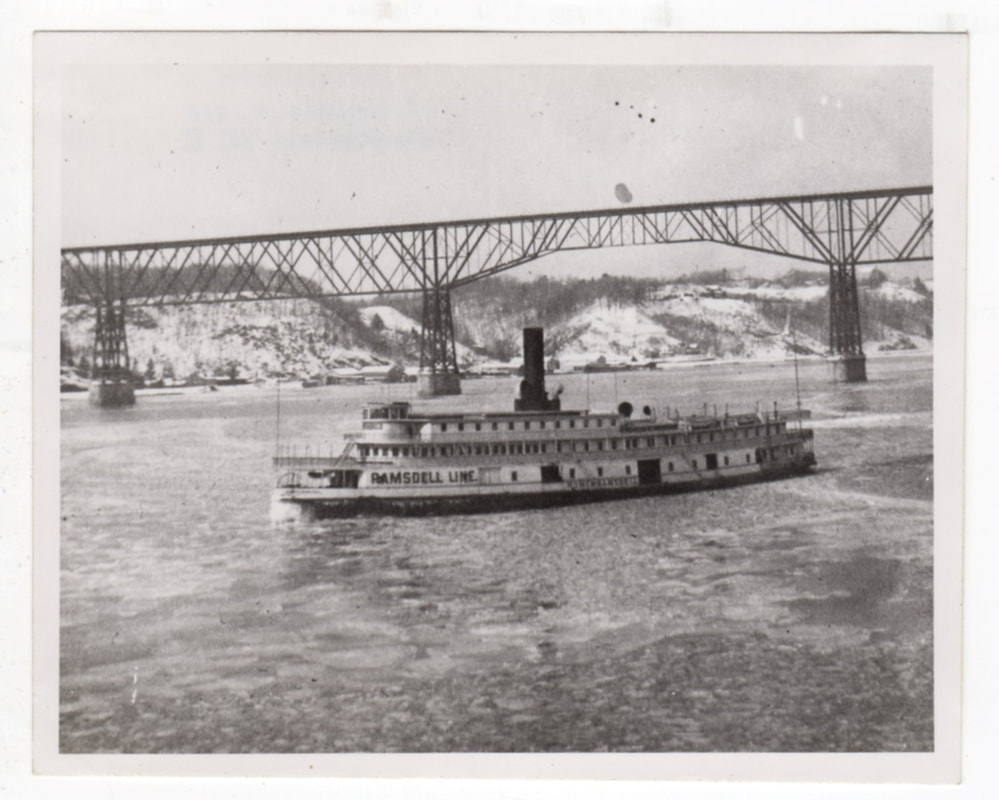 Ramsdell Line steamboat "Homer Ramsdell" passing through the ice of the Hudson, Poughkeepsie Railroad Bridge (now Walkway Over the Hudson) in the background. Hudson River Maritime Museum Collection. Leaks Develop When the crew of the "Hercules" was sitting in the galley and having a cup of hot coffee, one of the scow captains hollered over and waving a lantern, said his scow was leaking and his pumps were frozen. Men from the "Hercules" then had to climb over the snow covered scow and try to find and stop the leak. One of the deckhands found the leak in the dark and patched it up. After about two hours, the same thing happened to another scow, the oakum having been pulled out of the seams at the water line by the ice. Finally, the tide began to ebb again and they were able to once again move the tow. Shortly after daylight the snow storm abated and the wind moderated. As the "'Hercules" and the "Hedges" moved further down river, the ice became more floes than solid ice. However, before arriving in New York, they were overtaken by the "Ramsdell" again the following night off Manhattanville. After the crews’ long battle with ice and snow and on arriving in New York, their reward was to have their tugs tied up and to be layed off for the winter. In those days their pay was extremely modest. As a matter of fact, the pay of deckhands and firemen was a bunk, food and a dollar a day, — for a twelve hour day, seven days a week. As the boatmen used to say. "Thirty days and thirty dollars." AuthorCaptain William Odell Benson was a life-long resident of Sleightsburgh, N.Y., where he was born on March 17, 1911, the son of the late Albert and Ida Olson Benson. He served as captain of Callanan Company tugs including Peter Callanan, and Callanan No. 1 and was an early member of the Hudson River Maritime Museum. He retained, and shared, lifelong memories of incidents and anecdotes along the Hudson River. If you enjoyed this post and would like to support more history blog content, please make a donation to the Hudson River Maritime Museum or become a member today!
Editor’s Note: The following text is a verbatim transcription of an article featuring stories by Captain William O. Benson (1911-1986). Beginning in 1971, Benson, a retired tugboat captain, reminisced about his 40 years on the Hudson River in a regular column for the Kingston (NY) Freeman’s Sunday Tempo magazine. Captain Benson's articles were compiled and transcribed by HRMM volunteer Carl Mayer. See more of Captain Benson’s articles here. This article was originally published December 17, 1973. 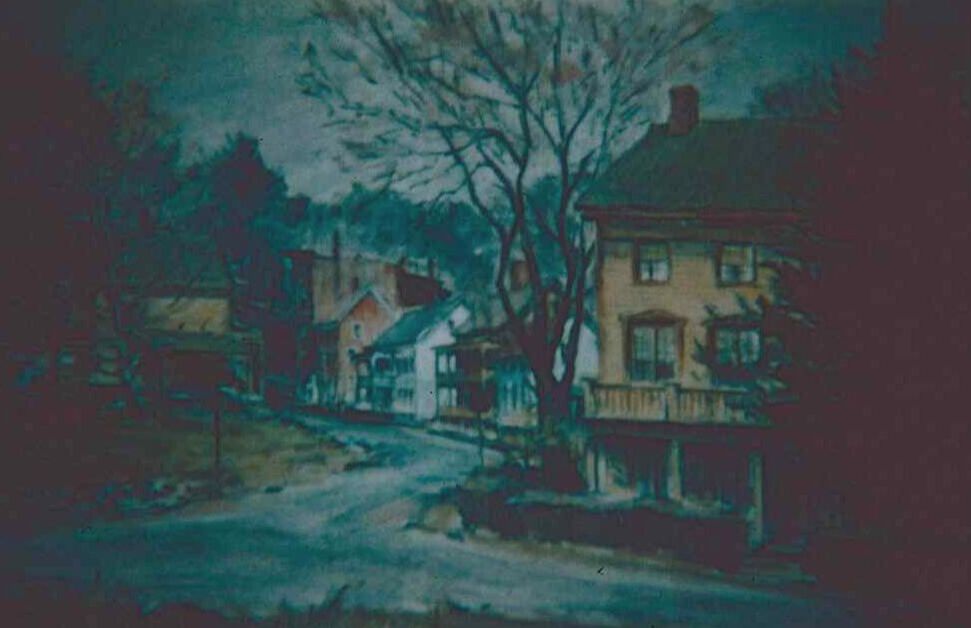 "Santa Claus Hotel" in Wilbur NY, painting by J. Erwin Porter, Photograph by J. Haywood Madden, Levonia NY. Donald C. Ringwald Collection, Hudson River Maritime Museum. Last summer a rather ramshackle old building on Abeel Street, directly opposite the Fitch bluestone building so recently and magnificently restored by James Berardi, was demolished. It was known as the Santa Claus Hotel and, at the time, questions were asked as to where the building had gotten its odd name. As far as I can determine, the old hotel was named after the steamboat “Santa Claus.” Way back in the 1840's, the community of Kingston was located inland where the uptown area of the city is today. Access to the Hudson River on Rondout Creek was over three roads. The longest road went through a swamp to what later became Kingston Point. Another came down a steep hill to the small but bustling hamlet of Rondout. The third, shortest and least steep was the road to Wilbur. Starting in 1848, a steamboat with the rather improbable name of “Santa Claus” began operating as a day steamer between Wilbur and New York. Since the steamer left Wilbur early in the morning, I have heard some enterprising individual shortly afterward built a hotel opposite the steamboat landing to provide accommodations for the travellers [sic] coming from inland to board the steamboat. Because ground transportation was primitive at best, many travellers would arrive the night before and stay at the hotel before embarking on their down river journey. Whether the fancy of the hotel's owner was caught by the steamer's name, or if the name was chosen solely to promote business is hard to say. In any event, it is my understanding the hotel was named for the steamboat. _advertisement.jpg) An advertisement for the steamboat "Santa Claus," published April 17, 1847 in the "Carbondale Democrat," Carbondale, PA. St. Nick Paintings The steamboat “Santa Claus” had been built in the early 1840's and first ran as a day steamer between New York and Albany. In 1847 the steamboat was used in a service between Piermont and New York, and then briefly returned to her old Albany run before starting her service from Wilbur in 1848. An unusual decorative feature of the steamboat were paintings of St. Nick himself going down a brick chimney with a bag full of all kinds of toys of the era which appeared on her paddle wheel boxes. During the early 1850's, the local landing of the “Santa Claus" was shifted from Wilbur to the fast growing and lusty village of Rondout. Operated by Thomas Cornell and commanded by David Abbey, Jr., she now ran as a night boat on opposite nights to the steamer “North America,” commanded by Jacob H. Tremper. The “Santa Claus" would leave Rondout for New York on Monday, Wednesday and Friday nights at 5 p.m. and return the following nights. During the latter part of the 1850 decade, Thomas Cornell withdrew the "Santa Claus” from the passenger trade, removed the passenger accommodations and converted the steamer to a towboat. During the winter of 1868-69, she was thoroughly rebuilt at South Brooklyn. When she came out in the spring of 1669, the name “Santa Claus" disappeared and on her name boards instead appeared the name “A. B. Valentine," in honor of the man who was the New York agent and pay master for the prospering Cornell Steamboat Company. 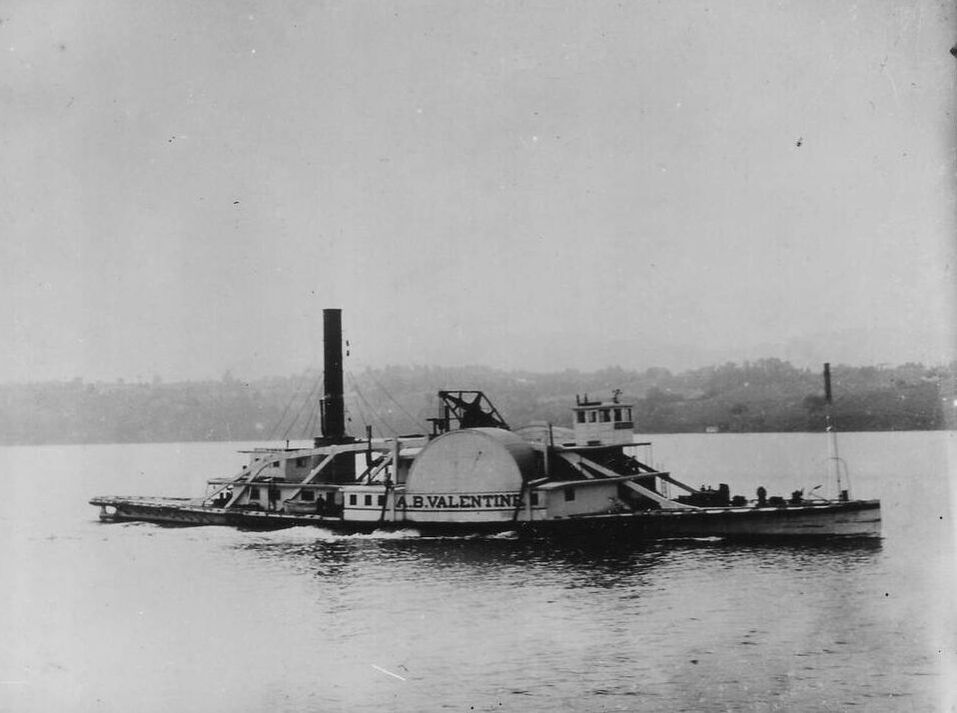 The steam towboat "A.B. Valentine" underway on the Hudson River. Donald C. Ringwald Collection, Hudson River Maritime Museum. Down River Tows As the "A. B. Valentine,” the sidewheel towboat was first used to pull the down river tow between Rondout and New York. But as some of the older boatmen told me their father had told them, she was not quite powerful enough for the large tows that were coming out of New York — sometimes with over a hundred canal boats and barges. Cornell then put more powerful side wheelers on the lower river and shifted the “A. B. Valentine" to towing between Rondout and Albany. On the upper river the “Valentine" ran opposite one of the best known towboats of them all, the old faithful sidewheeler “Norwich." I have been told their helper tugboats were the sister tugs “Coe F. Young” and “Thomas Dickson," the “Young” working mostly with the “Norwich” and the “Dickson" with the “A. B. [Valentine."] For many years a man lived in Sleightsburgh by the name of Fred Cogswell. He had been the pilot on the “A. B. Valentine" in her latter years. At the time the “Valentine” was withdrawn from service, Mr. Cogswell was a man well along in years and I am told S. D. Coykendall pensioned him off on a pension of $7 a month. He passed away in the early 1920's well into his nineties. At the turn of the century, the “A. B. Valentine" had outlived her usefulness and was layed up at Sleightsburgh at what later became known as the Sunflower dock. In the late fall of 1901 she was sold for scrapping. By a quirk of fate, on the day she was sold, the man for whom she was named, A. B. Valentine, died after serving as the New York superintendent of the Cornell Steamboat Company for half a century. The steamer left Rondout on Dec. 17, 1901 for Perth Amboy, N.J .where the steamboat built as the “Santa Claus” was finally broken up. Although there are a number of photographs of the steamboat as the "‘A. B. Valentine,” I know of no photos of her as the “Santa Claus,“ probably because during service under her original name photography was in its infancy. However, during the early 1930's there was a saloon on Abeel Street, just off Broadway, that had a lithograph of the "‘Santa Claus.” It was a broadside view with her Rondout to New York schedule imprinted on the sides. To my knowledge, this was the only likeness of the old steamer as the “Santa Claus." Now, this too, has long since disappeared. AuthorCaptain William Odell Benson was a life-long resident of Sleightsburgh, N.Y., where he was born on March 17, 1911, the son of the late Albert and Ida Olson Benson. He served as captain of Callanan Company tugs including Peter Callanan, and Callanan No. 1 and was an early member of the Hudson River Maritime Museum. He retained, and shared, lifelong memories of incidents and anecdotes along the Hudson River. If you'd like to learn more about the steamboat "Santa Claus," check out this extensive Wikipedia article.
If you enjoyed this post and would like to support more history blog content, please make a donation to the Hudson River Maritime Museum or become a member today! |
AuthorThis blog is written by Hudson River Maritime Museum staff, volunteers and guest contributors. Archives
May 2024
Categories
All
|
 RSS Feed