
HUDSON RIVER MARITIME MUSEUM
  • Visit
    • About
    • Plan Your Visit
    • Guided Tours
    • Events Calendar
    • Rondout Lighthouse
    • Visiting Vessels
    • Docking
  • Learn
    • Lecture Series
    • Youth Programs
    • School Programs
    • Exhibits on View >
      • Working Waterfronts
      • New Age of Sail
      • Warning Signs
      • Mary Powell
      • Rescuing the River
    • Online Exhibits
    • Speaking Engagements
  • Solaris Cruises
    • Cruise Schedule
    • Meet Our Boat
    • Book A Charter
  • Wooden Boat School
    • Boat School
    • Youth Classes
    • Adult Classes
    • Boat Building Classes
    • Boats For Sale
  • Sailing
    • Sailing School
    • Adult Sailing
    • Youth Sailing
    • Riverport Women's Sailing Conference
    • Sea Scouts
  • Join & Support
    • Donate
    • Membership
    • Volunteer
    • Ways to Give
    • Boat Donations
    • Our Supporters
  • Online Store

History Blog

Canal Boats at New York (1852)

7/16/2021

0 Comments

 
Editor's note: the following engraving and text were originally published in Gleason's Pictorial Drawing Room Companion, December 25, 1852. Thanks to volunteer researcher George A. Thompson for finding and cataloging this article. The article was transcribed by Sarah Wassberg Johnson, and includes paragraph breaks and bullets not present in the original, to make it easier to read for modern audiences.
Picture
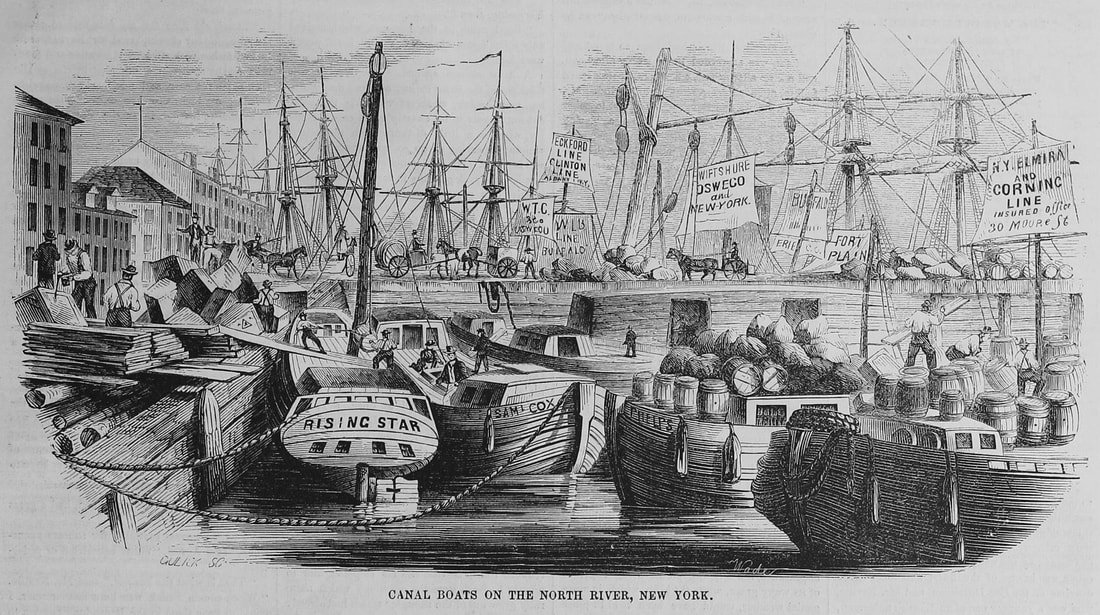
"Canal Boats on the North River, New York" by Wade, "Gleason's Pictorial Drawing-Room Companion," December 25, 1852. Note the sail-like signs for various towing lines and destinations, as well as the jumble of lumber and cargo boxes on the pier at left, waiting to be loaded onto the canal boats (or vice versa).
Next to the immense foreign export and import trade, comes the inland trade. The whole of the western country from Lake Superior finds a depot at New York. The larger quantity of produce finds its way to the Erie Canal, from thence to the Hudson River to New York.

The canal boats run from New York to Buffalo, and vice versa. These boats are made very strong, being bound round by extra guards, to protect them from the many thumps they are subject to. They are towed from Albany to New York - from ten to twenty - by a steamboat, loaded with all the luxuries of the West.

The view represented above is taken from Pier No. 1, East River, giving a slight idea of the immense trade which, next to foreign trade, sets New York alive with action. We subjoin from a late census a schedule of the trade; the depot of which, and the modus operandi, Mr. Wade, our artist, has represented in the engraving above, is so truthful and lifelike a manner.

​In 1840, there were
  • 474,543 horses and mules,
  • 1,911,244 neat cattle,
  • 5,118,777 sheep,
  • 1,900,065 swine,
  • poultry valued at $1,153413,
  • 12,286,418 bushels of wheat,
  • 2,520,060 do. [the same] of buckwheat,
  • 10,972,286 do. of Indian corn,
  • 9,845,295 lbs. of wool,
  • 447,250 do. of hops,
  • 30,133,614 bushels of potatoes,
  • 3,127,047 tons of hay,
  • 10,048,109 pounds of sugar,
  • 1,735 lbs. of silk cocoons;
  • the products of the dairy, $10,496,021;
  • the orchard, $1,701,935;
  • lumber, $3,891,302;
  • 6,799 gallons of wine.
​In this connection we may say, the Hudson and Erie Canal is a noble work of enterprise. It passes from Albany along the western bank of the Hudson River, until it meets the Mohawk; then runs, in a northwesterly direction, up the southwestern bank of the river, to the town of Rome, where it turns more westerly, on a summit level of about sixty miles, without a lock, and, passing in a line corresponding, in some measure, to the direction of the southern shore of Lake Ontario, and crossing the Seneca and Genesee Rivers in its course, communicates with Lake Erie at Buffalo, 363 miles from Albany. But canals are fast giving place to railroads, speed in business being the order of the day.

​If you enjoyed this post and would like to support more history blog content, please make a donation to the Hudson River Maritime Museum or become a member today!​
Donate Now
Join Today
0 Comments

Your comment will be posted after it is approved.


Leave a Reply.

    Author

    This blog is written by Hudson River Maritime Museum staff, volunteers and guest contributors.

    Archives

    January 2026
    December 2025
    November 2025
    October 2025
    September 2025
    August 2025
    July 2025
    June 2025
    May 2025
    April 2025
    March 2025
    February 2025
    January 2025
    December 2024
    November 2024
    October 2024
    September 2024
    August 2024
    July 2024
    June 2024
    May 2024
    April 2024
    March 2024
    February 2024
    January 2024
    December 2023
    November 2023
    October 2023
    September 2023
    August 2023
    July 2023
    June 2023
    May 2023
    April 2023
    March 2023
    February 2023
    January 2023
    December 2022
    November 2022
    October 2022
    September 2022
    August 2022
    July 2022
    June 2022
    May 2022
    April 2022
    March 2022
    February 2022
    January 2022
    December 2021
    November 2021
    October 2021
    September 2021
    August 2021
    July 2021
    June 2021
    May 2021
    April 2021
    March 2021
    February 2021
    January 2021
    December 2020
    November 2020
    October 2020
    September 2020
    August 2020
    July 2020
    June 2020
    May 2020
    April 2020
    March 2020
    October 2019
    September 2019
    May 2019
    February 2019
    January 2019
    October 2018
    September 2018
    August 2018
    June 2018
    May 2018
    April 2018
    March 2018
    February 2018
    January 2018
    April 2017
    February 2017
    December 2016
    November 2016
    September 2016
    July 2016
    June 2016
    May 2016
    April 2016
    March 2016

    Categories

    All
    Agriculture
    Amusement Parks
    Barges
    Black History
    Bridges
    Canals
    Captain William O. Benson Articles
    Catskill Mountains
    Environmental History
    Featured Artifact
    Ferries
    Fireboats
    George W. Murdock Articles
    Halloween
    House Boats
    Hudson River Commercial Fishing
    Iceboats
    Ice Harvesting
    Immigration
    Indian Point
    Indigenous Peoples
    Industrial History
    Labor
    Lighthouses
    Marine Art
    Military
    Muddy Paddle Series
    Photo Contest
    Railroad
    RMS Titanic
    Rowing
    Sail
    Sail Freight
    Schooners
    Shipbuilding
    Shipyard
    Sloops
    Sports
    Steamboats
    Towboats And Tugboats
    Whaling
    Winter
    Women's History
    Wrecks And Mishaps

    RSS Feed

GET IN TOUCH
Hudson River Maritime Museum
50 Rondout Landing
Kingston, NY 12401

​845-338-0071
[email protected]
​

Contact Us
​

RFP

Boat Shed Solar System RFP
HVAC System​

GET INVOLVED

Join & Support
​​Donate
Boat Donations
Membership
Volunteer

Work with Us
​
RESEARCH
History Blog
Collections
Research Resources

stay connected

Join Our Email List
ABOUT
News
Publications
​Docking
Museum Store
Facility Rentals
Board
​
Proudly powered by Weebly
  • Visit
    • About
    • Plan Your Visit
    • Guided Tours
    • Events Calendar
    • Rondout Lighthouse
    • Visiting Vessels
    • Docking
  • Learn
    • Lecture Series
    • Youth Programs
    • School Programs
    • Exhibits on View >
      • Working Waterfronts
      • New Age of Sail
      • Warning Signs
      • Mary Powell
      • Rescuing the River
    • Online Exhibits
    • Speaking Engagements
  • Solaris Cruises
    • Cruise Schedule
    • Meet Our Boat
    • Book A Charter
  • Wooden Boat School
    • Boat School
    • Youth Classes
    • Adult Classes
    • Boat Building Classes
    • Boats For Sale
  • Sailing
    • Sailing School
    • Adult Sailing
    • Youth Sailing
    • Riverport Women's Sailing Conference
    • Sea Scouts
  • Join & Support
    • Donate
    • Membership
    • Volunteer
    • Ways to Give
    • Boat Donations
    • Our Supporters
  • Online Store