HUDSON RIVER MARITIME MUSEUM
  • Visit
    • About
    • Plan Your Visit
    • Guided Tours
    • Events Calendar
    • Rondout Lighthouse
    • Visiting Vessels
    • Docking
  • Learn
    • Lecture Series
    • Youth Programs
    • School Programs
    • Exhibits on View >
      • Working Waterfronts
      • New Age of Sail
      • Warning Signs
      • Mary Powell
      • Rescuing the River
    • Online Exhibits
    • Speaking Engagements
  • Solaris Cruises
    • Cruise Schedule
    • Meet Our Boat
    • Book A Charter
  • Wooden Boat School
    • Boat School
    • Youth Classes
    • Adult Classes
    • Boat Building Classes
    • Boats For Sale
  • Sailing
    • Sailing School
    • Adult Sailing
    • Youth Sailing
    • Riverport Women's Sailing Conference
    • Sea Scouts
  • Join & Support
    • Donate
    • Membership
    • Volunteer
    • Ways to Give
    • Boat Donations
    • Our Supporters
  • Online Store

History Blog

View on the Hudson at Anthony's Nose

10/7/2020

2 Comments

 
Editor's Note: This article is from the January 1, 1851 issue of  Holden's Magazine​.
Picture
                         View on the Hudson River at Anthony’s Nose
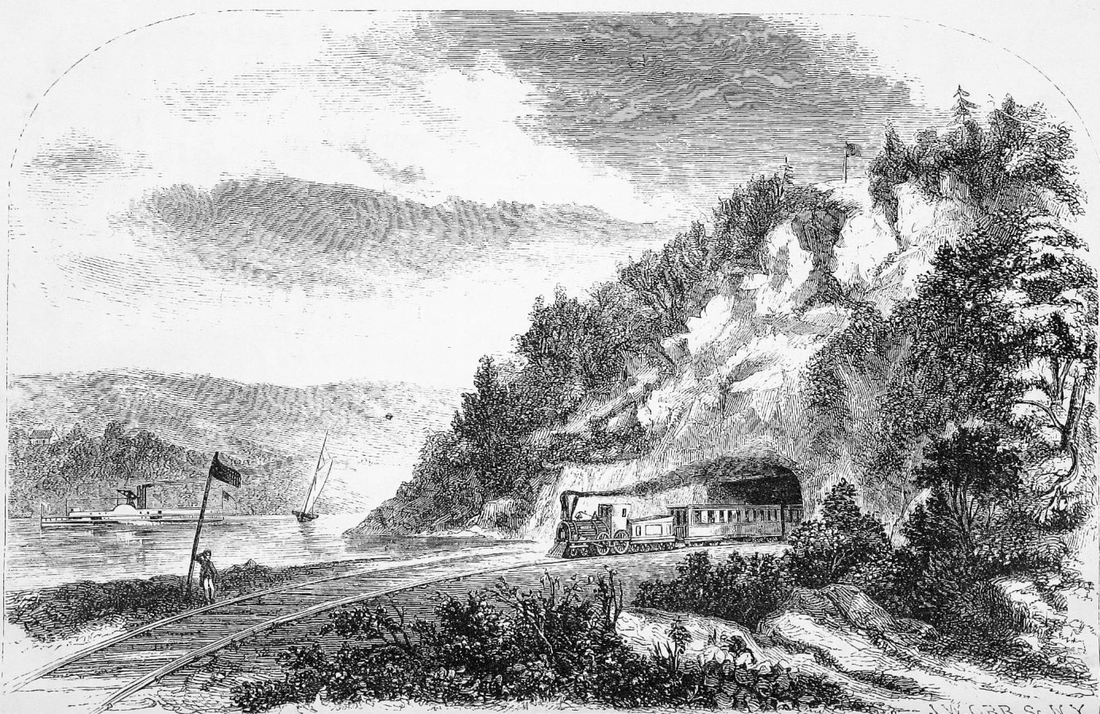
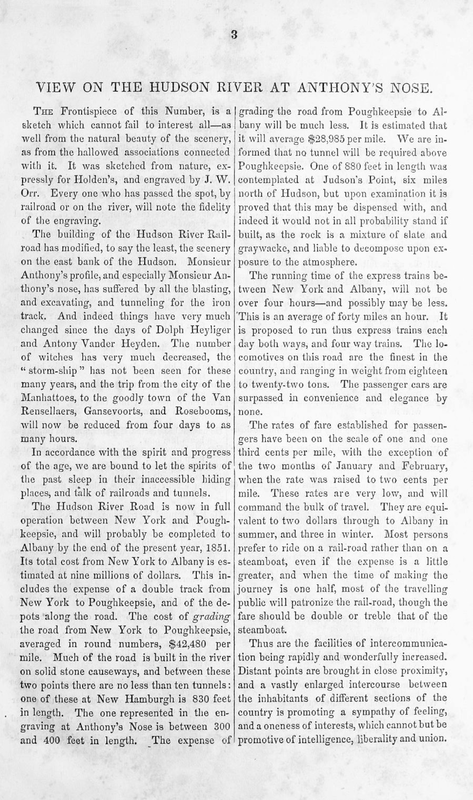
The Frontispiece of this Number, is a sketch which cannot fail to interest all – as well from the natural beauty of the scenery, as from the hallowed associations connected with it. It was sketched from nature, expressly for Holden’s, and engraved by J.W. Orr. Every one who has passed the spot, by railroad or on the river, will note the fidelity of the engraving.

The building of the Hudson River Railroad has modified, to say the least, the scenery on the east bank of the Hudson. Monsieur Anthony’s profile, and especially Monsieur Anthony’s nose, has suffered by all the blasting, and excavating, and tunneling for the iron track. And indeed things have very much changed since the days of Dolph Heyliger and Antony Vander Heyden. The number of witches has very much decreased, the “storm-ship” has not been seen for these many years, and the trip from the city of the Manhattoes, to the goodly town of the Van Rensellaers, Gansevoorts, and Rosebooms, will now be reduced from four days to as many hours.
In accordance with the spirit and progress of the age, we are bound to let the spirits of the past sleep in their inaccessible hiding places, and talk of railroads and tunnels.
The Hudson River Road is now in full operation between New York and Poughkeepsie, and will probably be completed to Albany by the end of the present year, 1851. Its total cost from New York to Albany is estimated at nine millions of dollars. This includes the expense of a double track from New York to Poughkeepsie, and of the depots along the road. The cost of grading the road from New York to Poughkeepsie, averaged in round numbers, $42,480 per mile. Much of the road is built in the river on solid stone causeways, and between these two points there are no less than ten tunnels: one of these at New Hamburgh is 830 feet in length. The one represented in the engraving at Anthony’s Nose is between 300 and 400 feet in length. The expense of grading the road from Poughkeepsie to Albany will be much less. It is estimated that it will average $28,985 per mile. We are informed that no tunnel will be required above Poughkeepsie. One of 880 feet in length was contemplated at Judson’s Point, six miles north of Hudson, but upon examination it is proved that this may be dispensed with, and indeed it would not in all probability stand if built, as the rock is a mixture of slate and graywacke, and liable to decompose upon exposure to the atmosphere.

The running time of the express trains between New York and Albany, will not be over four hours – and possibly may be less. This is an average of forty miles an hour. It is proposed to run thus express trains each day both ways, and four way trains. The locomotives on this road are the finest in the country, and ranging in weight from eighteen to twenty-two tons. The passenger cars are surpassed in convenience and elegance by none.

The rates of fare established for passengers have been on the scale of one and one third cents per mile, with the exception of the two months of January and February, when the rate was raised to two cents per mile. These rates are very low, and will command the bulk of travel. They are equivalent to two dollars through to Albany in the summer, and three in winder. Most persons prefer to ride on a rail-road rather than on a steamboat, even if the expense is a little greater, and when the time of making the journey is one half, most of the travelling public will patronize the rail-road, though the fare should be double or treble that of the steamboat.

Thus are the facilities of intercommunication being rapidly and wonderfully increased. Distant points are brought in close proximity, and a vastly enlarged intercourse between the inhabitants of different sections of the country is promoting a sympathy of feeling, and a oneness of interests, which cannot but be promotive of intelligence, liberality and union. 
Picture

Author

Thank you to HRMM volunteer George Thompson, retired New York University reference librarian, for sharing these glimpses into early life in the Hudson Valley. And to the dedicated HRMM volunteers who transcribe these articles.

Donate Now
Join Today
2 Comments
Linds Herzog
10/7/2020 11:06:14 pm

Still a lovely scenic ride along the river. Wish the old train seats were more comfortable though.

Reply
A. Donnelly
10/28/2021 01:08:23 pm

Wonderful..having acquired a copy if this engraving by Orr some two decades ago, I am thrilled to see it documented. The Hudson River Railroad reportedly used a flag control system for traffic in the years before mechanical signals came into existence. It would appear here that a flagman may have been at each end of the tunnel at Anthony's Nose with the one on the hilltop possibly (?) used to relay information. In this way no two opposing movements could enter at the same time where the view ahead would be obscurred. If true, then this might be a case of one of the earliest "block signal" systems ever used in the United States, if not the first itself.

Reply

Your comment will be posted after it is approved.


Leave a Reply.

    Author

    This blog is written by Hudson River Maritime Museum staff, volunteers and guest contributors.

    Archives

    November 2025
    October 2025
    September 2025
    August 2025
    July 2025
    June 2025
    May 2025
    April 2025
    March 2025
    February 2025
    January 2025
    December 2024
    November 2024
    October 2024
    September 2024
    August 2024
    July 2024
    June 2024
    May 2024
    April 2024
    March 2024
    February 2024
    January 2024
    December 2023
    November 2023
    October 2023
    September 2023
    August 2023
    July 2023
    June 2023
    May 2023
    April 2023
    March 2023
    February 2023
    January 2023
    December 2022
    November 2022
    October 2022
    September 2022
    August 2022
    July 2022
    June 2022
    May 2022
    April 2022
    March 2022
    February 2022
    January 2022
    December 2021
    November 2021
    October 2021
    September 2021
    August 2021
    July 2021
    June 2021
    May 2021
    April 2021
    March 2021
    February 2021
    January 2021
    December 2020
    November 2020
    October 2020
    September 2020
    August 2020
    July 2020
    June 2020
    May 2020
    April 2020
    March 2020
    October 2019
    September 2019
    May 2019
    February 2019
    January 2019
    October 2018
    September 2018
    August 2018
    June 2018
    May 2018
    April 2018
    March 2018
    February 2018
    January 2018
    April 2017
    February 2017
    December 2016
    November 2016
    September 2016
    July 2016
    June 2016
    May 2016
    April 2016
    March 2016

    Categories

    All
    Agriculture
    Amusement Parks
    Barges
    Black History
    Bridges
    Canals
    Captain William O. Benson Articles
    Catskill Mountains
    Environmental History
    Featured Artifact
    Ferries
    Fireboats
    George W. Murdock Articles
    Halloween
    House Boats
    Hudson River Commercial Fishing
    Iceboats
    Ice Harvesting
    Immigration
    Indian Point
    Indigenous Peoples
    Industrial History
    Labor
    Lighthouses
    Marine Art
    Military
    Muddy Paddle Series
    Photo Contest
    Railroad
    RMS Titanic
    Rowing
    Sail
    Sail Freight
    Schooners
    Shipbuilding
    Shipyard
    Sloops
    Sports
    Steamboats
    Towboats And Tugboats
    Whaling
    Winter
    Women's History
    Wrecks And Mishaps

    RSS Feed

GET IN TOUCH
Hudson River Maritime Museum
50 Rondout Landing
Kingston, NY 12401

​845-338-0071
[email protected]
​

Contact Us
​

RFP

Boat Shed Solar System RFP
HVAC System​

GET INVOLVED

Join & Support
​​Donate
Boat Donations
Membership
Volunteer

Work with Us
​
RESEARCH
History Blog
Collections
Research Resources

stay connected

Join Our Email List
ABOUT
News
Publications
​Docking
Museum Store
Facility Rentals
Board
​
Proudly powered by Weebly
  • Visit
    • About
    • Plan Your Visit
    • Guided Tours
    • Events Calendar
    • Rondout Lighthouse
    • Visiting Vessels
    • Docking
  • Learn
    • Lecture Series
    • Youth Programs
    • School Programs
    • Exhibits on View >
      • Working Waterfronts
      • New Age of Sail
      • Warning Signs
      • Mary Powell
      • Rescuing the River
    • Online Exhibits
    • Speaking Engagements
  • Solaris Cruises
    • Cruise Schedule
    • Meet Our Boat
    • Book A Charter
  • Wooden Boat School
    • Boat School
    • Youth Classes
    • Adult Classes
    • Boat Building Classes
    • Boats For Sale
  • Sailing
    • Sailing School
    • Adult Sailing
    • Youth Sailing
    • Riverport Women's Sailing Conference
    • Sea Scouts
  • Join & Support
    • Donate
    • Membership
    • Volunteer
    • Ways to Give
    • Boat Donations
    • Our Supporters
  • Online Store